

It was only as we made our way out of al-Eizariya that we understood what residents had been telling us throughout the day we spent there. The Palestinian town, located in Area B east of Jerusalem and beyond the separation barrier, is trapped in a draconian maze of roads and checkpoints that turns routine activities, such as getting to work, into a grinding nightmare repeated day after day.
Getting into the town in the morning is easy enough. Try leaving in the afternoon. It is complete chaos. A traffic cacophony stretches for miles along Jericho Road, the town’s main artery, where vehicles pour in from surrounding streets and alleys. They squeeze into a slow-moving stream of cars belonging to al-Eizariya residents and people arriving from the nearby town of Abu Dis.
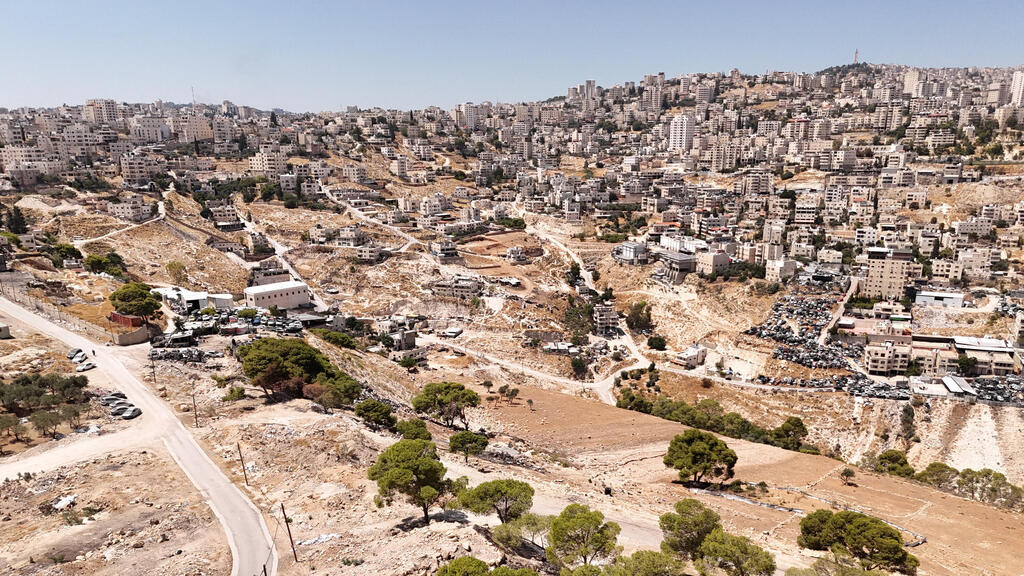
It is the only road leading east and from there to the rest of the West Bank. One road, with a single lane in each direction, lined with supermarkets, garages, butcher shops, greengrocers and other businesses. All it takes is a truck unloading merchandise or a car stopping briefly along the side, trying to edge closer to the vehicle ahead that has also stopped, and the entire road clogs up.
That is it. There are no other roads or bypasses. The route is jammed and oppressive, and it is little wonder that drivers cut one another off, squeeze into gaps without consideration and lean on their horns in frustration. It is not as though Israelis know nothing about traffic jams. After all, we live in Israel, which when it comes to transportation, often feels like a developing country. Even so, the experience here makes clear that there are places where things are far worse.
The demographics are ripe
We came here following the publication last month of construction tenders for the E1 area. These 12 square kilometers (4.6 square miles) are among the best-known pieces of land in the West Bank internationally. The area begins east of Jerusalem and stretches toward the settlement of Ma’ale Adumim, about 6 kilometers (3.7 miles) into the West Bank.
The international community condemns settlement construction in the West Bank, but Israel has continued to press ahead. Under Prime Minister Benjamin Netanyahu’s far-right government, records have been broken for settlement and outpost construction, without provoking the strongest possible international response. But E1 is where the European Union and U.S. administrations have traditionally drawn a red line.
For Palestinians, the area contains the only remaining open land reserves that could allow the towns east of Jerusalem to build and expand.
There is no need to visit in person. A glance at a map is enough. Al-Eizariya, Abu Dis, a-Za’im and Anata have only one direction in which they can expand: east, toward Jericho. Israel has hemmed in these towns with a maze of barriers and fences, forcing residents to build chaotically, often without planning approval or permits. The result is an urban jungle of unauthorized construction, with little oversight of building quality or safety.
E1 also contains another issue that has alarmed the international community. Construction there would sever Palestinian territorial continuity between the northern and southern West Bank. It is the last stretch of land on which building is still possible and through which people can travel from the Ramallah area south toward Bethlehem and Hebron and vice versa.
Israeli construction there would eliminate one of the most basic requirements for a functioning political entity: the ability to move from one part of it to another. Preventing that continuity would amount to a fatal blow to the practical possibility of establishing a Palestinian state. Twelve square kilometers could effectively destroy the two-state solution.
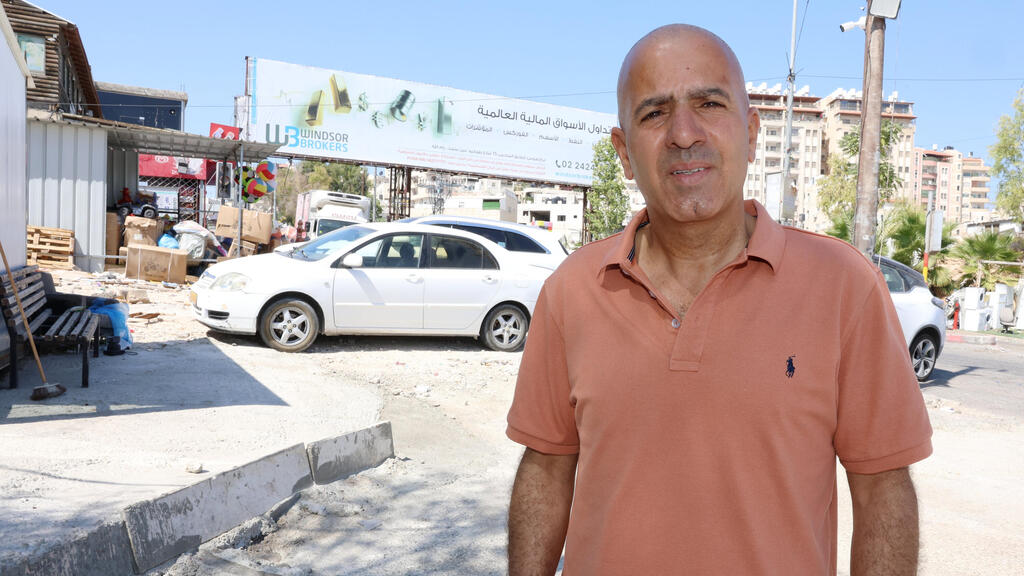
Attorney Bassam Bahr
(Photo: Shaul Golan)
Even before the diplomatic implications, there is a human issue. Attorney Bassam Bahr, an Abu Dis resident and member of the Committee for the Defense of East Jerusalem Lands, said Abu Dis and al-Eizariya were still villages when construction of the separation barrier began in 2003.
“There were only a few thousand residents in a-Za’im as well,” he said. “But since then the population has grown. These are cities now. Drive around Abu Dis, a-Sawahra, Sheikh Sa’ad or Anata and see how crowded they are. There is nowhere to expand.
“E1 is land belonging to Abu Dis, Anata, al-Eizariya and a-Za’im. Israel seized it under military orders and expropriated it from the Palestinians. This suffocation created an uncontrollable situation when it comes to construction. It happened because, just as in Israel, we have lives too. People get married, children are born and the population grows. A roof over your head is a basic necessity of life, just like water and food.”
Even now, Israel does not allow you to expand onto additional land. Would another settlement in E1 really change anything?
“It would change things enormously. The land there is empty now and it gives us hope for a better future. If you take that land, you take that hope away from us.”
Frustration on the road
“Have you heard of the ‘Fabric of Life Road’?” Bahr asked, without waiting for an answer.
“It is a road Israel is building for us because once E1 is built, Palestinians will no longer be able to use Highway 1 to reach Jericho or travel from Jericho to Ramallah. It is a road only for Palestinians, an apartheid road. It separates us from Israeli roads and forces us onto a single-lane road in each direction carrying enormous volumes of traffic.
“This is supposed to be the road connecting the northern and southern West Bank. Israel has already completed one section, and if you feel like trying it, be my guest. The traffic jams are already insane. You can take it from Ramallah to a-Za’im, and two months ago Israel announced plans to build the second section and connect it to al-Eizariya through a tunnel beneath Highway 1; heaven forbid that we Palestinians and you Israelis should drive on the same road.
“This is not a ‘Fabric of Life Road.’ It is a road of dispossession and oppression of life. That is what it is. Show me another place in the world with roads like these that separate people.
“And that is not all. In this part of al-Eizariya, where we are now, another wall is planned. It will cut al-Eizariya and Abu Dis off from E1, and then all this traffic you see here will be funneled onto the single-lane road and block it completely.”
It is a reality hidden from most Israelis, who have little idea what happens beyond the separation walls and fences.
Diana Mardi, a field researcher with Bimkom – Planners for Planning Rights, said Palestinian communities east of Jerusalem are already trapped in a maze of congested roads and checkpoints.
“There is a Facebook group called ‘Road and Checkpoint Conditions,’” she said. “Before you leave home, it is worth checking what people are saying about conditions at the Qalandiya checkpoint or the Jaba checkpoint, for example.
“Palestinians are stuck in terrible traffic jams because the road infrastructure cannot handle the volume of traffic and because all the roads funnel into checkpoints where inspections hold everything up. The entire conversation on social media is: ‘The checkpoint is open, the checkpoint is jammed, if you do not have a good enough reason to leave home today, stay home.’
“You burn hour after hour on the roads. Israel keeps building more roads to make travel easier for settlers, while Palestinians remain trapped on side roads interrupted by checkpoints. You see it every day in this area east of Jerusalem.
“The result is that Palestinians are being worn down and withering. It has a psychological effect. People fight in traffic and become angry. Construction in E1 would intensify the existing situation. It would be a catastrophe for Palestinians living in this area, and that is not an exaggeration.”
Sanctions on the way
But the issue goes beyond driving a wedge through Palestinian territorial continuity.
About 5,000 Bedouins live in the E1 area, and Israel intends to relocate them to a new neighborhood on the outskirts of Abu Dis. Israel has previously moved Bedouin communities in the area to make way for settlement construction. That happened in the 1990s, when Ma’ale Adumim expanded and took over more and more land in the area.
The Bedouins were moved to the village of Arab al-Jahalin, on the outskirts of al-Eizariya. Apart from being connected to a water line, almost no development was carried out there.
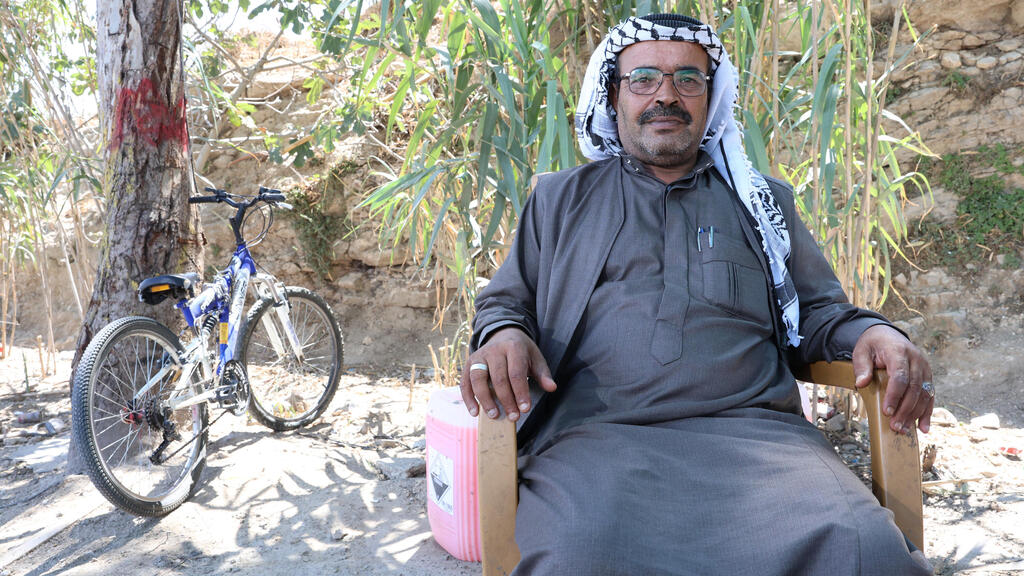
Daoud Jahalin
(Photo: Shaul Golan)
Daoud Jahalin, one of the heads of the local committee, asked that we not use the word “relocation.”
“It was displacement,” he said. “We were uprooted from the land we were living on so a settlement could be built. Now Israel intends to uproot 22 Bedouin communities, thousands of people, in order to build E1.
“They want to move them to an area next to the Abu Dis garbage dump. I would not wish that place on anyone. From our experience, this kind of displacement destroys the social, cultural and tribal fabric — everything you can imagine.
“It drove our young people toward crime, theft, drugs and even terrorism. It badly damaged the community and radicalized many people. So why do it again? I am telling you, construction in E1 will lead to collapse in every sense. It will be a disaster for all of us.”
It was not concern about the hardship imposed on Palestinians that prevented Israel from building here over the years. Those were years when Israel was more responsive to international pressure and careful not to cross certain red lines.
Netanyahu’s current government, however, appears far less concerned about European pressure or threats of sanctions. Last summer, it instructed planning authorities to move forward with approval for construction in E1, and the plan subsequently cleared all relevant committees.
Meanwhile, attorney Michael Sfard petitioned the High Court of Justice on behalf of the human rights groups Ir Amim, Bimkom and Peace Now, creating the expectation that construction would not begin immediately.
“Because of the High Court proceedings,” said Hagit Ofran of Peace Now, “the state prosecution promised it would notify us before a tender was issued to contractors. But suddenly, a week ago, the Housing Ministry pulled a fast one and issued a tender for part of the plan, 1,234 housing units.
“The deadline for bids was set for Oct. 19, one week before the election. That means that even before the election, the state could announce the contractors who won the tender and sign contracts with them. At that point, it would be much harder for the next government to withdraw from the plan.”
Beyond the practical implications, the issue is highly explosive. Aviv Tatarsky, a researcher at Ir Amim, said the plan would have a dramatic and direct impact on the lives of some 600,000 Palestinians and far-reaching geopolitical consequences.
“There are only two possible outcomes to this move,” he said. “Once it is carried out, Israel will become either a binational state or an apartheid state. There is no middle ground.
“There can be no Palestinian state if E1 is built. There will not be a South Palestine and a North Palestine. That would not be a functioning state. They would not want to establish a state like that.”
That is why the publication of the tenders drew a swift international response.
Attorney Danny Seidemann, an expert on East Jerusalem and construction in E1, said this time the international community would not settle for condemnations.
“For decades, the world has prevented Israel from building in this area,” he said. “Every U.S. president has told Israel, ‘Don’t,’ when it comes to E1. Bibi has declared several times that Israel would build there, but he always backed down. It happened after a phone call from the administration in Washington or a conversation with the German chancellor,” he added, using Netanyahu's nickname.
“Now he has lost all restraint, and the world understands that there is no point in making another round of phone calls. Germany, Britain, Italy, France, Canada, New Zealand and Australia issued a strongly worded statement last week accompanied by a significant threat.
“They said any construction company that bids on the tender risks economic sanctions and violating international law. A company exposed to sanctions is a high-risk company, and banks and financial institutions will have difficulty doing business with it.
“Israeli banks that provide financial guarantees to those companies could expose themselves to sanctions, and financial institutions in Israel are required to comply with international sanctions regimes.
“So it is doubtful those companies would receive credit or financing for the project if they won the tender. It is doubtful any financial institution would agree to back a company that bids on it in the first place, even before it wins.
“This will make every serious construction company and every bank or other financial institution think not 100 times, but 2,000 times before bidding on this tender or financing a project like this. This is not an empty threat. But Israel is leaving the world no other choice.”