

When Olga and Nikolai Boguslavsky welcomed their newborn son at Soroka Medical Center, the joy of his arrival was inseparable from the grief their family had endured. Just over a year earlier, their 18-year-old daughter Noa had been killed in an Iranian missile strike on Be'er Sheva, alongside her boyfriend, Eitan Zacks, also 18, and his mother, Michal, 50.
The couple, who live in the southern city of Arad, named their baby Amitai-Eitan. His second name honors the young man their daughter had loved, while his first came from an unexpected source: ChatGPT, an application Noa herself had taught her mother to use.
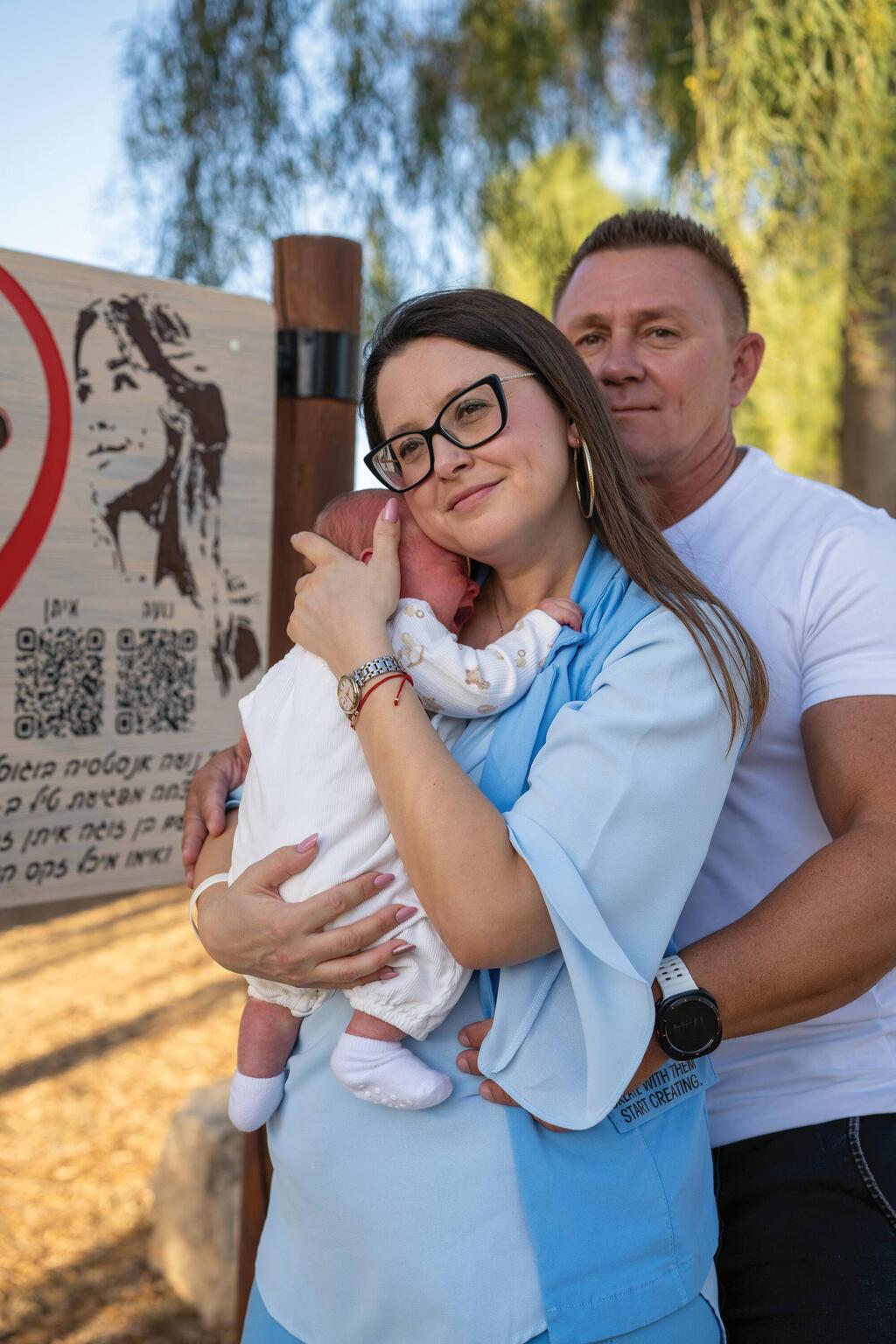
For Olga, 40, a kindergarten teacher for the past 17 years, the decision to have another child was something she had never expected to make. She and Nikolai, 48, already had two children, Noa and Matvey, now 12, and she had long considered their family complete. A difficult and traumatic second delivery had convinced her she did not want to go through another pregnancy.
Noa, however, had occasionally asked her parents why they did not have another baby. She wanted another brother or sister. After her death, those conversations took on an entirely different meaning.
"After we decided to have another child, I suddenly remembered those conversations and knew she would have given us her blessing," Olga recalled.
The decision came during the shiva, the traditional seven-day Jewish mourning period, following Noa's death. Overwhelmed by the sudden loss of her daughter, Olga found herself thinking about how unpredictable life had become and what would happen to Matvey if he lost his parents as well.
"I felt I had no control over my life. The ground had been pulled out from under me," she said. "I realized I didn't know whether we'd even be alive tomorrow. I thought about our son and knew we couldn't leave him alone. I wanted him to have someone he could turn to for help, even when we're no longer here."
At the time, Matvey was the only source of light in their lives. Olga said their love for him kept them going through the darkest days.
Nikolai initially opposed the idea of another child, but changed his mind when Olga explained that she wanted Matvey to grow up with a sibling. At 39, she knew another pregnancy was not guaranteed. She had already scheduled an appointment at a fertility clinic when, just days beforehand, she discovered she was pregnant naturally.
"I couldn't believe it. I took several tests just to make sure," she said.
The pregnancy brought excitement throughout Arad, where Olga has taught kindergarten for nearly two decades and where many residents knew the family and had shared in their grief. She remembered how the city's residents had lined the streets carrying Israeli flags as the family made its way to Noa's funeral. Now, those same neighbors were celebrating the arrival of a new child.
Choosing his name, however, proved difficult. Olga and Nikolai had decided early on that if the baby was a boy, they would name him after Eitan, whom they had loved almost as another son.
"Eitan was such a wonderful, special boy. I kept saying how lucky we were that Noa had chosen him. We fell in love with him the moment he became part of our family," Olga said.
As the delivery approached, the couple worried that giving their son Eitan as his only name would be emotionally overwhelming, both for them and for Eitan's father, Igor, who had lost his wife and only son in the strike. They decided to use Eitan as a middle name but struggled to agree on a first name.
That was when Olga remembered the technology her daughter had introduced her to. She turned to ChatGPT and asked it to suggest names that would sound right alongside Eitan. One of the suggestions was Amitai.
"It was such a special name. I've been a kindergarten teacher for 17 years and had never come across it even once," she said.
Igor had known about the couple's plans to have another child even before Olga became pregnant. When they told him they would name a son after Eitan, he was deeply moved, as was Eitan's grandmother. Igor later served as the sandak, the person honored with holding the baby during the circumcision ceremony.
The connection between the two families, forged through the young couple's relationship and strengthened by their shared loss, has remained central to Olga's life. She considers Igor part of her family and credits him with helping her survive the worst moments of her grief.
"He lost both his son and his wife, yet he always held his head high," she said. "In those first days, I looked at him and thought that I wanted to be like that too."
A love story that began on Instagram
Noa and Eitan had met through a mutual acquaintance on Instagram. A friend of Noa's from Arad had moved to Be'er Sheva for school and become friends with Eitan. He told Eitan about a particularly beautiful girl he knew back in Arad, prompting the teenager to ask for her photograph.
Eitan was immediately interested but did not know how to approach her. After noticing a poster on the wall of Noa's bedroom in one of her Instagram photographs, he sent her a message asking where she had bought it. He later admitted that the question was simply an excuse to start a conversation.

Noa and Eitan
Both were around 16 and a half when they met, with Eitan a few months younger. Their relationship quickly became serious, and they spent the next year and a half almost constantly together.
Olga recalled how the relationship revealed a new side of her daughter. Watching Noa with Eitan, she discovered how affectionate, warm and loving she could be. Their relationship, she said, was unusually close and deeply moving.
Because Eitan lived in Be'er Sheva, the couple frequently stayed at each other's homes. Initially, Olga was reluctant to let Noa sleep over before meeting his parents. She wanted to understand the family her daughter would be staying with.
Eitan's mother, Michal, called to reassure her. What was supposed to be a brief introductory conversation lasted two hours. The women discovered they had both studied teaching at Kaye College in Be'er Sheva and had numerous other things in common.
Three months into the teenagers' relationship, the families arranged to meet at a restaurant. Nikolai was unusually excited about the occasion, prompting Olga to tease him that their children were not getting married yet.
The meeting felt less like an introduction between strangers than a reunion between old friends. The families became close, and Olga recalled returning from subsequent visits to Eitan's home filled with happiness.
Noa, meanwhile, was making plans for her future. She had graduated high school at ORT Arad and was preparing to enlist in a special IDF Intelligence Corps unit. After military service, she hoped to travel the world, marry Eitan and build a career in high-tech.
She wanted to become a mother while still young and had spoken about having her first child at 24. She had also worked hard to complete advanced mathematics studies, despite finding the subject difficult, because she believed it would help her achieve her ambitions.
August was supposed to be a month of celebrations. Noa would turn 19, begin her military service and mark a year and a half with Eitan. She never reached any of those milestones.
The message sent two minutes before the missile struck
On June 24, 2025, just two hours before the ceasefire that ended Operation Rising Lion, an Iranian missile struck the apartment building in Be'er Sheva where Eitan lived with his family.
Noa, Eitan and Michal were killed, along with their neighbor Naomi Shaanan, 73. Eitan's father, Igor, survived because he was in the bathroom when the missile hit.
Just minutes before the strike, Noa and her mother had exchanged WhatsApp messages. At around 4 a.m., Olga told her daughter that sirens were sounding in Arad and that the family was entering its safe room. Noa replied that there were no alerts in Be'er Sheva yet.
At 5:41 a.m., after Olga had gone back to sleep, Noa sent another message: "Now we have them here."
Two minutes later, the missile struck. Noa, Eitan and Michal did not manage to reach the safe room in time.
Olga awoke later that morning and saw her daughter's message. She assumed Noa had taken shelter and was safe. When she turned on the news and heard reports of fatalities in Be'er Sheva, she did not initially imagine her daughter might be among them.
Then the police called, asking questions about Noa. Olga insisted that her daughter was fine, but the conversation left her increasingly uneasy. She tried calling Michal, only to have the phone answered by Home Front Command personnel who had found it outside the building.
They told her a missile had struck the apartment block. Olga woke Nikolai, and the couple rushed to Be'er Sheva. Approaching from the side of the building that had sustained less damage, they initially felt a measure of relief because the structure appeared relatively intact.
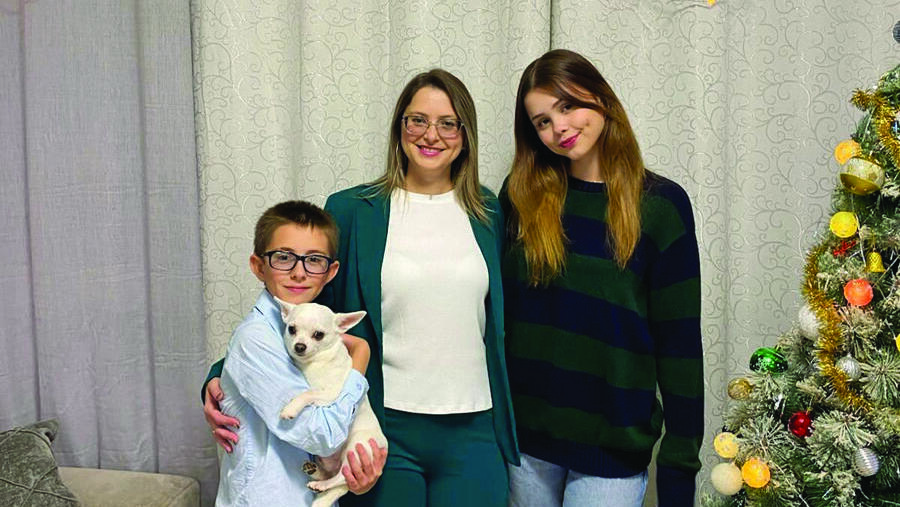
Noa with her mother, Olga, and brother Matvey
When they learned that people had been killed, they drove to Soroka Medical Center, hoping to find their daughter and Eitan among the injured.
There, they found Igor, wounded but alive. For a moment, his survival gave them hope. Then he told them that Eitan was dead.
Olga immediately feared the worst. Noa and Eitan had been inseparable, and she could not imagine one being in the apartment without the other.
She later learned that the force of the blast had thrown Noa through a window and that her body had been found below the building. Olga believes her daughter may have been on the balcony when the missile struck, leaving her no time to reach shelter.
The family returned to Arad to inform relatives before news of Noa's death became public. Olga told Matvey separately, hoping to spare him the sight of their extended family's anguish.
He initially refused to accept that his sister had died. For a long time afterward, he struggled to express his own grief, apparently trying to protect his parents from further pain.
"Today, he mainly worries about us," Olga said. "He keeps asking, 'Are you crying? Please don't cry.'"
In the months that followed, Olga repeatedly revisited the final days of her daughter's life, searching her memories for details that had taken on new significance.
A week before the attack, Noa had visited Arad with Eitan, who had already enlisted in the military and was undergoing combat training in the IDF's multidimensional Unit 888. Noa had arranged a manicure appointment, while Eitan attended an online meeting. She prepared breakfast for him before leaving the house.
When the meeting ended, Eitan left to visit friends in Meitar and then returned home to Be'er Sheva. Olga remembered hugging him goodbye. It was the last time she saw him.
Noa was unusually upset that her mother had allowed him to leave without waiting for her. Looking back, Olga wondered whether her daughter's intense reaction had reflected some instinctive sense of what was coming, although Noa herself could not explain why she had become so distressed.
The next day, Noa traveled to Be'er Sheva to spend the night with Eitan before he was due to return to his base. She came home the following morning and visited a swimming pool with friends, despite receiving a call from Eitan saying he had gone on leave.
It became her final outing with those friends. The following day, Nikolai drove her to Eitan's home. Neither parent saw her again.
A new life alongside an enduring loss
Olga and Nikolai's own relationship began in Arad, where they met after immigrating separately to Israel from the former Soviet Union. Olga arrived from Ukraine in 2001, at 15, through the Naale educational program, while Nikolai had moved from Russia the previous year with his sister.
Olga's parents had divorced when she was a baby. Her grandmother followed her to Israel six months after she arrived, settling in Arad, and Olga eventually moved nearby. She met Nikolai through a mutual friend shortly afterward.
They moved in together and married after Nikolai proposed a year later. Olga had initially hesitated, wanting to be certain their relationship would last after witnessing her own parents' divorce. When she became pregnant with Noa, she took it as the sign she had been seeking.
The couple have now been together for 21 years, and Olga says their relationship has been a source of strength since their daughter's death.
Returning to work also played an unexpected role in her recovery. She had feared that losing Noa had left her incapable of feeling affection for anyone, including the children she had spent years teaching.
But when she returned to her kindergarten after the shiva and saw the children's love and excitement, she realized those feelings had not disappeared.
Her pregnancy offered another source of hope. Matvey had initially hoped for a baby sister, but Olga said he was delighted when his younger brother arrived.
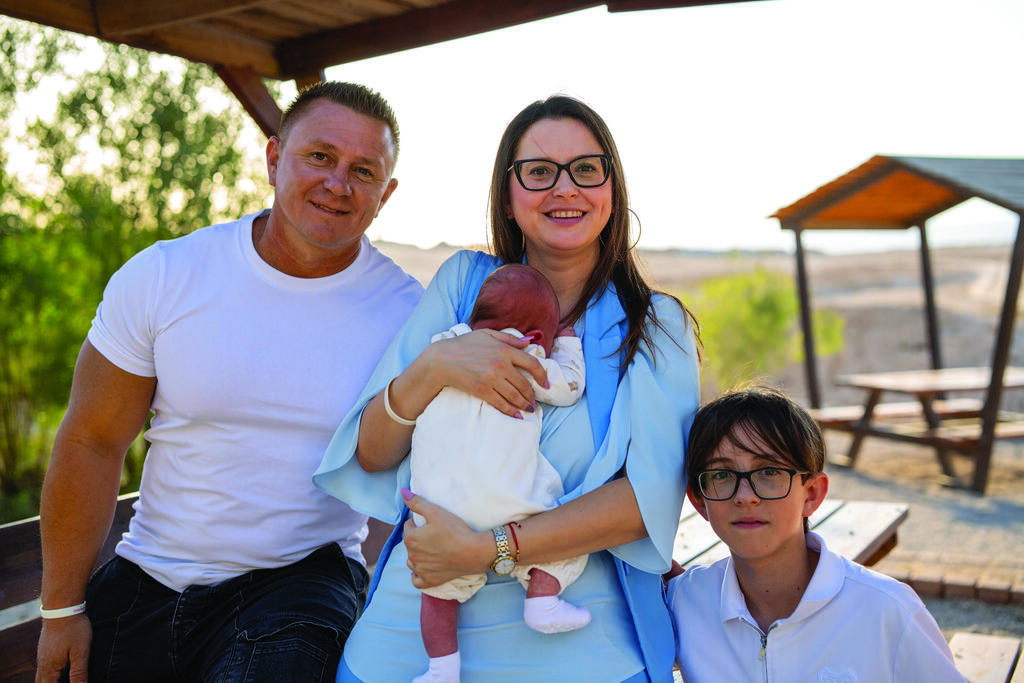
(Photo: David Amar)
The delivery itself was relatively straightforward, although emotionally overwhelming. Months earlier, Soroka Medical Center had opened a counseling room named in memory of Noa, Eitan and Michal. During the dedication ceremony, Olga met a maternity counselor who later showed her around the delivery ward.
The visit helped ease her anxiety about giving birth again. When she returned to the hospital for the delivery, the surroundings were already familiar, and she felt supported by the medical staff.
But Noa remained constantly on her mind. When Olga first held Amitai-Eitan, she was struck by how closely he resembled his older sister.
"He looks exactly like Noa," she said. "When I breastfed him, I felt as though I were breastfeeding her. It was something beyond words. I feel like a miracle happened to me. Who would have imagined I'd have a third child?"
The joy of motherhood has not erased her grief. Olga describes her life today as a combination of unending pain and happiness she never believed she would experience again.
That contrast is also why she has chosen to speak publicly about her experience. Hearing about soldiers who have died by suicide after experiencing wartime trauma has been particularly painful for her, especially because her daughter was the same age as many of them. She hopes her story can reach people who feel overwhelmed by loss and help them see that a future remains possible.
"I want people to know there is life after death," she said. "I want to tell them there is always hope. I've been in that place too. I had very difficult thoughts, and I looked for someone whose example could inspire me."
For Olga, that inspiration came from several directions: Matvey, her husband Nikolai, Igor, the children in her kindergarten and, now, Amitai-Eitan.
She knows that the loss of Noa will remain part of her life, just as the love between the families connected by Noa and Eitan will endure. The baby's name is a reminder of that bond, even as he begins a life of his own.
"I thought my life was over," she said. "But eventually I realized that it's possible to live alongside death. You have to look for the light wherever you can. In the end, it will come and bring comfort."