

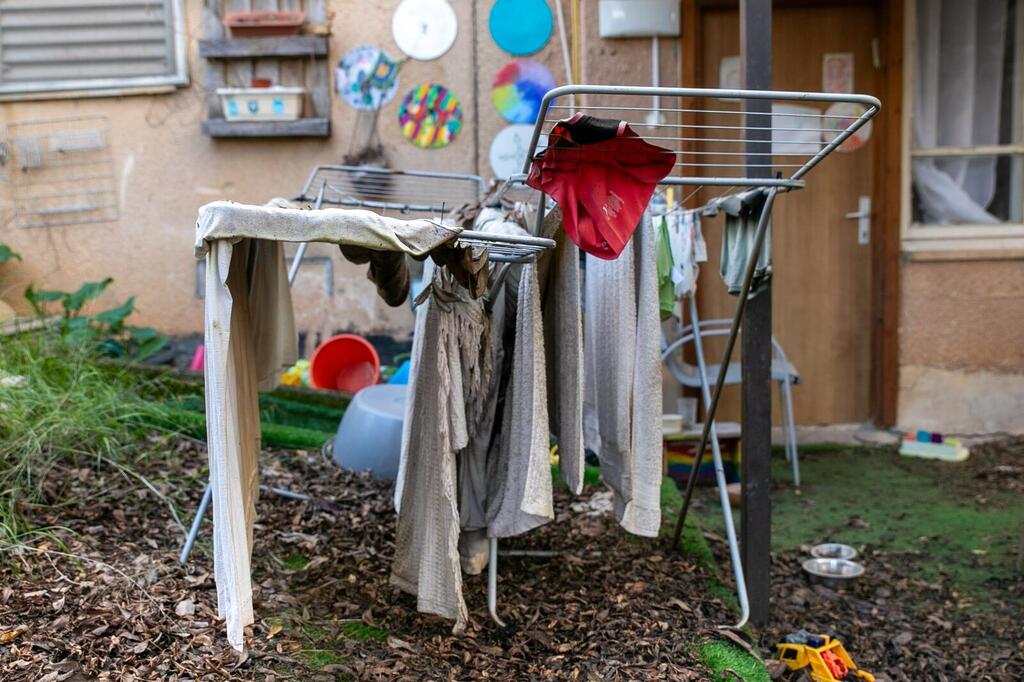
A shattered light-blue swimming pool, laundry hanging on a rack in an abandoned home and a guard post standing in the middle of nowhere. At first glance, it looks like imagery from places hit by extreme disaster, such as Chernobyl. On second glance, an Israeli viewer realizes with alarm that Chernobyl is here, just three hours from Tel Aviv.
In early June, the exhibition “A Man Hanging His Yesterday” by Roy Kasher opened at the “Beit Hashomer” museum in Kfar Giladi. It features striking and haunting photographs from some of the most difficult days for the kibbutz, which was founded 110 years ago, faced many security threats over the years but had never been evacuated until the turbulent fall of 2023.
Originally, Kasher, 32, a native of the kibbutz, planned to study music. “When the war broke out,” he recalls, “I had just finished Rimon School of Music and I was supposed to start working on music projects.”
Following the events of October 7, he felt he could not sit at home and went in the first days after the disaster to the Gaza border communities, armed with courage and his phone, where he began his relationship with photography.
“I never had a real camera,” he says, “and little by little I realized I was good at it and that I loved it. When I was called up for reserve duty in Gaza and understood I would be without a phone for operational security reasons and therefore without a camera, I posted: ‘Who can donate an old digital camera?’ In the end a friend brought me one, and that is how I got into it.”
Kasher served in the reserves in the Jerusalem Brigade. “Operation Iron Swords was not my first war,” he says. “First, I enlisted during Operation Protective Edge and from basic training was sent to Gaza.”

Roy Kasher. 'I never had a real camera'
(Photo: Yanai Shapiron)
After his unit was released in late December 2023, Kasher, who had finished his studies and therefore left his apartment in Ramat Hasharon, found himself without a home.
He made a conscious decision to return to the shelled and evacuated kibbutz. “My parents were evacuated to a hotel in the Kinneret area,” he says, “but my brother, who was in the local emergency squad, stayed in the kibbutz. I came to him and went out to photograph. Even then I understood this was a historic event.”
The atmosphere, he recalls, was anxious, and people were uneasy about the young man walking through the kibbutz paths with a camera. “In the emergency squad,” he laughs, “they didn’t really like me walking around them, and I was also reprimanded several times by the army, but I felt I needed to document it.”
“I was obsessive. I photographed the entire kibbutz and specifically the members’ homes from the outside. There is not a single centimeter I did not photograph. I was in a kind of low mood and I found in these photos an echo of my mental state.”
From time to time he would upload the images from evacuated Kfar Giladi to his Facebook page and send friends, who were staying in hotels around the Kinneret, “a greeting” from home.
“Being in the kibbutz during that period,” he recalls, “was difficult and sad. I remember saying to myself: the community is not here, they left home and do not know what is happening. I felt I had to tell them what was happening in ‘home.’ The private home and the collective home.”
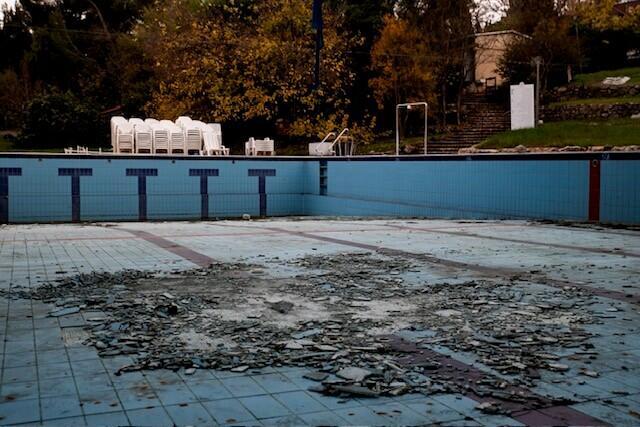
A neglected light-blue swimming pool
(Photo: Roy Kasher)
Did it depress them?
“In my opinion it actually calmed them. The news coverage tends to be extreme, while war is made up of a million pixels, small everyday things that do not get media attention.
“As a kibbutz member I know these places from the inside, and it gave me a closer point of view. It is not like Ziv Koren coming to photograph Be’eri or a journalist coming to photograph an abandoned kibbutz. It is me, someone who grew up here, and that allows a more personal and sensitive perspective.”
A testimony to trauma
Kasher admits he never planned a photography career, but after the responses he received he has already mounted three exhibitions. “A Man Hanging His Yesterday” is only one of them. He also won second place in the most recent “Local Testimony” exhibition in the category of urbanism and culture.
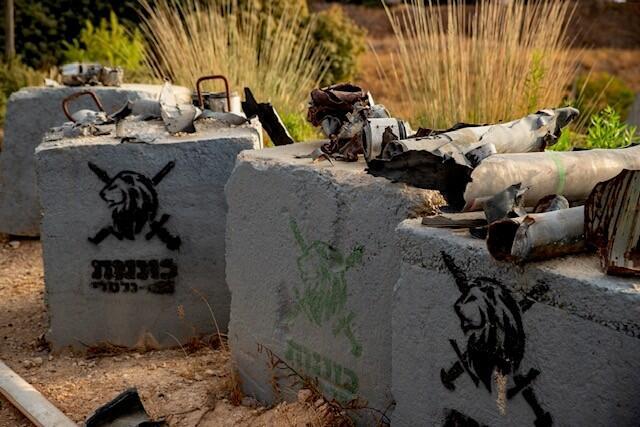
Missile fragments that fell on the kibbutz during the war
(Photo: Roy Kasher)
“I did not become a disaster photographer,” he says. “It was a moment in time, something I did, but I do not feel it defines me.”
For a year and four months, Kfar Giladi was evacuated. In February 2025, residents returned and have since been rebuilding the kibbutz rapidly. The pool, for example, has already been renovated and reopened.
“The kibbutz has come back to life,” Kasher says. “Suddenly there are children on the lawn riding bicycles, people on the paths and a screening of the World Cup in the central square in front of the dining hall.
“I feel the community is rebuilding itself socially. It is now clear to everyone that no matter what, there will not be another evacuation. But my exhibition and these photographs are an important testimony to the trauma we went through here.”

Overgrowth engulfing a bench in Kfar Giladi
(Photo: Roy Kasher)
“I believe the exhibition tells a broader story, of the Kfar Giladi community but also of other kibbutzim, because a kibbutz pool is a symbol, not just a specific pool. The experience of seeing a destroyed pool is something shared, both by kibbutz members and city residents, each from their own place.
“People tell me the photos are heartbreaking, and I understand the emotional reaction they create, in the dissonance between a pool, a symbol of summer and freedom, and then suddenly a missile hits it. Photography freezes something in time and allows the viewer to imagine the before and after. It was a difficult and sad situation for me because I knew these places in a different way.”
'Reassembling ourselves'
When Kasher wanted to exhibit the photos, he quickly found a home within his home: the “Beit Hashomer” museum in his kibbutz, operated by the Defense Ministry and curated by Bosmat Hareuveni Zeevi.
“This exhibition tells our story, the story of the kibbutz,” she says. “The evacuation was an unforgettable event for us and it is important that it resonates and that people see what happened here. These photographs tell the story of our community without showing people. What happens when there are no people around, when vegetation takes over, when laundry remains hanging on a line for over a year as it was left. That is the whole story. And it is disturbing.

Bosmat Hareuveni Zeevi. 'Every exhibition I curate these days is therapeutic for me'
(Photo: Roy Kasher)
“When Roy sent us the photos in real time, it mainly made me sad. To leave such a place and be away from home for a year and a half is something you cannot simply move past. This July marks a year since our return and we are still in healing. This exhibition is part of that process.
“Every exhibition I curate these days is therapeutic for me. Those who do not know what happened here will not feel it. But we are still reassembling ourselves. I cannot forget Roy’s images of what was here, the bench and the pool. Those two images do not leave my mind. A pool that symbolizes life and joy became, in an instant, a dangerous place.”
'Abandoned connects to nostalgia'
Kasher’s images of abandoned structures are not unfamiliar in the worlds of architecture, art and photography. In recent years, they have become part of a well-known genre in which photographers “hunt” abandoned places, which are often isolated and difficult to inhabit, spaces where nature takes over human-made urban environments.
Abandoned psychiatric hospitals, cities that experienced mass disaster such as Chernobyl in Ukraine and Fukushima in Japan, and even a “graveyard” of trains in Bolivia have become sought-after photography sites and tourist destinations.
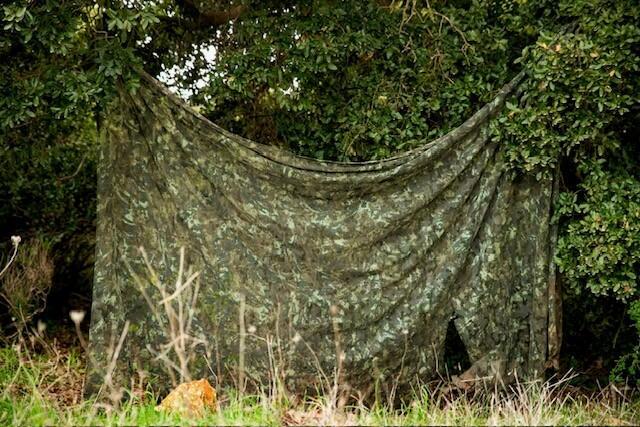
The abandoned Kfar Giladi during the war
(Photo: Roy Kasher)
“There are also thousands of abandoned structures in Israel of different types and periods,” says architect Sharon Raz, considered an authority on the subject and author of the blog “Netushim” (Abandoned). “I estimate there are several hundred abandoned swimming pools. I have photographed many of them over the past 22 years. For people, abandoned places are associated with nostalgia, like old ice cream shops, cinemas, specific things people experienced. I am more interested in buildings I do not have a personal connection to.”
What do you think draws people to abandoned or ruined places?
“People are drawn to the beauty of nature taking over a structure and reclaiming space from humans. Visually it is very powerful, with something melancholic and sad.”
“We are far more part of our physical environment than we realize,” says Dr. Idit Gutman, a clinical psychologist from Tel Aviv University’s Department of Psychology. “Our home is part of us. It is where we feel most comfortable and most whole. When there is damage to the home, it becomes damage to us as well. But when the pool fills again, there is a sense that we can return and continue. If nature renews itself, so can we.
“Abandoned places carry deep loneliness, and loneliness is a basic existential fear. What terrifies us most is being left alone, and at the same time it also attracts us. That is why most people enjoy peeking and then leaving. Art and visits to abandoned places allow that experience because it is time-bound and offers emotional release. It is the fulfillment of our worst fears, but under control.”
From a psychological perspective, such images trigger us emotionally because they resemble a dream. These are everyday places we all know, but something about them looks different, chaotic and illogical. It is difficult to process them rationally. This surreal language, like Salvador Dalí, resonates with the unconscious and stirs emotion.
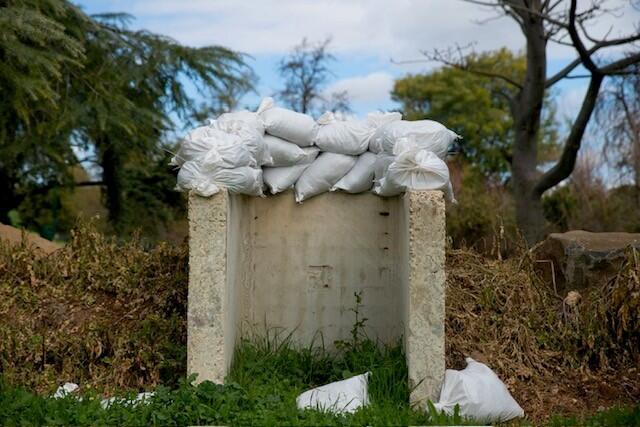
Kasher’s images of abandoned structures are not unfamiliar in the worlds of architecture, art and photography
(Photo: Roy Kasher)
“Of course, someone for whom this is not their home, not a constant reminder of trauma, experiences the images differently than someone who was evacuated and this was their home. The emotional distance works for the outside viewer: this is not my home, this is art, this is not reality. That is why we cannot look away."
And for those inside the situation?
“It depends on the person. Art provides catharsis. That is why Titanic was a blockbuster. People paid to cry, just like they pay to enter a haunted house. It is contained in time and clearly not real life. But for Kfar Giladi residents, these images can help in processing trauma, like looking at photos during a shiva.
“These images do more good than harm. Those who developed acute stress reactions will not look at them. But most people have managed to survive and function, and part of that process included initiatives like this.
“When I worked with survivors from Kfar Aza, someone managed to bring me a coffee cup from a woman’s home. It looked generic, but it had a silly drawing and a crack, and most importantly it created a sense that something was saved from the past. A ritual can be preserved. What happened has already happened, and perhaps we can fear it less because we survived it. The feeling that there is no evidence of the destruction is very heavy. Here there is another set of eyes that sees and proves it happened, and that helps coping.”