


Few things frustrate Israelis more than seeing LGBTQ organizations abroad adopt pro-Palestinian positions and publicly criticize Israel. For many, the instinctive reaction is sharp: How can these groups side with Hamas terrorists—people who, if the critics were in Gaza, would kill them without hesitation? How can they speak against Israel, the only Middle Eastern country where LGBTQ individuals are an integral part of society with pride parades and a robust liberal discourse?
Hila Pe’er, chair of The Aguda — The Association for LGBTQ Equality in Israel, says the cognitive dissonance of seeing groups abroad support both a terrorist organization and a Palestinian population whose actions run counter to the groups’ stated values is difficult to reconcile.
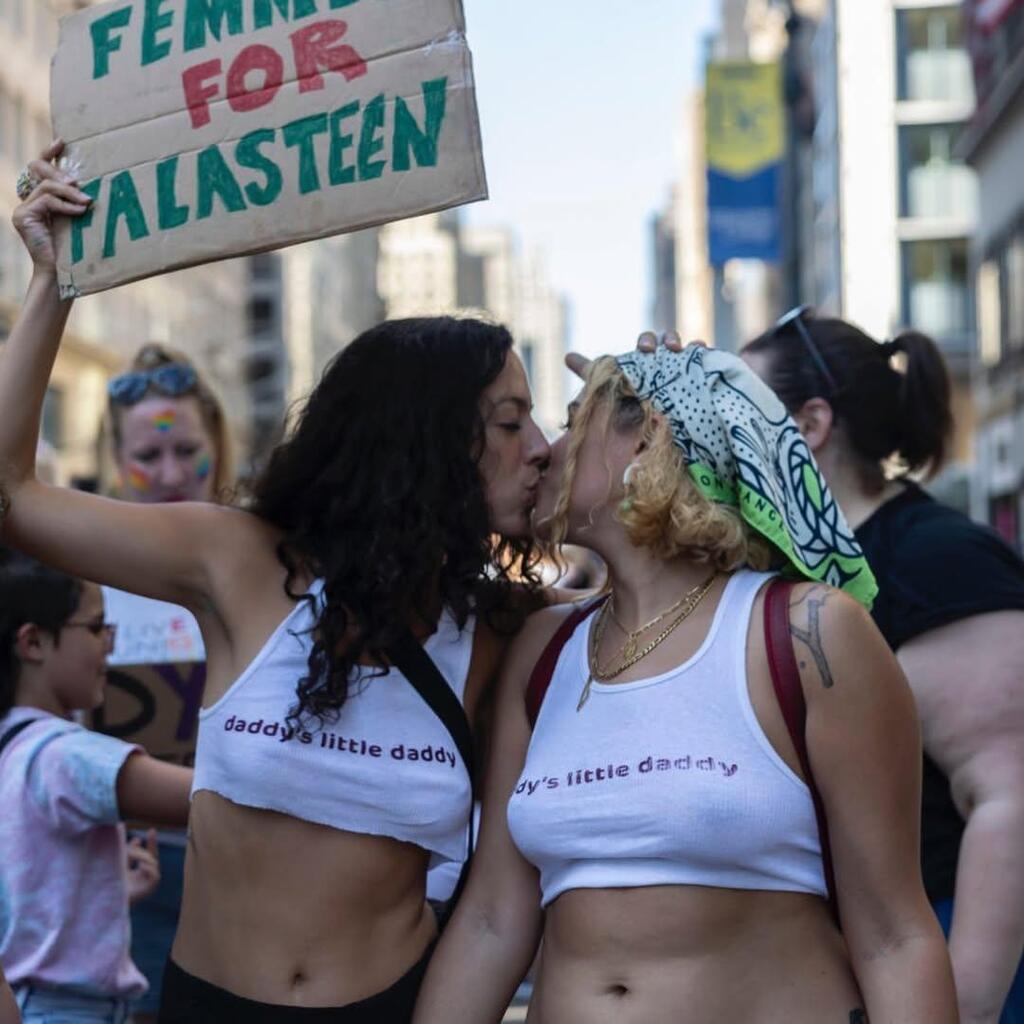
“Before October 7, 2023, we rarely encountered significant hostility toward Israel among LGBTQ organizations abroad,” Pe’er said. Until then, The Aguda’s work, which focused in part on human rights, was positively received worldwide. “We are a civil society organization not seen as the Israeli government. We also advocated for members of the Arab community, refugees and Palestinians persecuted for their sexual orientation. We were committed to human rights for everyone living here. That perception made us part of the global LGBTQ community.”
October 7 changes the perception
Pe’er said the events of October 7, 2023, marked a turning point. “There was a mental merging between what they called ‘resistance actions’—not just against the IDF or Israeli government, but against all of Israel and Israelis. Those speaking out against Israel now see all of us as a single block. I don’t think they are pro-Palestinian as Palestinians; they are simply siding with the weak and oppressed and opposing the powerful—Israel. For them, it doesn’t matter that we are LGBTQ; we are complicit in oppression and occupation. The separation no longer exists. From their perspective, they cut ties with Israeli civil LGBTQ organizations on principle because they see us as part of the government carrying it out.”
Following the war, Pe’er and The Aguda engaged in a lengthy legal and public relations battle with the global LGBTQ umbrella organization after being suspended. Only after an appeal and extensive discussion was the suspension lifted.
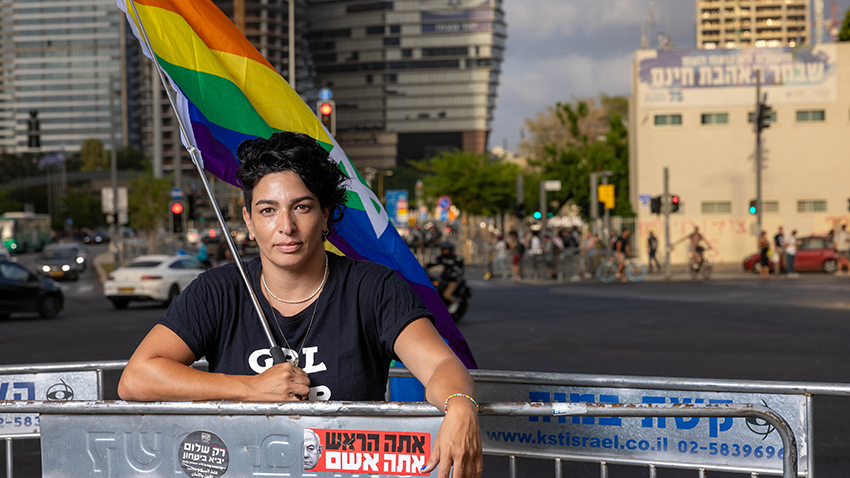
Hila Pe'er
(Photo: Tal Shachar)
“Our argument was that they cannot flatten reality. The situation on the ground is complex,” Pe’er said. “October 7 was not legitimate resistance—it was a mass slaughter of civilians. Explaining the complexity and causes of the war was not easy, but I believe it was right to defend our legitimate place in this global community.”
Graphic images and human rights debate
Graphic footage of murders and abuse of LGBTQ individuals in Gaza circulates online, raising the question: should pro-Palestinian LGBTQ activists be challenged with the risks they would face in Gaza?
Pe’er said, “Maybe it’s legitimate, but it’s not relevant and won’t advance the discussion. Their basic argument is that while they are LGBTQ, they are first and foremost human, opposing the killing of people. They base their stance on human rights.”
She acknowledged, “Even human rights are denied in Gaza, long before the war. True, but they respond that doesn’t justify killing. There is a huge explanatory gap and a lack of Israeli statements emphasizing that we do not target civilians and that our war is against a terrorist organization not the population. Many pro-Palestinians don’t know the reality; they are exposed only to Hamas messages and some don’t even know what happened on October 7 or understand the situation’s complexity.”
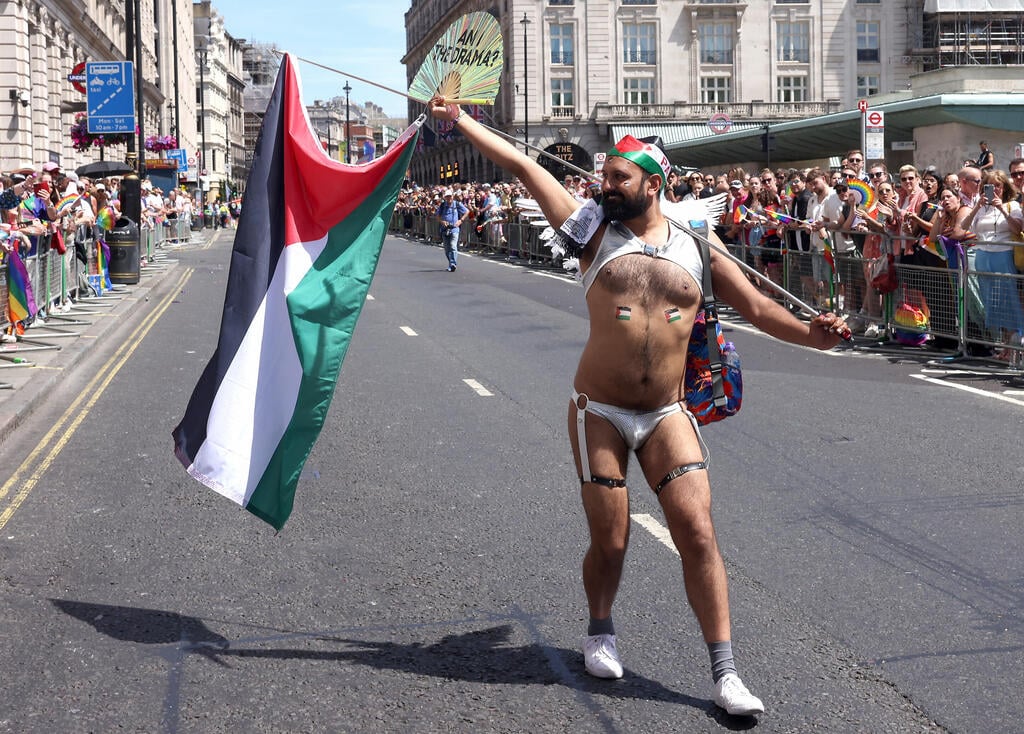
(Photo: Alex McBride / Getty Images)
Pe’er stressed that loud “Queer for Palestine” groups are a minority within the global LGBTQ community. “Pressed on this, they say: ‘I don’t support Hamas; I oppose the killing of civilians.’ To them, they are siding with a people who seem different and oppressed, who are being crushed, blockaded, denied independence and now being killed. I exaggerate intentionally, but these are the narratives. There’s a flood of such content and we cannot respond fast enough.”
Demands for loyalty
A recent trend among pro-Palestinian activists is requiring Israelis to declare they do not support the war or that what happens in Gaza is “not in their name.” Pe’er said this stance is deeply problematic.
“If I have to start a conversation by proving loyalty, something never required of a Russian or Iranian citizen, there’s a problem. What does ‘not in my name’ mean? I may support ending the war, but my cousin is fighting in Gaza—that is my cousin. I served in the army believing the IDF defends Israel and its values. So what is ‘not in my name’? This is my country and I am determined to defend it. It’s another attempt to create a black-or-white world: you are with us or against us. In the LGBTQ world, we have long moved beyond black or white, gay or straight—it’s a spectrum. The same applies here.”
Looking beyond the conflict
Pe’er said it is unclear what post-war relationships will look like. “That is a dramatic question without an answer. Bridges may be built, but not the ones we had. We may need to see reality differently. There is definitely a change in how we are perceived.”
Dr. Kobi Barda, an expert on U.S. affairs and lecturer at HIT Holon, said the alignment of LGBTQ activists with Palestinians reflects a broader coalition of the oppressed against Israel. “It’s not surprising. Islamic groups on campuses oppose LGBTQ rights, but in this specific anti-Israel agenda they are willing to cooperate.”
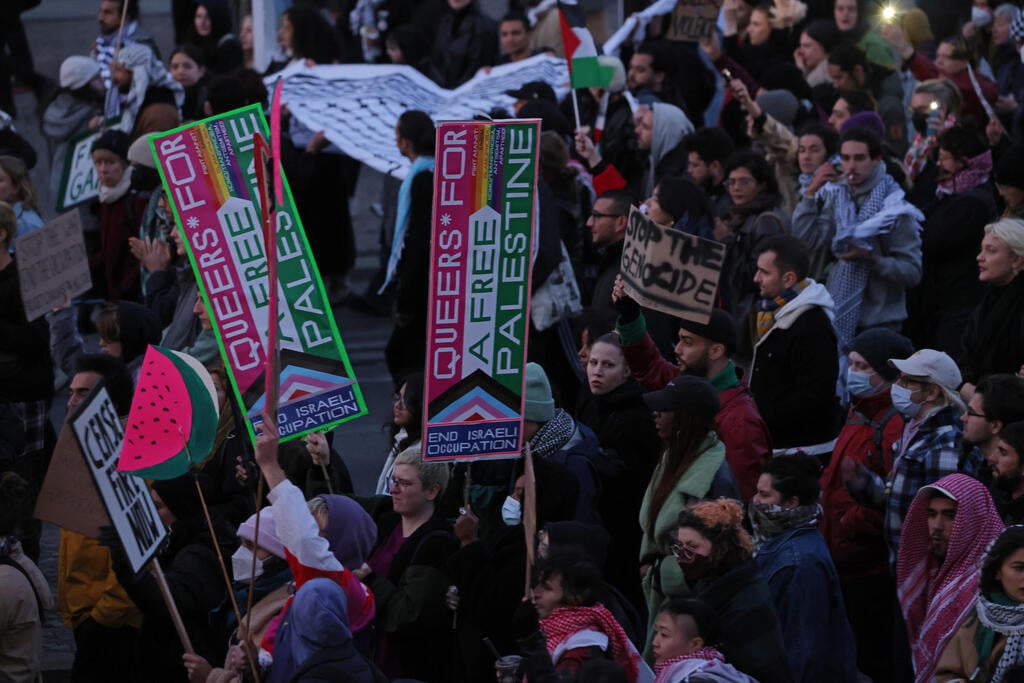
(Photo: Sean Gallup / Getty Images)
Barda added, “The prevailing narrative is that Israel is the last place of white colonialism, oppressing the ‘brown man.’ Reality doesn’t matter—there is no link between Israel and European colonialism and many Israelis are of Middle Eastern descent. People reject their country and Western values. Everything merges against Israel, currently the active front.”
Supporting those who oppose them
Pe’er said these activists, in effect, support people who could threaten them. “They argue: ‘I disagree with his desire to kill me for being homosexual, but I am fine working with him against colonialism.’ They have a social scoring system based on suffering and oppression. In their perception, those historically oppressed now seek alliances with others they consider oppressed—today, Palestinians.”
She concluded, “They promote an agenda that the world is black or white—oppressor or oppressed. In essence, they have been oppressed most of their lives and now they seek alliances with the oppressed, which today are the Palestinians.”