

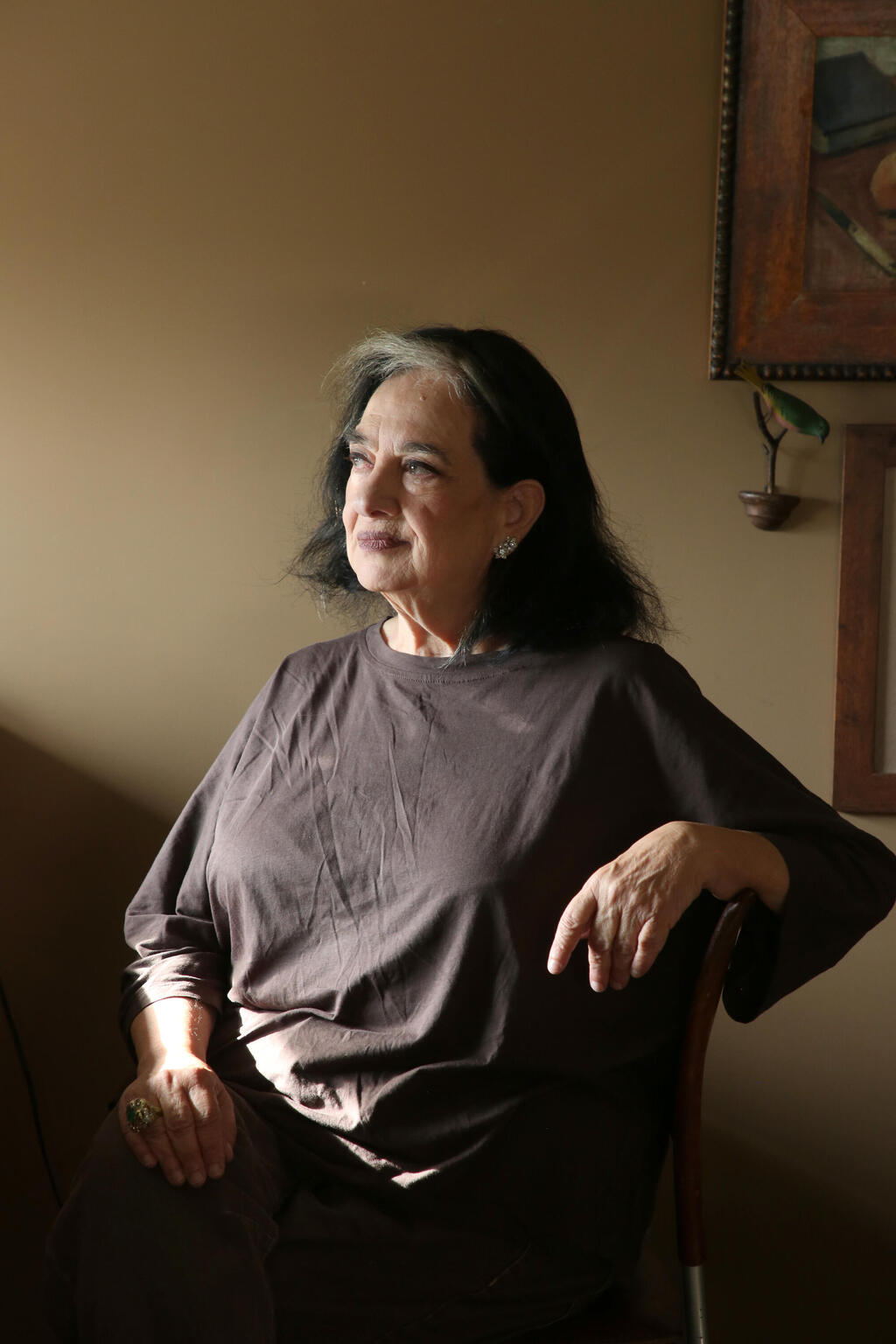
Even during the terrifying moments when the Flydubai plane plunged and shook violently in the sky, Israeli fashion designer Hagar Alembik did not suddenly discover faith. She did not turn to God or cry out "Shema Yisrael," the Jewish declaration of faith, as many of her fellow passengers did. "It was sheer terror," she recalls. "I was certain this was the end, that this was what the end of life looked like. But I didn't turn to God because I don't have a God. I've been an atheist through and through since birth. Ever since we landed safely, people have been asking me whether I've recited Hagomel, the Jewish prayer of thanksgiving after surviving danger, and I ask them what that is."
So whom do you thank for landing at Ben Gurion Airport without a scratch?
"Maybe the universe, maybe the world. The whole attempted hijacking is beyond my comprehension, and I don't pretend to understand it. But one thing is certain. It's behind me, behind all of us. It's over."
That's it? You've already moved on?
"Yes. The incident is over, and life goes on. I've always said that to live, you have to die a little. It's a philosophical idea that's accompanied me for years, through good times and bad. I always look forward, with my eyes wide open. Now I'd be happy to sell fashion to Japan, which hosted us so beautifully, and to Saudi Arabia, which welcomed us with open arms."
According to reports, every passenger on the flight is expected to receive about $250,000 in compensation.
"I heard. I think someone wrote about it in the passengers' WhatsApp group. One of the women opened a group for us while we were waiting in Saudi Arabia. She called it 'Flydubai Victims,' a name that grated on me, and later, perhaps because of the reactions, it was changed to 'Flydubai Survivors.' I'm not comfortable with either name, and I also don't believe we're talking about such large sums."
Maybe you need to prove that you're suffering from post-traumatic stress.
"Why would I try to prove something that isn't true? I have absolutely no intention of making a project out of proving that I'm traumatized. That's not my direction at all. If everyone receives compensation, then obviously my daughter, my grandson and I, who were all on the flight, will receive it too. I have no moral objection to accepting the money. It's not reparations from Germany. But the bottom line is that it wasn't worth it. I wouldn't recommend it."
‘To live, you have to die a little’
Dressed in black as always, her figure slimmer than ever ("At least 30 kilograms [66 pounds] lighter. I don't weigh myself. Thanks to whoever invented weight-loss injections"), Alembik, 71, opens the door to her apartment in a leafy area behind Ichilov Hospital in Tel Aviv. Parking is virtually nonexistent, but for her, living here feels like coming home.
"From third grade, I grew up two houses away from this building," she says. "Two years ago, I bought this apartment, across from my mother's apartment, and we had such a wonderful time together. We ate together, watched television together, we loved Raviv Drucker and Noa Koler's television series Makom Sameach, and talked endlessly. Those were the closest 18 months of our lives. My mother was a very opinionated, sharp woman, and she wasn't always easy to deal with. But thanks to living almost together, we gained a good relationship toward the end, with tenderness and love."
Her mother, Noa Hatzofe, died four months ago at the age of 92 "and a half," Alembik emphasizes. "Mom started to feel that things weren't right anymore. She wasn't prepared to reach a point where she'd have to sit in a wheelchair and could no longer go to the theater and the movies she loved. So she said goodbye."
The bright smile on Alembik's face does not disappear as she remembers. "She was unbelievably lucid. She always insisted on pointing out that her name was spelled Noa without a vav in Hebrew, and she was terrified of missing the moment after which she would no longer be able to express her wishes. That was her greatest fear. Forty years ago, she donated her body to science, so she called the university to check whether the arrangement was still valid, whether they were still interested in her body. She made sure every loose end was tied up. My mother was quite a character, a woman of tremendous strength."
Are you like her?
"In terms of strength, yes," says the eldest daughter of Noa, whose name was spelled without the Hebrew letter vav, and sculptor Emmanuel Hatzofe, whose works are displayed throughout her apartment. "I have two brothers: Ohad Hatzofe, who is seven years younger than me, an ecologist with the Israel Nature and Parks Authority who works to protect the country's vulture population, and Yonatan, who's 20 years younger than me. Same father, same marriage. And when Yonatan became religious, my mother almost died from it. Literally, not metaphorically. She was a complete atheist. Well, I'm like her in that respect too."
When you were 20 and already married, your mother had another baby.
"That was quite something. I accepted him completely, even though I was surprised at first. Because of the age differences between us, Mom used to say she'd raised three only children."
How did you react when she decided to say goodbye to life?
"It wasn't new to us. Mom had always said she wasn't prepared to die without dignity. She received palliative care, everything was legal and properly handled, and after a few days she departed on another journey, without suffering. Because she'd donated her body to science, there was no funeral. That's what she wanted. Some people might say she wanted to leave this world while remaining completely in control of the situation. I see it as an act of compassion toward us."
Do you support that approach?
"Absolutely. I'd follow exactly the same path. Her death taught me a lesson about life."
Following her mother's death, Alembik told herself, "Come on, it's time to fulfill some dreams," and decided to travel to Japan. "I'd wanted to go there for years, but I kept putting it off. There was always something that seemed more important, a fabric exhibition here, a fashion exhibition there. When I finally told myself, 'That's it, now it's happening,' I didn't look for friends to join me. I wanted to experience Japan with Lee, my only daughter, and her only son, Nimrod, who's also my only grandson."
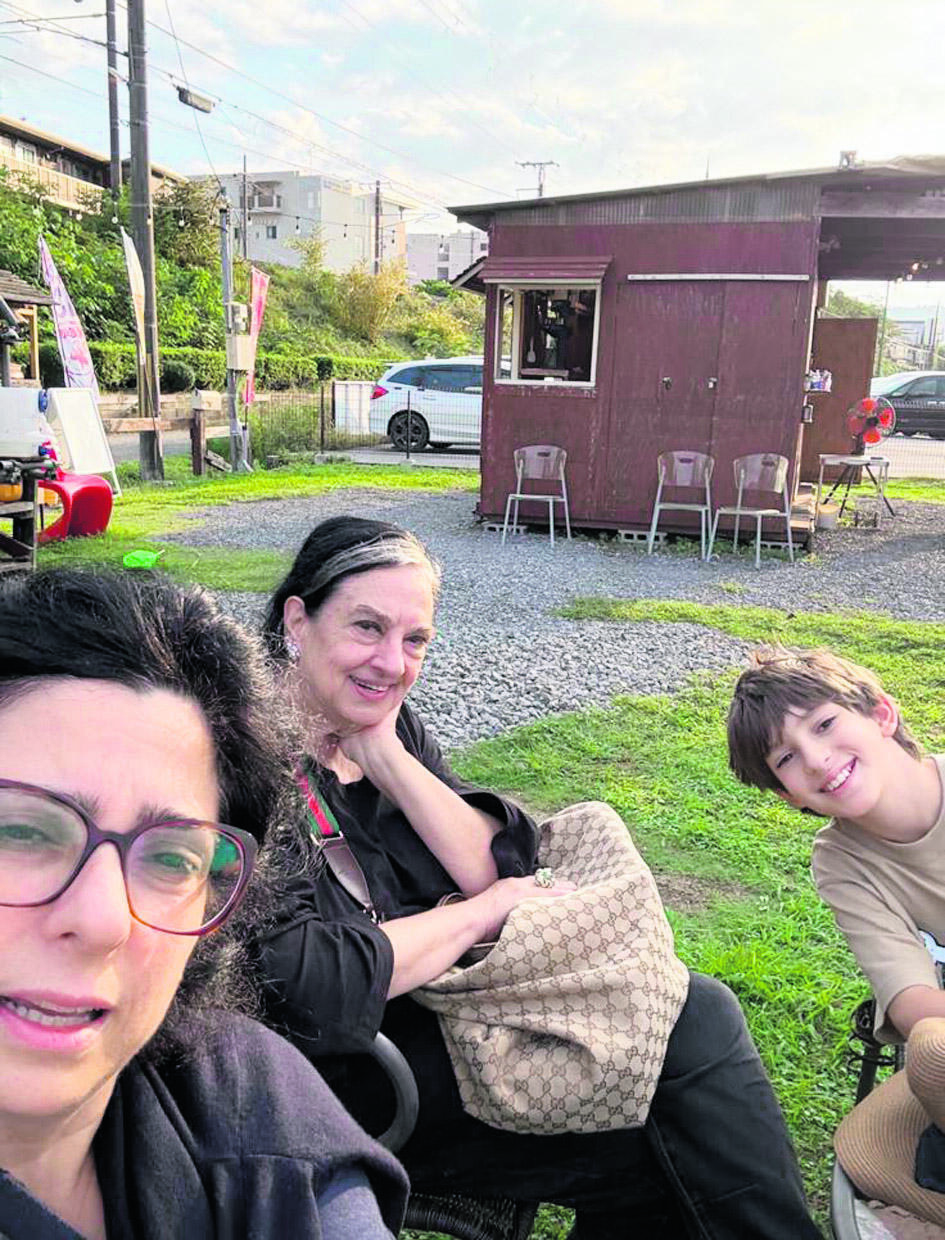
Hagar Alembik with her daughter Lee and grandson Nimrod in Japan
(Photo: Courtesy)
For a moment, her eyes cloud over. "Imagine what would have happened if we'd really been hijacked and never returned. That would have been the end of the Alembik family. There are no other Alembiks in Israel, and only a handful in the world. Our family could have been wiped out."
Alembik entered the fashion world, and eventually established the Alembika chain that bears her name, after spending time in Düsseldorf, Germany, where she had moved with her former husband, Moshe Alembik, who opened an advertising agency there. "When we were about to return to Israel, a local friend told me, 'Go study at Shenkar.' She'd seen me running from one clothing store to another. Luckily, I was accepted. I was the oldest student in my class. Everyone else had just finished their military service, while I already had a daughter in second grade who would finish school and come to another day of classes, at Shenkar. It was a pleasure for both of us."
She and Moshe divorced after 18 years, partly because of her success. "We separated because I believed in a better future, and the financial position I'd reached meant I no longer had to be afraid. Last week, he immigrated to Israel from Berlin and returned to Tel Aviv. According to him, the streets had become much more fascist, and he felt he could no longer live there."
So will your ex-husband move into the empty apartment across from you?
"Absolutely not. Besides, I've already found a kind of 'replacement' for my mother. I'm joking, of course. After she died, we adopted Tali, an elderly white dog, from SOS Animals. It was Lee's idea. She found me someone to take care of."
In the mid-1980s, Alembik was considered a trailblazer. "I was the first designer to graduate from Shenkar and build a retail chain with my own two hands, operating 15 stores. Who else was around at the time? Only Dorin Frankfurt and Raziella Gershon. I remember standing in line at the cinema and hearing a woman ask her friend, 'Have you been to Hagara's new place yet?' That's when I realized the brand had caught on. I had 15 good years, very good years.
Regular customers, and even women who didn't know me personally, named their daughters Hagar or Hagara after me. I bought a penthouse at Gan Ha'ir in Tel Aviv and filled the rooftop with plants. Life was smiling on me in a big way. But I worked alone, without any help, and I made poor management decisions until I reached the point where I lost everything."
The collapse came after she brought an investor into the business as a partner to steer the sinking ship. In an earlier interview, she told me: "He sprinkled fairy dust over me. At a certain point, I realized that my baby, the retail chain I'd built with my own ten fingers, had become a hornet's nest, and I stopped going to the office."
‘I thought: This is what death looks like’
Her daughter, Lee Alembik, 50, followed in her mother's creative footsteps and established a successful career as a costume designer, working "in cinema, on Eretz Nehederet, Israel's popular television satire show, and on the wonderful films of Ronit and Shlomi Elkabetz. She met her partner, Yaron Ashkenazi, whom everyone calls Rocco, on the set of Gett. He was the lighting technician, and Ronit brought them together. She whispered to my daughter, 'I've noticed that Rocco has noticed you, so you should notice him.' That's how their romance began. They have a wonderful relationship, and Lee has Nimrod, my wonderful 11-year-old grandson."
Both women rejected the idea of an organized tour of Japan, "so Lee took on the mission. She researched, consulted people, met with them, read and put together a dream itinerary for us. It's no simple task to keep three generations engaged for three weeks. I boarded the plane like a piece of luggage, without knowing where we'd be going, without having read anything. I trusted her."
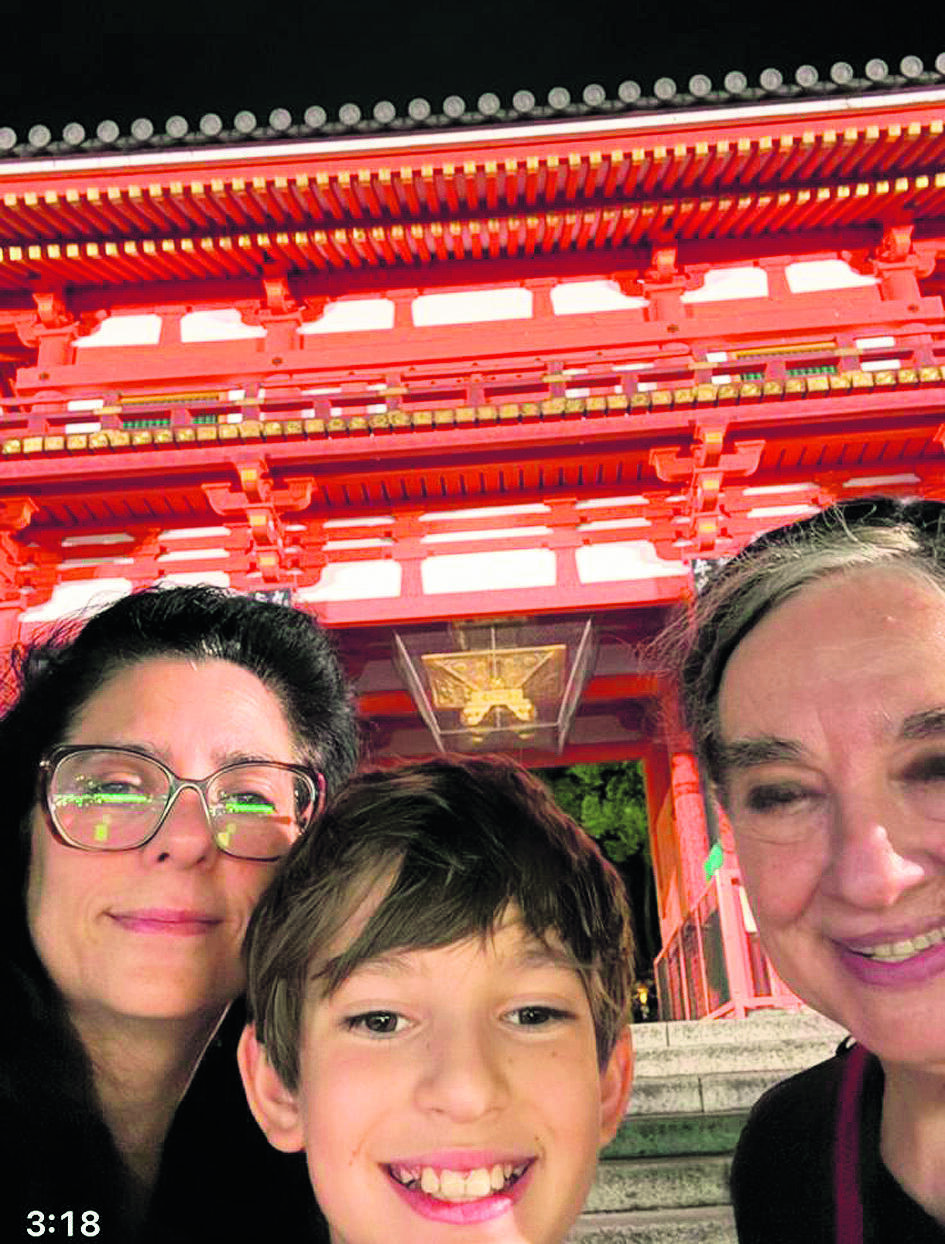
Hagar Alembik with her daughter Lee and grandson Nimrod in Japan
(Photo: Courtesy)
Why did you fly with Flydubai?
"Four months earlier, it was already impossible to get El Al tickets to Japan, so we started looking for alternative routes. Dubai was the last place on earth I wanted to visit, but the travel agent said there was a good connection. We flew premium, and it was a wonderful experience. Spacious seats, all the amenities, amazing service. On the return flight, we sat in the middle of the plane, row 17. Nimrod was by the window, Lee was between us, and I was on the aisle. On the plane that eventually brought us back to Israel, Nimrod refused to sit by the window. He wanted to sit in the middle, between his mother and grandmother. He's still struggling. He says he'll never get on a plane again. I imagine he'll get over it. In any case, I've already told Lee that I'm booking El Al tickets for the three of us for next year. Where to? Japan, of course."
Unlike her usual habit, when they boarded the terrifying return flight, Alembik did not look around to see who was sitting nearby. "I was in my own bubble. I didn't see who was behind me or in front of me, and the flight was normal until about an hour before landing. Maybe even less. I'd already started preparing for landing, organizing my belongings and folding up my newspaper, when suddenly, all at once, everything turned upside down. It's difficult for me to describe in words because it was both a physical and an out-of-body experience."
What do you mean?
"Suddenly I felt the plane plunging. There were terrible noises, and it was as though everything was spinning together. Objects weren't flying through the air, but I felt the plane making some kind of turn and plunging, then stabilizing slightly before plunging again. It was terrifying, and the entire plane was screaming. I assume we were too. There were screams like chickens being slaughtered. What I mainly remember is the three of us holding hands very, very tightly. An image from World War II flashed through my mind, a mother holding her child at the edge of a pit while a German gunman shoots them from behind. Lee says she saw the ground coming closer. I didn't, but I said to myself, 'Okay, Hagar, that's it, this is the end. What you've done, you've done. What you haven't done, you haven't done. You're here with your loved ones, and that's something too.'"
Those sound like words of farewell.
"Because I understood there was nothing we could do. If we perish, we perish. The physical sensation was terrible too. I felt as though something was exploding inside me, that my body simply couldn't withstand it anymore. Lee says it was the opposite for her, that she couldn't feel her body at all because she'd become disconnected from it."
What did you think was happening?
"I thought something had happened to the pilot. Lee thought the plane had been hit. I remember telling myself, 'This is what death looks like.' The plane kept circling for about another hour until it landed in Saudi Arabia. We were awake and aware that there was no pilot at the controls, and we couldn't understand how it would land at all. Then we started seeing men coming out of the cockpit covered in blood. One of them was absolutely drenched in blood, and someone shouted, 'We neutralized him!' Only then did we understand there had apparently been an attacker. Even before landing, the plane shook again for a moment and didn't fully stabilize, and one of the flight attendants said it was going to be a hard landing and instructed us to bend forward and put our hands over our heads. So there was an hour of sheer terror, with every worst-case scenario from the most frightening movies running through our minds. But a minute after we landed in Saudi Arabia, I calmed down."

Moments from the attempted hijacking of the Flydubai flight
How?
"We received an incredible welcome. They seated us in a spacious hall with comfortable reclining armchairs, somewhere between sitting and lying down, and served us coffee and food. In the morning, we received a light breakfast, and at lunchtime, chicken and rice. Doctors and psychologists were constantly walking among us, asking in English how they could help. In all the accounts I've seen in the media, nobody mentioned this royal treatment, and I don't understand why. I'm happy to be the first to thank them for such extraordinary hospitality. I felt they would have tried to bring down the stars from the sky just to make us happy. It was simply amazing. Israel should learn a lesson from the Saudis about how to welcome people."
After landing in Saudi Arabia, Alembik began trying to understand what had actually happened to them. "Once my breathing steadied, I started observing the passengers, making friends and approaching those who seemed to me to be our rescuers. Someone shouted, 'A round of applause for our saviors!' I asked them lots of questions. Only then did I understand that it had been the co-pilot."
The WhatsApp group created in Saudi Arabia helped the passengers exchange views about what to do next. "At around 5 p.m., someone wrote in the group, 'There's a plane that Dubai has sent.' Some passengers immediately protested. They weren't getting on it. They were afraid to fly with Flydubai and would board only an Israeli aircraft. My contribution to ending the ordeal was writing, 'There's a plane here, right now. Let's go home. This is our chance. Who knows what will happen later?' Someone wisely wrote that we could end up stuck in Saudi Arabia, and that Bibi [Prime Minister Benjamin Netanyahu] might want to exploit the situation for his own purposes, if that was a good enough reason to bring an Israeli plane there. I couldn't understand those who weren't rushing to board the plane waiting in Saudi Arabia. Who wants to remain at the center of a storm? You just want to go home."
The flight that was supposed to land in Israel at 9 a.m. finally arrived at around 9 p.m. "Rocco, Lee's partner, had already come to the airport at 7 p.m. to pick us up. Then, suddenly, the plane disappeared from the screen, and he couldn't understand what had happened. He completely fell apart. He thought that was it, that we were gone. When we finally came out, there was a line of journalists from all over the world standing in front of us, pushing microphones into our faces. What happened? What was it like? Without any compassion or attempt to offer help. I vaguely heard a woman asking me where the female power had been, because the whole incident had been built around male heroism. I don't remember what I answered her. It's possible I didn't answer at all. I couldn't believe that was what concerned her. I also couldn't believe they were keeping us there until Bibi arrived. It took him half an hour to get there. Of course I thought about all the people Bibi still hasn't come to see, even to this day."
Her gentle tone does nothing to soften the sting of her criticism. "Miri Regev told Ayala Hasson that she was prevented from responding to allegations made by Keren Turner, the former director general of the Transportation Ministry, because she's now involved in an election campaign. And what about you, Miri Regev? Aren't you worried about keeping your seat? Another broadcaster, a particularly repulsive one, said the plane was almost hijacked because the person responsible for approving foreign pilots has been sitting in his position for 20 years. Hasn't Bibi been stuck in his seat for 20 years? There are no words."
So how do you go on? What do you do now?
"Make lots of clothes. Even more clothes."
Twenty-one years ago, when detractors were taking pleasure in the fashion designer's spectacular downfall, Alembik learned an important lesson: Life goes on even when you move from a penthouse into a shoebox-sized apartment.
One person who stood by her and picked up the phone was Dr. Judy Fadlon, an anthropologist who had studied alongside her in an army teacher-training course.
"I left the course after six months because I was desperate to get married, and we lost touch. We arranged to meet for coffee, and she brought her husband, Gadi Fadlon, an accountant, along. The connection between Judy and me was immediate, and Gadi offered to help us with an attitude of 'Let the girls have fun and play.' Maybe he didn't believe how serious we were. Since then, Judy and I have been equal partners, and Gadi owns 50 percent of his wife's share. I called him from Saudi Arabia to tell him I wouldn't be coming to work that day. The two of us work at Alembika for 10 to 12 hours a day, and our partnership just keeps getting better. We work in harmony, with the joy of creating. We have 14 stores in Israel, and the 15th will open at Bilu Junction in December."
Without saying 'God willing.'
"Without."
How did Alembika survive three years of COVID and three years of war?
"We export all over the world. Our clothes carry a 'Made in Israel' label, and now there's a sense of discomfort coming from some countries. Not from the United States, thankfully, but from Europe, particularly England and Ireland. We haven't encountered anything significant, but the atmosphere is much less pleasant. This cruel war brings out a lot of evil in people, on both sides."

From Alembika's collection
(Photo: Yaron 'Rocco' Ashkenazi)
She serves me an overly generous slice of orange cake that one of her friends baked to celebrate her safe return to Israel and says that at her heaviest, she weighed 105 kilograms (231 pounds).
"Today I'm 73 kilograms (161 pounds), which is amazing, but I didn't lose it all at once. It happened in stages. About 15 years ago, I had gastric sleeve surgery and lost 10 kilograms. I weighed 95 kilograms, which was nice, but nowhere near enough to satisfy me. And like most women, I was an accordion. I'd lose weight and gain it back."
Did you want to lose weight for your appearance or for your health?
"Mainly for my health. A friend connected me with an amazing doctor, Dr. Maya Ish-Shalom, an endocrinologist, who opened the door to the world of injections for me. Four years ago, I started with Ozempic, and over time I switched to Mounjaro. And what can I say? Wonders of wonders. It's not just that I happily eat less because I'm full. The injections gave me complete freedom from constantly thinking about food. There's no more 'What should I buy for lunch?' I don't cook anymore either. I eat only when I'm hungry, and I don't need large quantities."
Have weight-loss injections reduced demand for larger clothing sizes?
"Absolutely. It started in the United States and spread across the world. Women are shrinking everywhere. That doesn't mean you can no longer find dresses in XXL. It's not black and white. Fashion houses continue producing clothes in all sizes, but the difference is noticeable in the quantities. In Israel, as elsewhere, the bestselling clothes are in sizes 2 and 4, corresponding to sizes 38 and 40. To me, this is a socioeconomic and cultural phenomenon. The women who've lost weight thanks to the injections are conscious of their health, they're connected to the here and now, and they can afford the expense. These are all things that tell you something about the profile of my customers."
At 71, aren't you thinking about retirement?
"Every single day, I give thanks for so many things. I'm grateful for my work, grateful that I find it interesting, grateful that I'm having fun and that it excites me. I'm also grateful for my family, for my loved ones, for everything that can't be taken for granted."
At a Friday night family dinner, she heard her grandson Nimrod say, "I was thinking that at some point we all have to die. Everyone dies eventually."
In response, she sent him a moving WhatsApp message. "My Nimrod, on our trip to Japan, I discovered a curious, intelligent and mature grandson. Not that I didn't know that before. I enjoyed being with you and sharing experiences with you so much. The ending was straight out of a movie, but the three of us were more together than ever. We went through an indescribable brush with death, and we were also born again. So come on, here's to life."
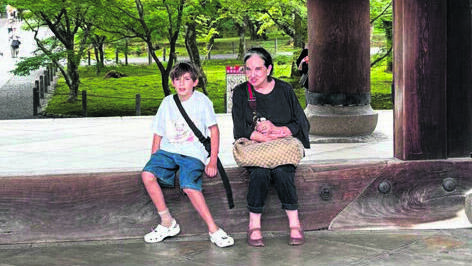
Hagar Alembik with her grandson Nimrod in Japan
(Photo: Courtesy)
Has anything changed in you since the flight? You haven't discovered spirituality or God?
"Since we returned to Israel and came home, I've been sleeping very well. Lee less so. She's taking it harder than I am. God isn't part of my language. I'm living fine, I'm living peacefully, I'm living. I don't need to call on God for every problem."
Her collections are remarkably colorful, but even after losing nearly a third of her body weight, Alembik remains loyal to black. "When I was young, I dressed in colors all the time. I remember having pink clothes and loving the all-over look, pink shoes and a pink shirt. After I graduated from Shenkar, I started wearing black. That was also when I started gaining weight."
Does black make you look slimmer?
"No, it absorbs and conceals. Now, in Japan, I came across something I've never seen anywhere else in the world. In large, prestigious department stores, there are entire sections devoted exclusively to black clothing. I couldn't understand the thinking behind it. I'll ask ChatGPT."