

When a residential building takes a direct missile hit, the result is total chaos: shattered concrete, severe trauma and uncertainty over who may still be trapped inside.
For analysts in the Home Front Command’s Information Collection and Analysis Branch, however, that chaos becomes a source of operational data.
Gallery
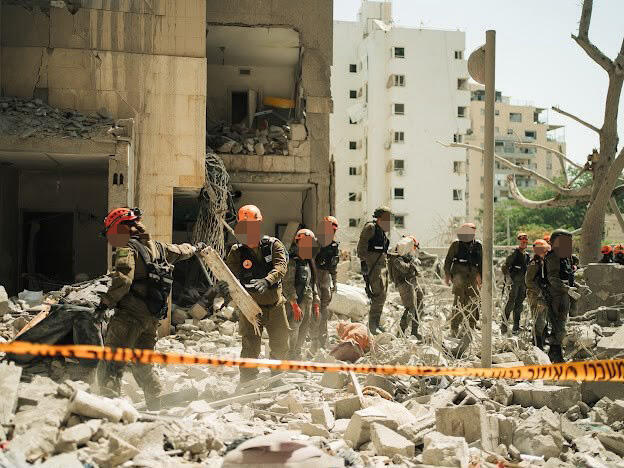
Rescue Brigade troops at the scene of a direct hit by an Iranian missile in Bat Yam
(Photo: IDF)
As Israel once again faces heightened tensions and prepares for the possibility of another campaign against Iran, attention is turning to the readiness of the civilian home front.
Any renewed conflict is expected to test national resilience through heavy missile barrages, large-scale launches and advanced threats requiring an immediate technological and operational response.
While search-and-rescue troops make their way to a strike site, the branch’s soldiers begin weaving together a dense network of information and building a potentially life-saving digital file on the damaged structure.
Each incident receives a detailed file containing the latest available information: the scale of the damage, who is registered as living in the building according to state records and the potential consequences of the strike.
The goal is to ensure that rescue teams arrive already familiar with the site and able to operate according to precise information.
In a rare first interview, Lt. Col. N., commander of the branch, said the unit is built around a core group of about 30 young soldiers specializing in programming and data analysis. In an emergency, it expands to roughly 50 reservists.
“Our work is divided into four areas,” she said. “The first is the ‘target file,’ which concentrates all the information on a damaged building and is constantly updated.
“The second is work in the command center, which receives information, remains in contact with the police and emergency services and creates three-dimensional models of the destruction site.
“The third is operational products, meaning tools produced in real time, such as the maps we created during Operation Roaring Lion showing the dispersal of cluster munitions.
“The fourth is infrastructure, which includes responsibility for cloud systems, expanding storage capacity and protecting the information.”
Acting immediately
N., a trained software engineer, entered the role in October 2025 after many years in the Military Intelligence Directorate.
She said the work carried out by the branch can directly save lives.
“In one case that I am not permitted to describe in detail, forces found a family at a destruction site with great precision after moving through the ruined building according to instructions based on our information,” she said.
“We were able to guide them all the way to the point where the family was located.
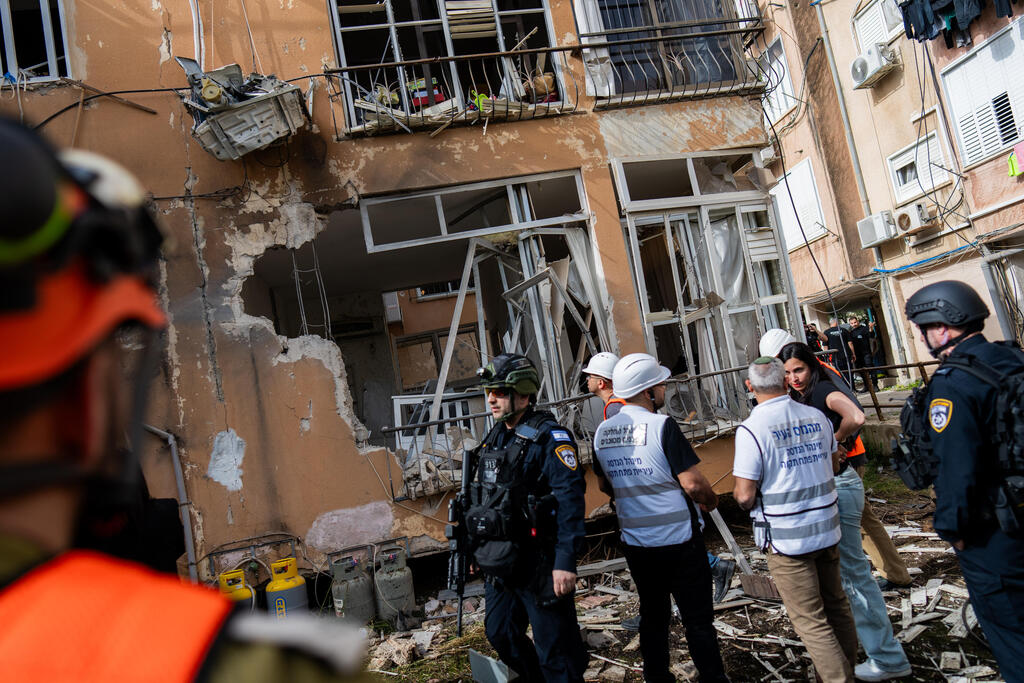
Damage at the scene of an Iranian missile strike in Petah Tikva during Operation Roaring Lion
(Photo: Erik Marmor/Getty Images)
“Because of the information we gather, forces in the field can search more efficiently while reducing the danger to trapped civilians. We learned to work quickly because we have no alternative. Within only a few minutes of an incident, we can provide the fullest possible picture.”
The digital file is sent directly to commanders’ screens in the field.
“As soon as the commander opens it, all the information appears,” N. said. “That includes photographs, weapons or munitions at the site, the location of protected areas and the number of residents. Everything is designed to allow the forces to act quickly.”
The artificial intelligence challenge
The spread of artificial intelligence across social media has also created new difficulties for the unit.
“Fake videos circulating online make our work harder,” N. said. “We carry out a filtering process and extract the relevant details from the information.”
She recalled a critical incident during Operation Roaring Lion in which she was involved.
“When a missile disperses submunitions, all the smaller bombs must be found,” she said. “From the computers here, we were able to direct the forces toward unexploded munitions.
“Think about what it means to take responsibility for a scene containing dozens of small bombs and then declare that the area is clear.”
Beyond its work at damaged buildings, the branch also provides the political leadership and the head of the Home Front Command with the situational picture used for some of the most consequential decisions during wartime.
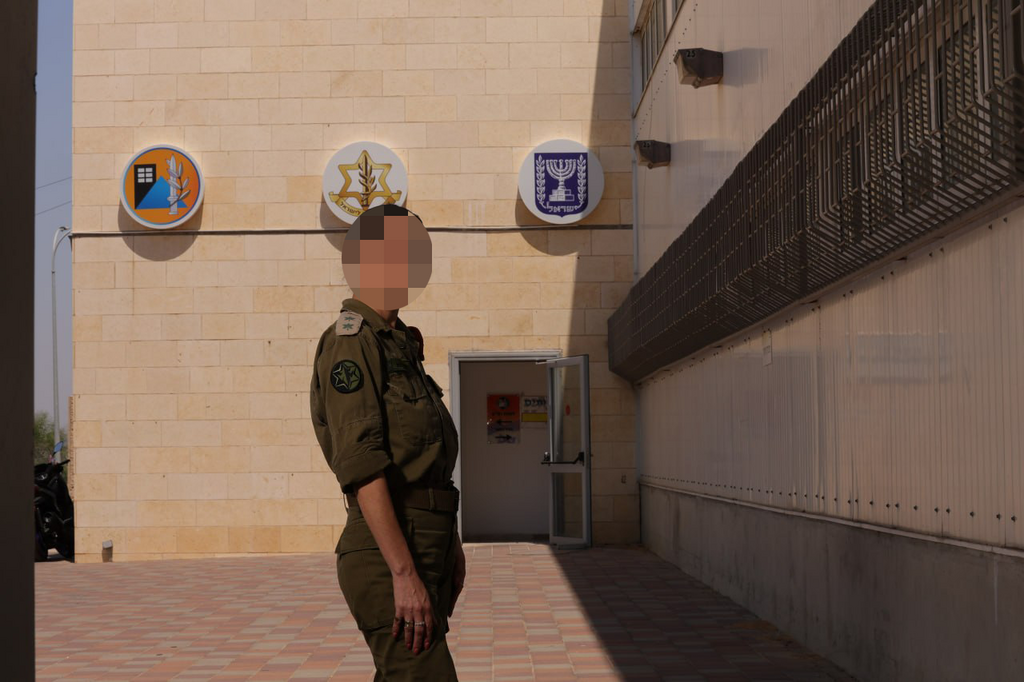
Lt. Col. N., commander of the Information Collection and Analysis Branch
(Photo: Orel Cohen)
Those decisions include when to reopen the economy, whether schools should operate, whether public performances can be held and where gatherings should be permitted.
N. described the reasoning behind the branch’s recommendations.
“The easiest thing is simply to close the entire economy, especially during a short campaign,” she said.
“If you know you are entering a campaign that you initiated and that is expected to last only a few days, the economic damage will probably not be too severe. Closing things down can be done relatively easily when the main consideration is saving lives.
“But that logic collapses when the campaign becomes prolonged. In a 40-day campaign, like Operation Roaring Lion and as could happen in the next one, you no longer have that luxury.”
She said the key to proper analysis lies in identifying the right questions.
“The secret of accurate information analysis is the ability to refine the data and ask the correct questions,” she said. “When you do that, the information needed for the decision will emerge. We analyze an enormous amount of material and formulate recommendations accordingly.”
Measuring public anxiety
Another central operational task is assessing public resilience and levels of anxiety.
The branch conducts detailed analysis aimed at identifying stress in specific communities.
“We analyze many different indicators,” N. said. “Among other things, we look at compliance with instructions, supermarket purchases and vehicle movement.
“For example, in one community, when the instructions were tightened, we saw a large flow of vehicles leaving the area. That indicated a certain level of anxiety. Everyone was fleeing, and the information had to be made accessible.
“The same applies to shopping. In some places, we saw supermarket purchases rise by hundreds of percent within a day or two as people rushed to buy supplies in panic.
“All of these indicators are analyzed together to form a broader picture, allowing us to tell decision-makers: ‘Here we are seeing signs of anxiety.’”
N. spoke cautiously about the Iranian threat.
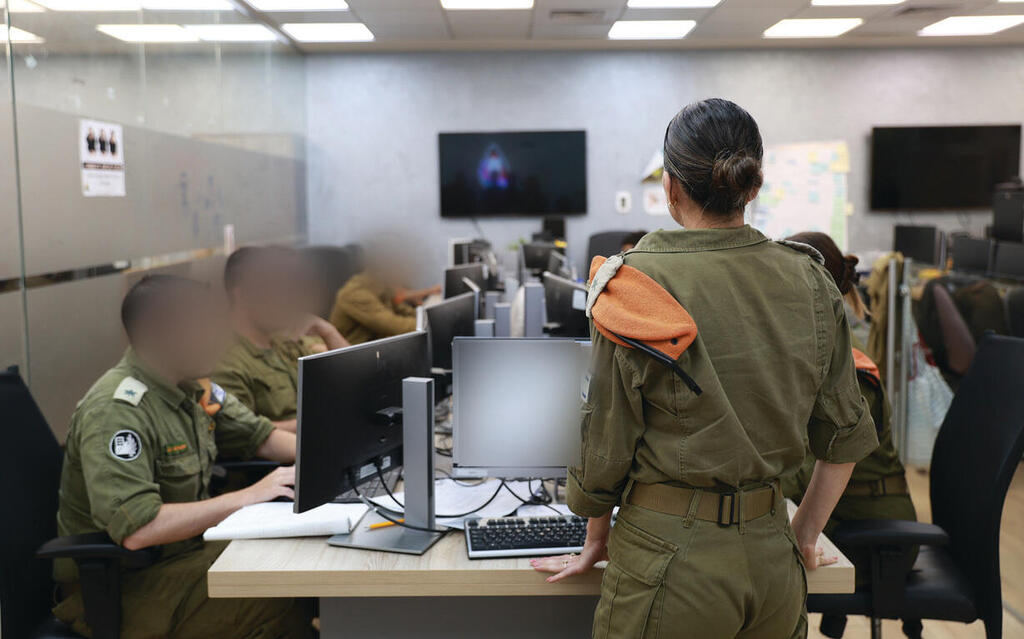
(Photo: Orel Cohen)
“The enemy studies us,” she said. “It is highly capable and changes its methods as events develop.”
She also addressed decisions by some mayors to open public shelters even without instructions from the Home Front Command.
“There are authorized bodies that know how to make these decisions, and ultimately responsibility lies with the Home Front Command,” she said.
“If a local council head suddenly decides independently to open shelters where it is not necessary, that could damage residents’ resilience. It could also be interpreted incorrectly by the enemy.”
The demanding role follows N., a mother of three, into her private life, where relatives and friends try to interpret her every move for clues about when the next campaign may begin.
“Everyone asks me, of course, whether there will be a strike in Iran and when it will happen,” she said with a smile.
“I do not always know, and I am not always allowed to say. But it reaches levels that are hard to describe.
“In one case, we had arranged to eat Friday night dinner at my mother’s house, but at the last moment we could not go for unrelated reasons. My mother’s sister heard that we had canceled and immediately ran to the supermarket to buy toilet paper and water.
“And there was nothing happening, all right?”