

Michal Gabay’s first attempt to return to work after months away lasted about an hour. “I collapsed,” she recalls. “After that, I didn’t go to work for a week. I saw that it was destroying me.” Her second attempt ended much the same way.
This was months after the hope that her daughter Shani, who worked as a security screener at the Nova music festival and was listed as missing for 47 days after the October 7 Hamas massacre, might return home before her body was identified.
Gallery
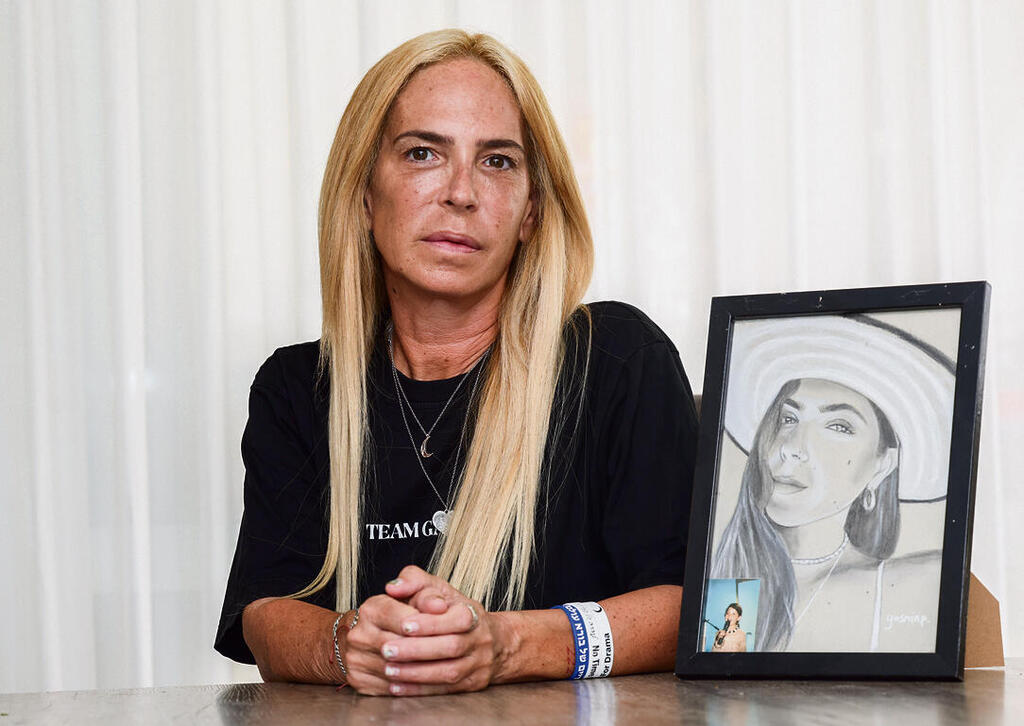
Michal Gabay. “We’re lost, we’re not functioning, and there’s no one to help us get back on our feet”
(Photo: Gil Nechushtan)
The uncertainty and fear were replaced by grief and pain that have never gone away. Nearly three years later, Gabay says time has done little to change that. “It isn’t something that passes,” she says. “There’s no set time for it. I wish there were.”
That pain has also made returning to work extraordinarily difficult. Before October 7, Gabay worked as a payroll accountant for the Yokneam municipality, a demanding, high-pressure job. “Shani would always tell me, ‘You’re killing yourself at work. You never think about yourself,’” Gabay recalls.
When she tried to return, she quickly realized she could no longer manage the work as she once had. Another employee had taken over the payroll position, leaving Gabay only to assist where she could, but even that proved overwhelming. “My brain goes blank. I don’t remember anything,” she says. “I used to do a million things, and now if I have one task, I panic.”
The mortgage payments, meanwhile, have not disappeared, while retraining for a new profession feels like an almost impossible hurdle.
‘The system expects you to move on’
Officially, Gabay is still employed. “My workplace is doing a lot to keep me,” she says. She tries to go in whenever she can, but that happens rarely: a few hours here, a few hours there. Her vacation and sick days have been exhausted, and her salary reflects that.
Her heart and mind are elsewhere, with Shani and with the talks she gives voluntarily in her daughter’s memory. “That’s what helps me lift my head off the pillow and keep functioning,” she says.
For a long time, Gabay believed her inability to return to a normal working routine was unique to her. Gradually, she discovered that she was far from alone. “There are people who aren’t working, or were fired, or moved to something that requires only a few hours a day,” she says. “And I realized that maybe I’m not the abnormal one.”
“We’re lost. We’re not functioning, and there’s no one to help us. No one helps parents who can’t get themselves back on their feet and return to the workforce.”
Gabay’s experience is reflected in findings from a new study by the Israel Institute for Occupational Safety and Hygiene examining employees directly affected by October 7 and the war that followed and the impact on their occupational health and safety.
The study surveyed nearly 600 people, including bereaved families, people who lost relatives, families of wounded people, reservists who served for extended periods and residents of communities near the front who were evacuated or remained under rocket fire and repeated alerts. Their responses were compared with a control group whose members had not been directly affected by the war.
While the psychological toll of the war has received broad public attention, its employment consequences have been discussed far less, as have the institutional responses available to those struggling to return to work.
The study found that people directly affected by the war were absent from work for longer periods and were much more likely than the control group to change positions or quit their jobs entirely. In some cases, workers resigned after feeling that their employers did not understand or support them. In others, the trauma itself changed their priorities. Often, the two factors overlapped.
“No matter how hard I tried to return, I realized I simply couldn’t,” says Miri Pines, whose daughter, Border Police officer Kim Dukarker, was murdered at the Nova music festival on October 7. Pines went back to her administrative job at a high school about two months later, but quickly found that returning to routine was far harder than she had expected.
“The system expects you to move on, to perform like any other employee,” she says. “That’s understandable. But you’re not really there. You’re not like everyone else. It feels as though the world has come crashing down on you. I just couldn’t keep going.”
Attempts to cut back to half-time or work some hours from home also proved unsuccessful. About 10 months later, Pines resigned and has since devoted herself to preserving her daughter’s memory. “You tell yourself, ‘I’m giving my time to other people instead of focusing on my daughter who was killed, on commemorating her,’” she says. “That’s how I see it.”

Miri Pines with her late daughter Kim
“The common assumption is that returning to routine is the healthy thing to do, and in some cases that’s true,” says Dr. Marganit Ofir Gutler of the Israel Institute for Occupational Safety and Hygiene, who conducted the study with Dr. Laliv Egozi and Maor Kalfon Hakhmigari, but it needs to happen in a tailored and informed way.”
The study focused in part on the occupational health of people affected by October 7 who had returned to work. It found they were at greater risk of burnout, sleep problems and negative emotions. About half also said that since returning to work, they were less likely to follow required safety procedures, a significantly higher rate than in the control group.
“People need a return-to-work path that is tailored specifically to them,” Ofir Gutler says. “That’s something no human resources course teaches you.”
‘The state needs to develop solutions’
The study found that many employers did try to support workers affected by October 7 and the war, offering greater flexibility, additional leave and other accommodations. Still, about one-third of respondents said they received no special adjustments at all.
“There is goodwill and genuine concern, but the study also points to serious difficulties that will affect both employees and workplaces for a long time,” Ofir Gutler says.
The researchers argue that goodwill alone is not enough and that both the government and employers need a more structured response. “It isn’t enough to tell employers, ‘Be attentive,’” she says. “The state needs to develop concrete solutions, provide resources and help organizations deal with this.”
One proposal is to introduce legal workplace protections for people coping with trauma, similar to safeguards already provided in other personal circumstances. The researchers also recommend creating a mechanism to assess whether trauma survivors are fit to return to high-risk jobs, such as working at heights or professional driving.
The researchers also recommend that employers develop clear internal policies for supporting workers dealing with trauma and returning to the workplace. “The challenges of returning to work can last a long time, and recovery isn’t linear,” Ofir Gutler says. “A trigger can suddenly bring everything back and cause a major setback. Right now, many workplaces simply don’t know how to handle situations like this.”
The study also highlights the difficulties facing military reservists, particularly those who spent very long periods away from their jobs. Abrupt transitions between combat service and civilian work, extended absences, the toll of service and the burden placed on spouses and partners were among the issues raised in the survey and interviews.
“Sometimes an employer expects you to immediately get back on track, but it’s difficult,” says Roshel Moshayev, a combat reservist who has spoken publicly about the challenges facing reservists. “In combat service, you experience your greatest fears, and then when you return, you’re expected to start talking about clients and deadlines. It takes time to adjust.”
Moshayev also changed careers between reserve deployments. “I worked in a job where if you weren’t available, you didn’t exist,” he says. Eventually, he left and became self-employed. “I realized it was too much,” he says, though he stresses that reserve duty was only part of the reason. He had also begun to feel that he had exhausted what his previous job had to offer.
Moshayev is skeptical that stronger legal protections against firing reservists would solve the problem, arguing that they could make employers more hesitant to hire reservists. Still, he believes there are other ways to provide meaningful support.
Reservists, he argues, should have a designated point of contact they can turn to after returning from service to raise concerns and seek support. “There should be someone reservists can turn to, just as workplaces have someone responsible for handling sexual harassment complaints or overseeing safety,” he says.
He also believes the state should offer financial incentives to small businesses where a significant share of employees serve in the reserves, particularly in combat roles.