

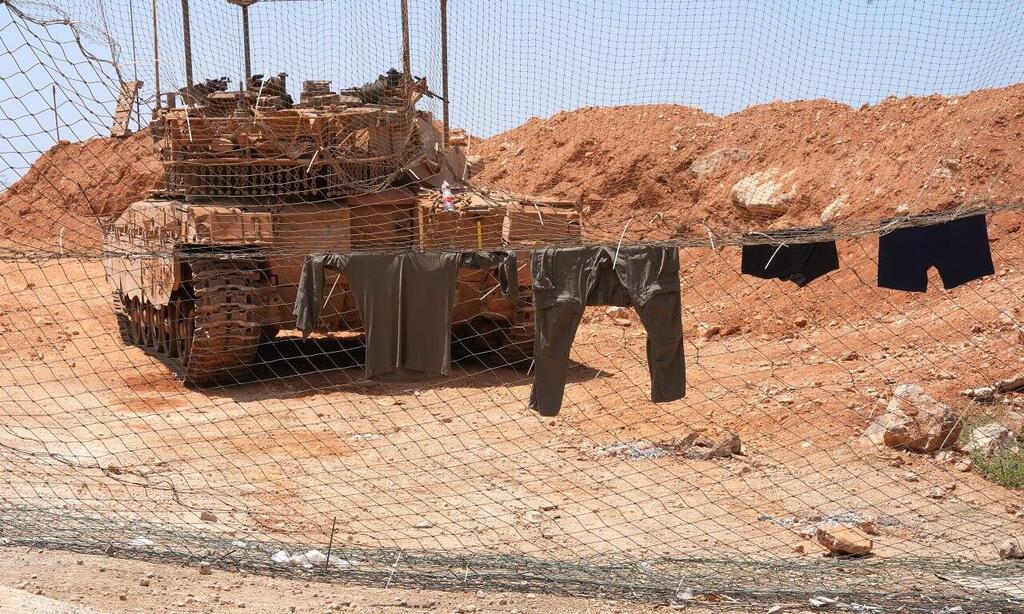
Through the netting stretched above the “New Vered” outpost, an improvised defense against explosive drones, the Lebanese landscape is breathtaking. Agricultural fields, some of them scorched, spread across the valley below.
Directly ahead lies the Shiite town of Khiam. To the right rises Mount Hermon, dry and free of snow, while Beaufort Castle can be seen on the horizon. Lebanese flags are painted on the concrete blocks inside the outpost, but until less than two years ago, it was not the Lebanese army that occupied this position.
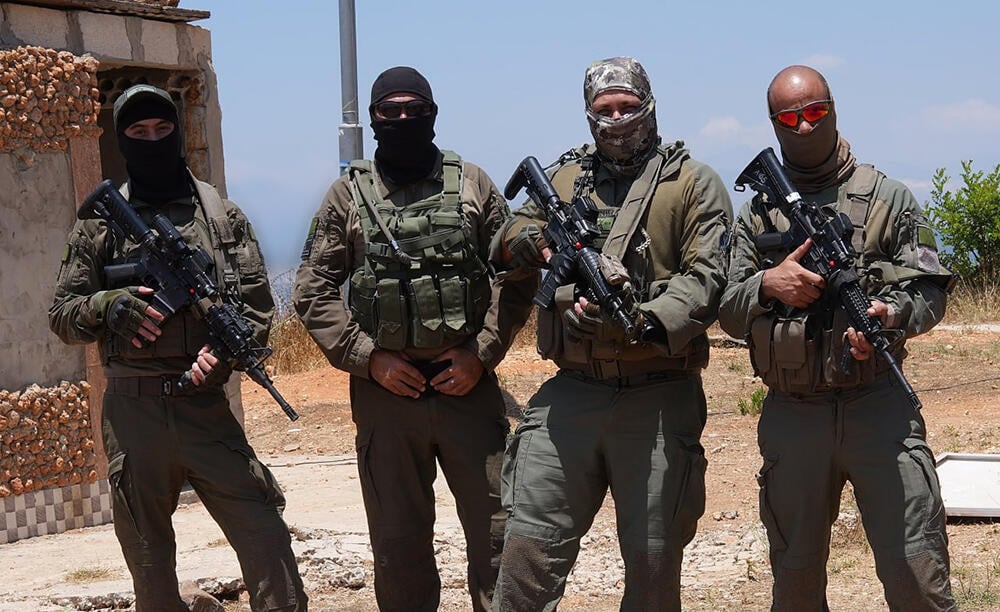
It was Hezbollah. We are standing at the observation post with Lt. Col. H., the tracker officer of the 810th Mountains Brigade, as he explains the brigade’s depth sector around Mount Dov.
‘The doctors told me I was crazy’
H., 40, is a Bedouin from the northern village of Eilabun, where he grew up and still lives, though most of his military service was spent in southern Israel. In his previous position, he served as tracker officer for the Paran Brigade along the Egyptian border. During the June 3, 2023, shooting attack near Mount Harif, in which three IDF soldiers were killed, H. was part of the force that killed the terrorist. Several months later, on the afternoon of October 7, he was seriously wounded in the battle for Kibbutz Holit.
“We charged together with Liran Almosnino, of blessed memory, a fighter from the Peled team defending the Gaza border communities,” H. recalled. “Liran was shot and killed on the spot, and I was hit by four bullets that shattered both of my legs.” One of the bullets remains lodged in his body. “It is close to a blood vessel, and removing it was considered too dangerous,” he said, showing an X-ray image on his phone. He then showed another photograph, taken a week before he was wounded near Kerem Shalom, in which he is embracing his close friend, Col. Asaf Hamami.
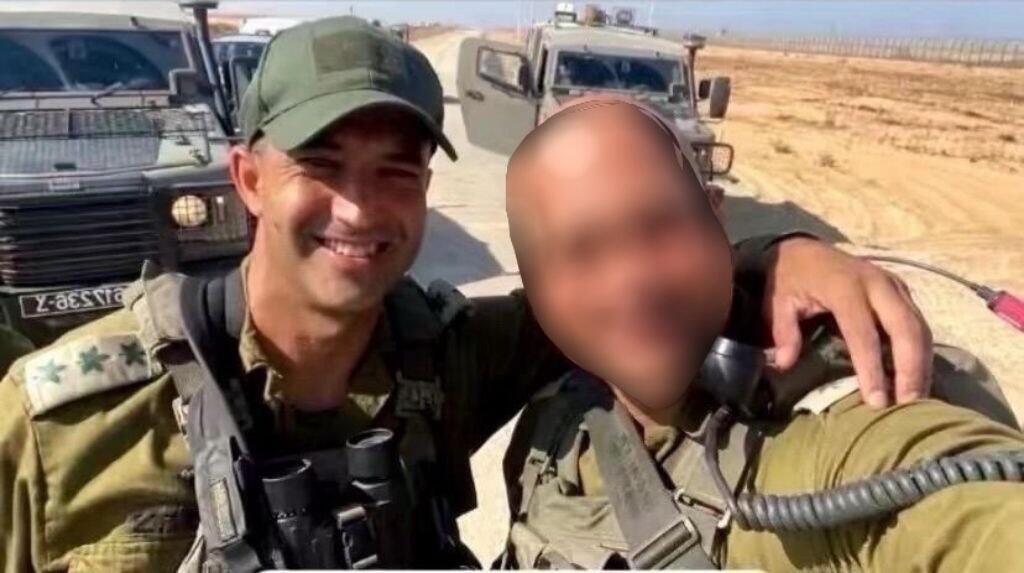
Lt. Col. H. with Col. Asaf Hamami
(Photo: IDF)
H. was still in hospital when he learned that the commander of the IDF’s Southern Brigade had been killed in battle and his body taken to Gaza. The emotional pain, he said, overshadowed his physical wounds. “I cried. I could not believe it. What a person. What a brigade commander. A role model for everyone who knew him.”
H. spent three months in hospital, first at Soroka Medical Center and later in rehabilitation at Emek Medical Center in Afula. “I have metal plates in my legs. I could have stayed home, but it was obvious to me that I would return to service,” he said. “I love this country. I am part of the people of Israel. That is how I was educated and how I grew up.” His grandfather served in the Palmach’s Bedouin unit, known as the Pal-Heib, and took part in defending northern communities during the War of Independence. A cousin who also served as a tracker was killed in Lebanon’s former security zone in the 1990s, while all of H.’s brothers serve in the security establishment. “So how could I stay home?” he said.
The doctors were less enthusiastic about the idea. “They told me, ‘Are you crazy? There is no chance.’ I told them, ‘Guys, you are not going to stop me. I am going back. I do not care about anything.’ Eventually, they agreed.”
Following the tracks
The 810th Mountains Brigade was established in March 2024 under the 210th Division. It is responsible for the Mount Hermon and Mount Dov sectors, the latter previously under the 91st Division. “I came for an interview with the brigade commander while I was still limping and in terrible pain,” H. said. “He offered me the chance to establish a brigade tracker unit and command it. I have been here ever since.”
Eleven trackers serve under his command, all of them Bedouin. “It was important to me to bring trackers who fought on October 7, who had been in Gaza, who had been wounded and had people killed beside them, and who had operated alongside commanders on the front line,” he said. “Not just trackers, but combat soldiers in every sense.” The approach, he said, has worked. “You see the trackers here first thing in the morning, opening the routes before everyone else to make sure there are no explosive devices. They arrive with the battalion commander at every incident in the sector, accompany the brigade commander during operations in villages beyond the border and take part in every mission.”
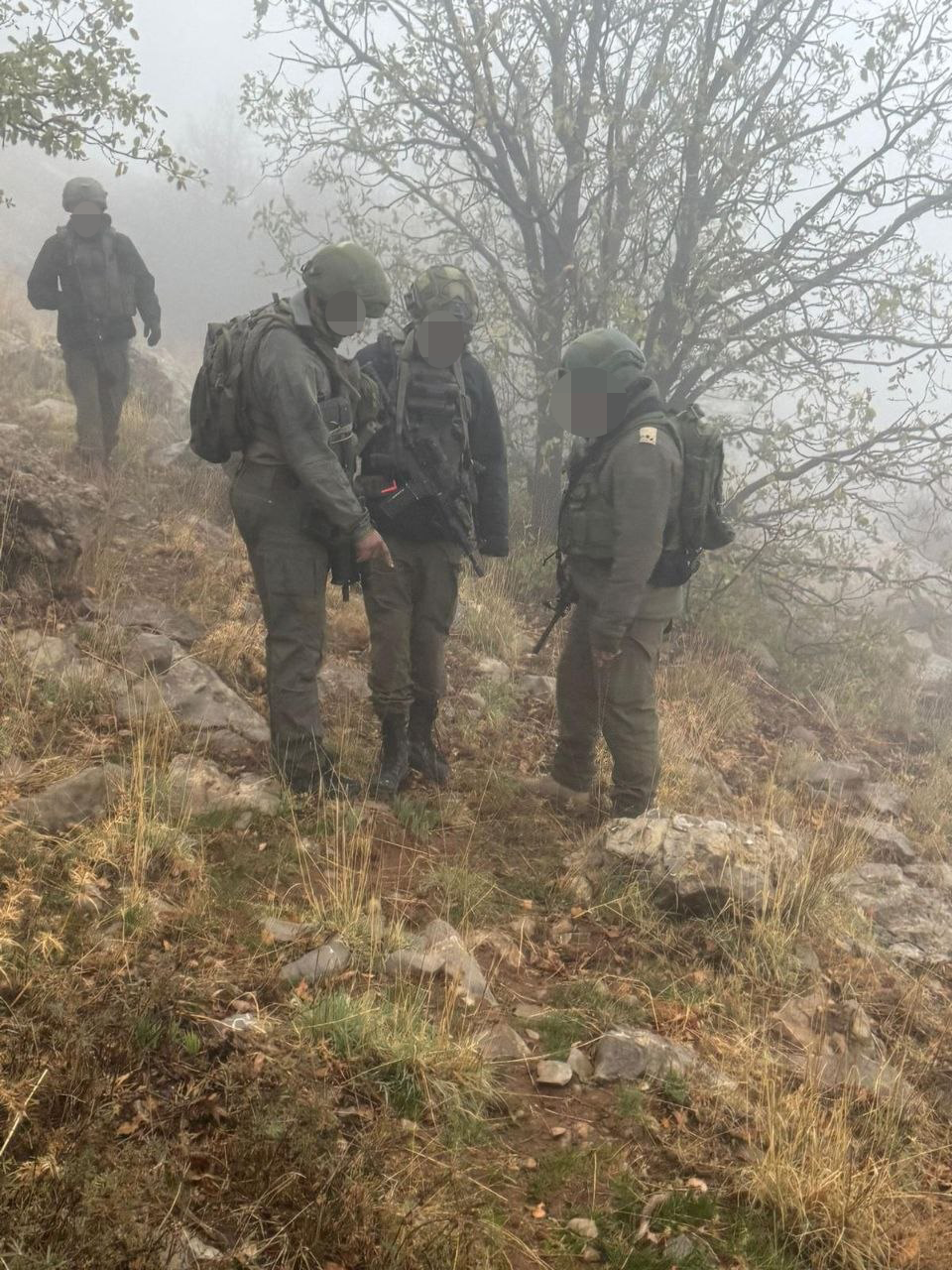
(Photo: IDF)
We met three of them at the New Vered outpost inside Lebanon, several hundred meters from the virtual border. There is no physical fence in the Mount Dov sector, making the tracker’s work even more difficult. One of their primary tasks is identifying infiltrations into Israeli territory.
Master Sgt. M., 38, is married with four children and has served in the military for 17 years. He also served in the Paran Brigade and took part in the battle in which his commander, H., was wounded. “We fought in Sufa, Holit, at the Kerem Shalom crossing and along Route 232 until we managed to overcome the terrorists,” he said. Today, he serves as the tracker for the battalion responsible for the Nahal Sion sector. Until recently, the area was held by a Givati battalion. It is now held by a reserve infantry battalion.
Sgt. Maj. R., 34, also served in the Paran Brigade’s tracker team. On October 7, he fought alongside Lt. Col. Or Ben-Yehuda, commander of the Caracal Battalion, and helped rescue troops from the Nahal Brigade’s reconnaissance unit who were trapped at the Sufa outpost. Reserve Sgt. Maj. S., 40, is married and a father of four. He previously served as a tracker in the 877th West Bank Division and the 143rd Gaza Division. “I came to finish my reserve duty, and then Lt. Col. H. told me, ‘Come with me to the 810th Mountains Brigade,’” he said. “I have been here ever since, almost two years. This is my first position as a tracker in the north.”
Despite the terrain being entirely different from the southern landscapes they knew, the trackers of the 810th Mountains Brigade have already recorded a series of operational successes. During one mission, the brigade commander dispersed the trackers across the area and asked them to search for missile launchers. “One of the trackers noticed something unusual inside the vegetation,” H. said. “He moved forward and discovered a tripod for a heavy machine gun that had been aimed at one of the northern communities.”
R. uncovered something even more dangerous during another operation. “We joined one of the forces, and during the searches I identified an explosive site ready for activation, with wiring and everything,” he said. “We reported it to the battalion commander, and a bomb disposal team arrived and neutralized it.” M. said R. had insisted on walking first and had spotted the device before the rest of the force reached it. “If R. had not insisted, the explosive would have detonated against the troops,” H. said. “He saved lives.”
S. described a similar incident on a foggy night, when an alert was declared over a possible terrorist infiltration. “We went out with the deputy brigade commander, followed the tracks and discovered an explosive site,” he said. “A bomb disposal team arrived the next day and blew it up.” When the IDF took control of the New Vered outpost, M. was responsible for making sure the area had been cleared. “As trackers, we have to certify that the location is 1,000% clean,” he said. “During the searches, we found a Hezbollah camera that had been monitoring the area.”
Iranians at the border
About a year and a half ago, S. said, three suspicious figures were spotted approaching the border. “It was 4 a.m., under extremely heavy fog,” he recalled. “A Zik drone that was in the air took out all three of them, and M., the brigade commander, the battalion commander and I went to recover the bodies. When we examined them, it turned out they were Iranians who had been working with Hezbollah.”
“They had Iranian passports, with entry stamps for Lebanon,” M. added.
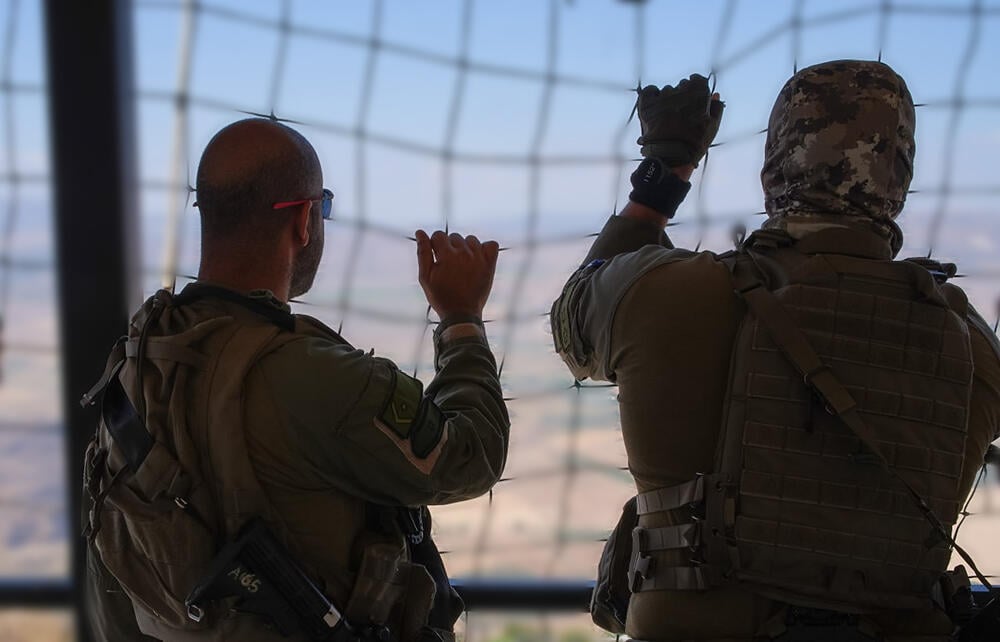
(Photo: Efi Shrir)
Reports have said that after the November 2024 ceasefire in Lebanon, Iran’s Islamic Revolutionary Guard Corps sent about 100 officers to the country to help rebuild Hezbollah. Those officers reportedly oversaw the terrorist organization’s rearmament and the training of its personnel. They also helped redesign its command structure, which had been exposed by Israeli intelligence, making it more decentralized and less hierarchical than before.
As a result, Hezbollah is now effectively composed of numerous smaller units, with knowledge compartmentalized between them to preserve operational secrecy. As part of that effort, Iranian officers and Hezbollah also planned coordinated attacks against Israel from Iran and Lebanon, plans that were reflected periodically during Operation Roaring Lion. The Lebanese government later demanded that IRGC personnel leave the country.
The trackers’ testimony marks the first disclosure that Iranian personnel had reached the immediate vicinity of the Israeli border and that some were killed in Israeli strikes against terrorists operating along it.
A Star of David on the patch
H. enlisted in the IDF’s Bedouin Reconnaissance Battalion and served there until becoming a company commander. Only afterward did he become a tracker. “There is an enormous advantage to someone who has spent more than 20 years in the military, lives the sector and knows every stone,” he said. “Battalions rotate, but the people who know the area better than anyone are the trackers.”
“There is no replacement for the tracker walking in front,” he added. “Not high-tech, not AI, nothing.” Before October 7, he said, trackers had been pushed farther back, route-opening missions had been canceled and positions had been cut. “That must never happen again.”
(Photo: Efi Shrir)
M. said the 143rd Gaza Division once had 120 trackers. “Then came the cuts under the Gideon Plan, and they cut us by half,” he said. “After that came another reduction, and on October 7 the division was left with 35 trackers, maybe 40.”
The men are frontline combat soldiers, but they say Israel’s Nation-State Law turned them into second-class citizens. Despite that, H. remains optimistic. “No law will separate us from the people of Israel because we are part of them, and true Judaism accepts the other,” he said. “I looked death in the eyes. I was almost in the grave, and here I am choosing to return and serve this country.”
He pointed to the Iron Swords patch attached to his vest. “Look, I have a Star of David on the patch,” he said. “Since October 7, the members of Kibbutz Holit invite me every year to light a Hanukkah candle with them.”
Since recovering from his wounds, H. has also visited Bedouin schools and encouraged students to enlist. “I tell them, ‘I am Lt. Col. H., a member of the Bedouin community, and I am calling on you to join the IDF,’” he said. “And they enlist. They send me photographs from the army. That is why I believe with all my heart that things will be good.”