

When people say “it stays in the family,” they usually mean loyalty or shared responsibility. For the Farkash family, it also means responding to medical emergencies together.
Seven siblings — Avraham, Rivki, Shlomi, Meir, Leah, David and Elisha Farkash — all volunteer with Magen David Adom, Israel’s national emergency medical service, in the Jerusalem region. Leah’s husband, Elazar, is also a volunteer. The commitment spans generations: Avraham is 41, while the youngest sibling, Elisha, is 19.
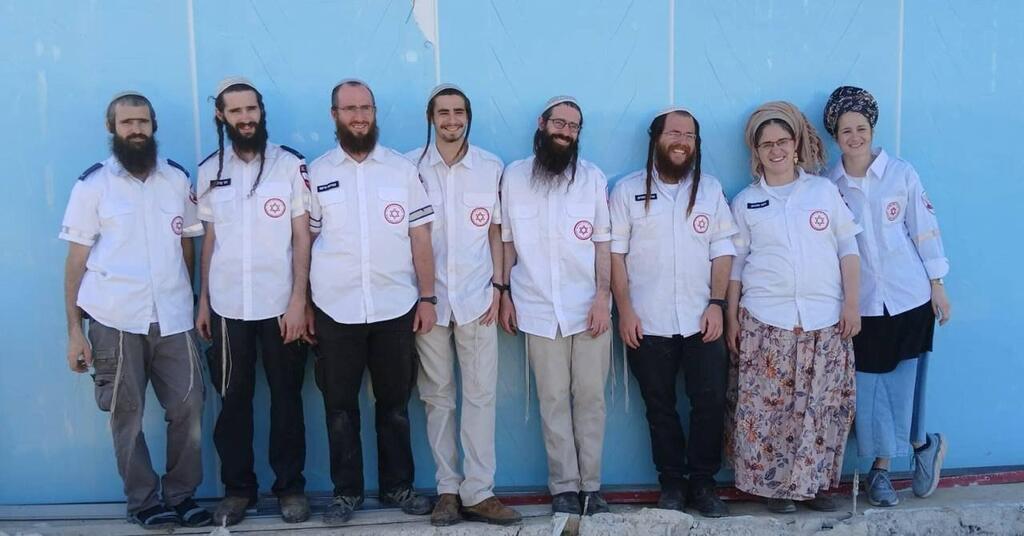
“The first were Avraham, Shlomi and Meir, who have been volunteering for many years,” Leah said. “In recent years the rest of us joined, each at a different time, without coordinating with one another. It turns out we all caught the volunteering bug.”
David, 25, said the siblings maintain a private family paramedics group chat. “When someone has a dilemma or a question, we feel comfortable sharing it discreetly,” he said. “And of course, it’s also a place to unload. It’s a kind of support group.”
Avraham, the eldest, said they were raised in a home built on values of giving and helping others. “Through this volunteering, I advise my brothers and sisters when needed, and I hope we continue to save lives,” he said.
With so many family members on duty, they sometimes find themselves at the same scene. When they hear over the radio that a sibling has been dispatched to a complex incident, they quickly offer assistance.
Shlomi recalled one of his first calls as a newly certified medic about 15 years ago. “Avraham and I were dispatched together to a serious accident — the most complex event I had encountered up to that day,” he said. “Avraham was professional, and I learned a lot from him during that case.” Years later, when their younger brother Elisha joined Magen David Adom about two years ago, Shlomi was able to pass on experience when they responded together to a difficult call. “Today he can already teach others,” Shlomi said.
Leah noted that she and Elazar usually take separate shifts because volunteering together can be complicated while raising children. “We did manage to do one shift together when a grandmother watched the kids,” she said. “God willing, when the children grow up, we’ll do many more shifts together — and maybe even with them when they become volunteers.”
Elazar said their shared commitment makes it easier to balance family life and emergency work. “The fact that we both volunteer makes it much easier,” he said. “We understand the importance, even at times when it’s less convenient for the family.”
For Leah, the experience is deeply meaningful. “Volunteering brings great fulfillment,” she said. “There is nothing more moving and amazing than saving lives — especially when it happens alongside your brothers and sisters, who share the same desire to spread goodness.”