

If Chen Goldstein-Almog and her family were abandoned once on October 7, she says what is happening now feels like abandonment all over again. For the past two and a half years, Goldstein-Almog and her three surviving children, Agam, Gal and Tal, have lived in temporary housing at Kibbutz Shefayim, north of Tel Aviv. They arrived there after returning from 51 days in Hamas captivity and have slowly begun rebuilding a life shattered in Kibbutz Kfar Aza.
Recently, the family was informed that the temporary homes in Shefayim are due to be dismantled in July 2027. They have been told they can eventually return to a rebuilt Kfar Aza, with Kibbutz Ruhama serving as an interim option if necessary. But Goldstein-Almog says she neither wants nor feels able to return to the place where Hamas terrorists murdered her husband, Nadav Goldstein, 48, and their eldest daughter, Yam Goldstein-Almog, 20, on October 7, 2023. Kfar Aza is where Yam once walked the paths laughing with friends and where Nadav ran through the surrounding fields. It is also where the family they had built together was destroyed.
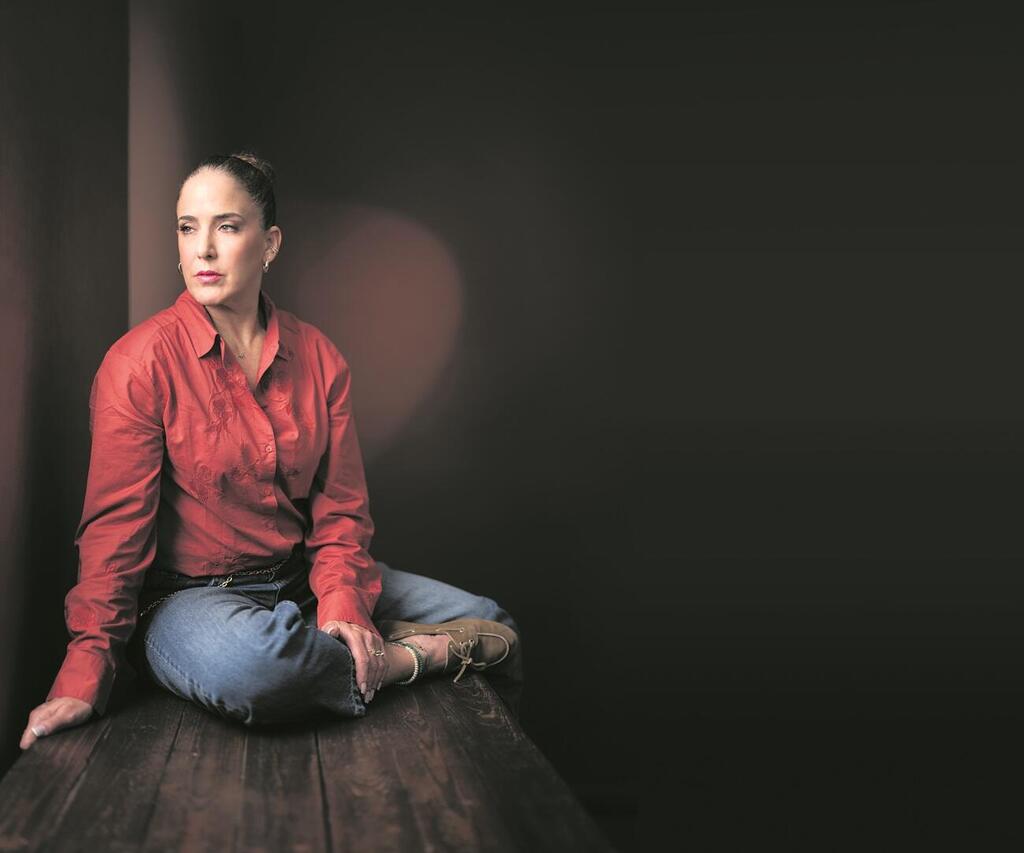
After captivity, bereavement and repeated moves, Goldstein-Almog says she and her children have finally begun to regain a measure of stability in Shefayim. Now she finds herself fighting simply to remain there. “When we came back, we were moved around Israel almost the way we had been moved around Gaza,” she says. “We returned in November 2023 and spent two and a half months in a hotel in Tel Aviv, then two and a half months at the hotel in Shefayim, and from there we moved into the temporary housing. This is where we started rebuilding our lives.
“The children found their place socially. It took time, but now they feel they can leave the house, ride their bikes around the kibbutz and feel safe. They receive treatment and support through their schools here. We had finally begun to find our footing. You can’t just say, ‘OK, time to move again.’ In July 2027, these temporary homes are going to be removed, and nobody ever asked me where I want to live or where I think my family can recover. Nobody seems to understand how important stability is for my children.”
Shefayim itself cannot simply allocate the family a plot of land, she says. There are already kibbutz families waiting for available building lots, while opposition lawmaker Chili Tropper tried to help her but was unable to find a solution. “They keep sending me from one government office to another,” Goldstein-Almog says. “Do I have contacts in the government? Has anyone from the government come here to see us? We’re being passed from one authority to another, and no one wants to take responsibility.”
“The state said it would make land available for evacuees, but not in Shefayim because the land here is so expensive. I simply don’t feel that what happens to us matters to anyone. Does anyone understand what it was like to celebrate Rosh Hashanah this year, sitting around the table without Nadav and Yam? At the very least, give me some certainty for the next six years, until Tal, my youngest, who is almost 12, finishes school. Instead of being able to focus on our recovery and rebuilding our lives, this is what I have to spend my energy on.”
‘I’m not going back to Kfar Aza’
Kfar Aza is now undergoing extensive reconstruction. Homes destroyed or burned on October 7 are being demolished and rebuilt, and many members of the community are preparing to return. Goldstein-Almog made her decision long ago. After October 7, much of the Kfar Aza community was initially evacuated to Shefayim before moving into temporary housing at Kibbutz Ruhama. “When that move happened, I decided there was no point in going to Ruhama because I already knew I wasn’t going back to Kfar Aza,” she says.
Other families have also chosen not to return. Some have rented or bought homes elsewhere and gradually separated from the community. Nadav’s parents and sister plan to go back; Goldstein-Almog’s parents do not. For her, that would once have been almost unimaginable. “We were the family that always stayed put,” she says. “Even during periods of fighting, we never left the Gaza border area. I always felt that even when there was danger, home was my anchor. That was where I could breathe. I held on to that for 20 years. But I can’t anymore.”
The family had built its dream home in Kfar Aza only four years before October 7. For now, Goldstein-Almog plans to rent it out once the repairs are complete. The same interior designer who helped them create the house originally is overseeing the renovation. “This time I told her to take care of everything,” Goldstein-Almog says. “I just can’t be involved.”
She has visited Kfar Aza many times since returning from Gaza, and every visit hurts. “Right now, Kfar Aza is one huge construction site. It’s going to be beautiful,” she says. “The question is whether it’s going to be safe. My captors told me, ‘We’ll come again.’ I told them, ‘Next time, just knock on the door and we’ll open it. You don’t need to blow it up.’
“I’ve been back to the kibbutz many times, and every time it hurts. It doesn’t feel like home anymore. It represents a life that will never come back and everything that was done to us. And there is still one question nobody has answered: How did the terrorists get all the way to us without being stopped? This is not an easy decision for me. Nadav was born and raised there. But now I have to do what is right for my family.”
Her children want to stay in Shefayim as well. Gal, now 14, says that if remaining there is impossible, he would rather return to Kfar Aza. Both he and Tal still keep in touch with friends from their old home. At the family’s most recent memorial gathering during Sukkot, Gal walked around Kfar Aza with friends, watched the reconstruction work and collected spent shell casings, including some from the family home. He did not enter the cemetery. Tal chose instead to attend a camp run by an organization supporting bereaved widows and orphans. “They’ll have plenty of years ahead of them to deal with the cemetery,” their mother says.
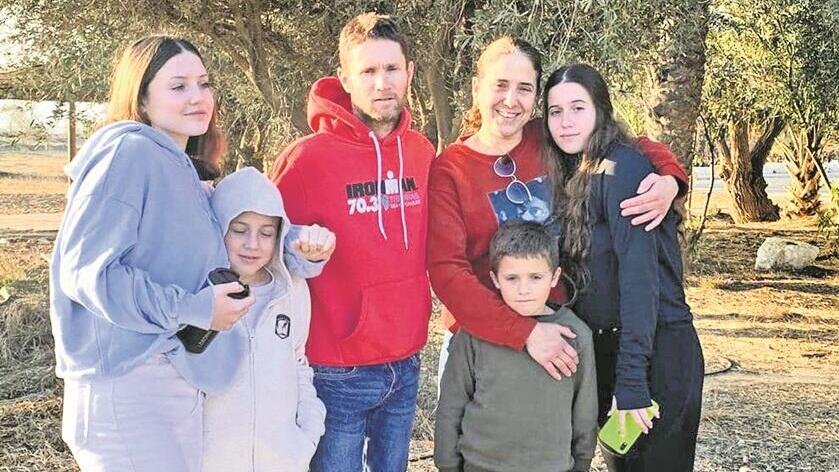
The Goldstein-Almog family, from right: Yam, Tal, Chen, Nadav, Gal and Agam
(Photo: Facebook)
Although she knew she would not return to live in Kfar Aza, Goldstein-Almog agreed to have Nadav and Yam reburied there. “I knew I wanted to respect Nadav’s parents,” she says. “They visit their graves every week.”
A home that was a dream
Goldstein-Almog, 52, is now publishing a memoir, Suddenly So Alone, through Yedioth Books. The last photograph Yam took before she was shot appears on the back cover: the family’s front door, blown off its hinges, leaning to one side as the green landscape of Kfar Aza is visible beyond it. Paradise turned into horror.
But Goldstein-Almog was determined that the book would not reduce her family to what happened to them on October 7. She devotes much of it to the happy, noisy life they shared before the massacre. She and Agam, who now serves in the IDF, have spoken publicly about the murder of Nadav and Yam, the family’s abduction and their captivity in Gaza, but Goldstein-Almog also wants people to know who Nadav and Yam were before they became victims. “They are not only what was done to them,” she says.
Chen and Nadav were childhood sweethearts. She was born and raised in Kibbutz Gevim but first met Nadav in first grade at the regional Sha’ar HaNegev school. They became a couple at 15, after Chen took the initiative. “We were friends, and I said to Nadav, ‘People keep asking whether we’re together. What should I tell them?’” she recalls. They would sometimes break up over the summer after serious teenage conversations about where the relationship was going, only to get back together. “It was a love that just kept growing.”
Goldstein-Almog served in the IDF as a physical fitness instructor, while Nadav became a fitness instructor with the elite Sayeret Matkal unit. After she completed her degree in social work, they settled in Kfar Aza. Nadav studied economics and eventually became vice president for business development and innovation at Kafrit, the kibbutz-based company that manufactures raw materials for the plastics industry. After Tal, their youngest child, was born, Chen left social work to focus on raising the family.
“We had the kind of home you dream about,” she says. “Every child we had brought Nadav and me even closer. I was his person. The way he looked at me, the way he still courted me after all those years. I loved him deeply. I admired him. He was smart and completely self-taught. He was always ordering books and teaching himself something new, but he was incredibly modest. He used to say, ‘There’s so much I don’t know.’”
Their extended families were woven into everyday life. After Chen moved to Kfar Aza, her parents followed. Her children grew up alongside the four children of Nadav’s sister almost like siblings, with both sets of grandparents nearby. “We had this whole extended family around us,” she says. “You felt the strength of it. It was wonderful. Everyone survived, by the way. Except us.”
Residents of the communities near Gaza used to describe life there as “95% paradise and 5% hell.” The Goldstein-Almogs understood exactly what that meant. During the 2014 Gaza war, Nadav insisted that they stay. “He said you don’t abandon your home,” Goldstein-Almog recalls. She was pregnant with Tal at the time. The kibbutz nurse, who would herself be murdered on October 7, asked how she could remain there while pregnant, and Chen’s parents also tried to persuade her to leave.
“Whenever there was an escalation, I hated the fact that we lived so close to Gaza,” she says. “But just thinking about moving away made me feel sick. Other families from the kibbutz spent weeks at a boarding school in Afula, sleeping on metal beds. At home, I felt healthiest. I felt most normal.”
When rocket sirens sounded, residents of Kfar Aza had only about 15 seconds to reach a reinforced safe room. The boys became accustomed to spending hours there, and Nadav even ordered them a basketball hoop that could be attached to a cabinet so they could play inside. Still, years of rocket fire gradually eroded the family’s sense of security. “We were always wondering how they would surprise us next time,” she says. “But terrorists coming into the kibbutz? That was never even a scenario in our heads. Not even one terrorist. We worried about rockets.”
From the large kitchen window, Goldstein-Almog could see a beautiful avenue of trees and, beyond it, Gaza. “That view used to make my heart expand,” she says. The trees had partly been planted to block the view from the other side. “Now we know they were watching us with binoculars and gathering intelligence.”
Yam, her mother says, was full of life, almost effervescent. “She had this incredible energy,” Goldstein-Almog says. “She was warm, affectionate, always hugging and kissing everyone.” Yam served as a squad commander at the IDF’s Bahad 7 communications training base and had been identified as a candidate for officer training, but chose not to pursue it. Her boyfriend had already finished his military service, and she was counting down the days until her own discharge. She planned to work in the kibbutz kindergarten and then travel with him.
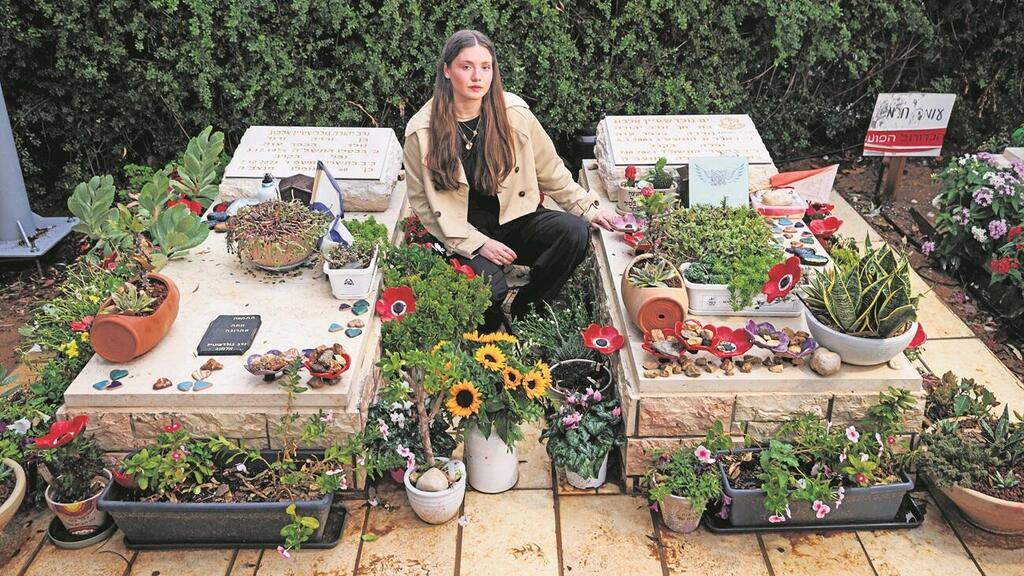
Agam Goldstein-Almog at the Kfar Aza cemetery beside the graves of her father and sister
(Photo: Ziv Koren)
Three months before October 7, the family had faced what seemed at the time like the worst thing that could happen to them. Nadav, a dedicated endurance athlete, was critically injured when a truck struck him while he was cycling near the Beit HaGadi junction on July 21. He spent nine days in intensive care, underwent surgery to stabilize his spine and suffered fractures to his pelvis and ribs. Only a week before October 7 had he begun walking again without assistance.
He was already talking about competing in an Ironman in Australia in 2024. “We didn’t realize we had only been given him back for another two months,” Chen says. On the morning of October 7, Nadav slowly made his way to the family’s safe room as Chen urged him to move faster. He was the last one inside.
‘The worst thing I have ever seen’
On October 6, the family spent the evening together at a holiday meal at the home of Nadav’s sister, Naama, before visiting friends in nearby Kibbutz Nir Am. They returned home close to midnight. “I love sleeping with the windows open so the air can come in,” Goldstein-Almog recalls. “I lay in bed looking at the sky and the moon through the window, next to the man I loved. I remember feeling grateful for everything I had. My whole family was there. We were complete.”
Hours later, they woke to rocket sirens. They immediately understood that something unusually serious was happening and went into the safe room, but even then they assumed they would be back in their bedrooms within a few minutes. Everyone left their phones beside their beds except Yam, whose bedroom also served as the family’s safe room. She became their only connection to what was happening outside.
The first moment Goldstein-Almog remembers feeling genuine fear for their lives came around 6:40 a.m., when Yam told them residents had been instructed to close their shutters, something that had never happened before. Chen went into the kitchen to shut them and saw figures dressed in green moving toward the home of the Kutz family, whose parents and three children would all be murdered that morning. “I came back and said, ‘The army is here,’” she recalls. They were Hamas Nukhba terrorists, members of the group’s elite assault force.
When residents were told to secure their safe-room doors, the Goldstein-Almogs tried to improvise using the cord from a hair straightener. It did not work. At one point Nadav crawled under a bed with the boys. The bed collapsed. “We just couldn’t understand it,” she says. “How was this still going on? Why had no one stopped it?”
At about 6:50 a.m., there was an enormous explosion inside the house. Then came an eerie silence, broken only by constant gunfire outside. The family carefully opened the safe-room door. Yam photographed what they saw: the blasted entrance to the house, the image that would later appear on the cover of her mother’s book. At first Chen thought the damage had been caused by debris from an intercepted rocket. Then reports began arriving that terrorists were already driving through Israeli communities.
Yam sent message after message to group chats saying terrorists were inside their home and begging for help. A member of the kibbutz who was also a senior IDF commander replied that forces were trying to reach them. “I want people to remember my daughter as someone who fought with everything she had,” Goldstein-Almog says. “She was a soldier, and she did exactly what soldiers are taught to do. She kept going. She did everything she possibly could.”
It was roughly four hours before the terrorists entered the room where the family was hiding. Goldstein-Almog remembers hearing them shouting about Jews. “I thought, this is it. They’re going to massacre us. This is what dying looks like.”
Gal and Tal were hidden in a narrow space between a wall and a wardrobe. Yam, Agam and Chen tried to shield them, while Chen placed a large stuffed animal over the group, hoping somehow that it might absorb some of the gunfire. Nadav had no weapon. When Chen said aloud how helpless they were, he picked up a thin piece of wood that had broken off the bed and stood facing the safe-room door.
Chen had her back to him and does not know whether he ever managed to strike anyone with it. “When I turned around, Nadav had already been shot,” she says. “He was lying on the floor, completely still.”
Two terrorists then entered screaming. The family were barefoot and in pajamas. The gunmen opened the wardrobe and ordered them to put clothes on before forcing them outside. At the doorway, Yam collapsed. After hours of managing the crisis through her phone, Chen initially thought her daughter had simply fainted.
She and Agam laid Yam down, stroked her and tried to wake her. Yam began to respond. Chen stepped outside briefly to check on the boys, who were standing near the entrance putting on shoes. A terrorist grabbed Agam by the hair and pulled her outside. Chen went back inside to check on Yam. That was when she saw her daughter had been shot in the face.
“I ran outside in shock,” she says. Beyond the house was the same green, pastoral Kfar Aza landscape she had always known. “I kept looking toward the bushes, waiting for some Israeli force to signal to us. Yam had told us the army was on its way. There was nobody there.”
The image of Yam followed her into captivity. “It is the worst thing I have ever seen,” Goldstein-Almog says. “I describe it deliberately because I want readers to try to understand what it was like to be there, at the most terrible moment of my life.”
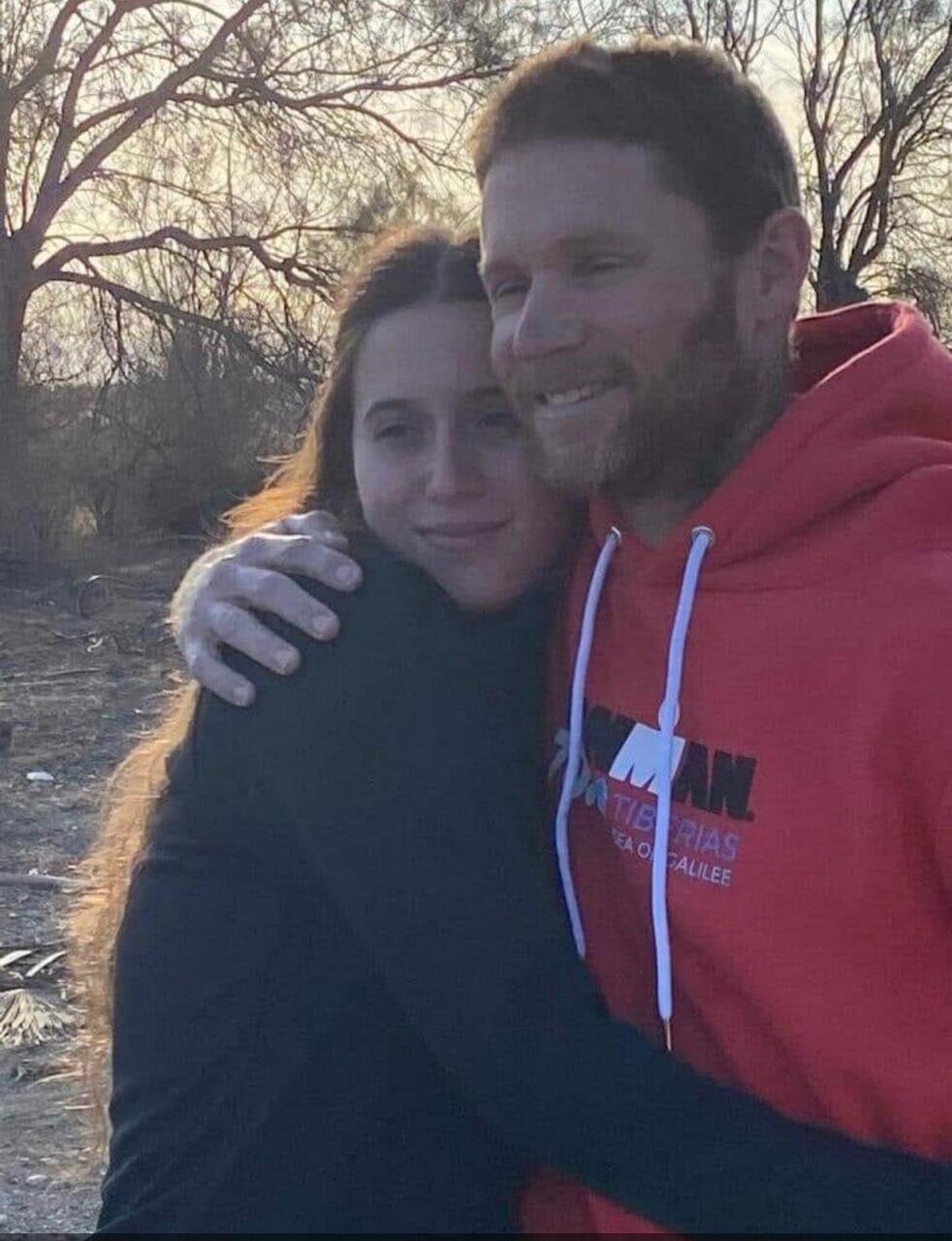
Nadav and Yam Goldstein-Almog
Every evening in Gaza, as darkness fell, she forced herself to replay the scene. “It was a form of self-punishment,” she says. “I kept asking myself: What if I had bent down over her? Would they have shot me too? Eventually, that image became less overpowering, and I was able to remember her happy and smiling as well.”
‘As surrounded as I am, I’m alone’
Outside the house, the surviving members of the family watched terrorists behaving as though there was no urgency at all. One man with a cut on his leg took an Israeli flag and tied it around the wound, Goldstein-Almog recalls, while others sat under the family’s pergola. They took the family’s phones and the keys to Chen’s car. One terrorist drove, another sat beside him, and Chen and the three children were squeezed into the back.
“We were in shock. Humiliated. Beaten,” she says. “They filmed us sitting there with our heads down. Tal cried for a little while and then stopped. And then, with unbelievable ease, the car simply drove out of our driveway.”
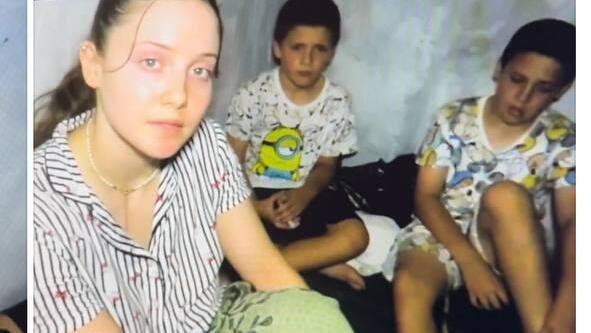
Agam Goldstein-Almog with her brothers Gal and Tal in an image taken during Hamas captivity
Seven minutes later, she says, they were in Gaza. The border fence was wide open. Along the way, the terrorists stopped to load bodies before continuing. They drove through fields where Nadav used to run. In the past, when he strayed too close to the border, the military would contact him and tell him to turn around. “Where was that army now?” she asks.
Over 51 days in captivity, Chen and her children were moved between apartments, a mosque and a tunnel. After returning to Israel, she was determined to tell senior military officials that the danger they had faced in Gaza had come not only from Hamas and the crowds around them, but also from Israeli airstrikes.
“We experienced that as a betrayal,” she says. “I can’t understand it, and I can’t explain it to a child who saw his father shot dead on October 7 and then had to live through explosions that shook him to his core. You never felt protected. Not for a moment.”
On one occasion, she says, the family was being held inside a supermarket when a nearby blast sent debris flying around them. Their captors moved them into an apartment upstairs, where another blast ripped out doorframes and shattered glass. In the middle of the night, the family was taken outside, exposed both to Israeli strikes and to people in the street. Suddenly shots were fired, and the terrorists holding them pushed them against a wall for cover. “The absurdity was that the terrorists were protecting us from fire coming from our own side,” she says.
After their release, Chen and Agam spoke publicly and repeatedly about the female IDF surveillance soldiers who were still being held in Gaza. The women had told them about the horrors they witnessed at the Nahal Oz base on October 7 and what they endured afterward. “We met young women who were doing absolutely everything they could to survive,” Goldstein-Almog says. “They treated their own wounds and told themselves that the next time someone bandaged them, it would be in Israel. We came out of Gaza feeling that we had a responsibility to tell everyone we could what was happening to those women.”
Even the moment of release was terrifying. To reach the Red Cross, the family had to pass through a large crowd in Gaza. “It was ugly, humiliating and frightening,” she says, sighing heavily. Agam turned to her and said, “We’ve survived until now. Are we going to die today?” The joy of going home was inseparable from grief. “Nadav and Yam weren’t waiting for us in Israel.”
Goldstein-Almog has also struggled with the question of accountability. She says she was invited to a meeting attended by members of the IDF General Staff. “Not one of the generals who came over to me could say, ‘I’m sorry,’” she says. “Maybe because they were afraid it would become a headline.”
The IDF chief of staff approached her and said he very much wanted her to return to Kfar Aza. She asked whether the danger had been removed. “He said, ‘You asked me a question, and I owe you an answer.’ There still isn’t one.”
After returning from captivity, the family also asked to meet a fighter squadron commander. Goldstein-Almog wanted someone from the Air Force to look her in the eye and explain how Israel could carry out intense airstrikes in Gaza while so many hostages were being held there. “He said to me, ‘I was fighting for you. Didn’t you feel that?’” she recalls. “I told him, ‘You were destroying us. You were breaking us apart.’”
She is especially angered by the argument that military pressure was what ultimately secured their release. “We were there for weeks,” she says. “We never saw military pressure bringing them closer to giving us up.”
Once the hostages began returning and she could finally think about recovery, Goldstein-Almog discovered that survival did not mean returning to anything resembling the life she had before. “We didn’t come back to a whole family,” she says. “We didn’t go back to our community or our home. We came back to enormous grief and absence.
“You survive October 7. You survive captivity. Your body and mind slowly start regaining strength, and from the outside it can look as if you’re doing OK. But nothing is OK. The loss is so enormous that there is no real recovery from it. One moment you’re inside the grief and the unbearable finality of Nadav and Yam being gone. The next you’re trying to build a life that can still contain happiness. Living between those two realities every day is emotionally brutal.”
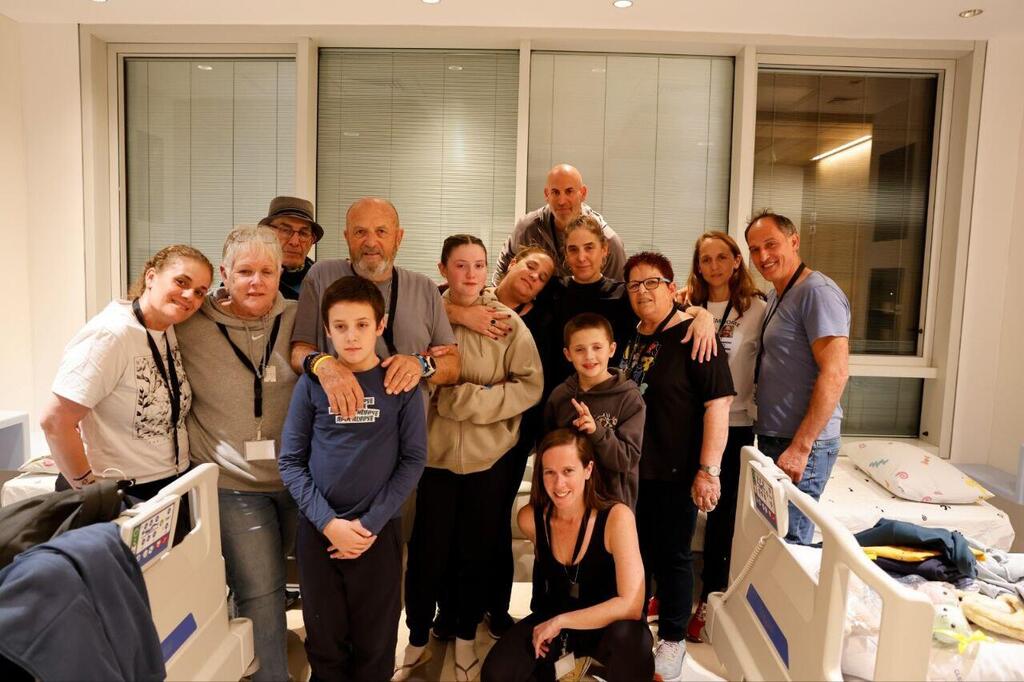
Chen Goldstein-Almog with Agam, Tal and Gal after their release from Gaza
(Photo: Schneider Children’s Medical Center Spokesperson’s Office)
Her children process the loss in different ways. Goldstein-Almog is now receiving parenting counseling because she worries the family does not talk openly enough at home about Nadav and Yam. She remembers being called to Gal’s school because he had been acting out. He looked at her and said, “Mom, you’re a clown. I want Dad to come.”
Sudden loud noises remain difficult for all of them. During Iranian missile attacks, the family returned to the safe room with almost no emotional reserves left. At the end of the summer, Agam was unable to reach her mother for an hour and 40 minutes because of a misunderstanding. By the time they reconnected, Agam had already filed a missing-person report with police. “That showed me how quickly everything can spiral,” Chen says. Agam has since installed a location-sharing app on her mother’s phone. “It’s usually the parent who tracks the child,” Chen says. “With us, it’s the other way around.”
Her days remain packed with decisions, meetings at the children’s schools, public lectures and memorial events. “Around memorial days, I get a lot of invitations,” she says with a smile. Humor surfaces repeatedly in the conversation, often at the darkest moments. Her speaking engagements fill her days and allow her to preserve Nadav and Yam’s memory, but they also leave her emotionally drained. “I’m trying to find places where I can simply stop and breathe,” she says.
She has been seeing a psychologist for two and a half years and also turns to bodywork, reflexology and other treatments. And after 34 years with Nadav, she now finds herself wanting something she was not sure she would ever want again: love.
“I really want to love someone and be in a relationship,” she says. “I was with my husband for 34 years, and something in me has started coming back to life. I want a good relationship.”
She lifts weights, runs and invests considerable energy in her physical and emotional recovery. “I feel strong,” she says. “I feel like I have so much to offer. I want someone who will appreciate all the work I’ve done to get here.”
But men do not exactly approach her. “Where would they?” she laughs. “At one of my lectures? On the highway?” Sometimes she goes to small trance parties, something she never did before October 7. Nothing happens there either.
Friends have made a few attempts to introduce her to people, but those encounters mostly reminded her how good her relationship with Nadav had been. Some men, she says, are intimidated by everything that comes with her story.
“One man told me he didn’t want to be the first man after Nadav,” she says.
Her answer is simple.
“But Nadav is dead.”
She knows that whoever enters her life will need emotional maturity and the courage to come close rather than retreat from what she has been through.
“As surrounded as I am by people, I’m still alone,” Goldstein-Almog says.
But there is one thing she has not lost.
“I haven’t given up on love.”