

“The minor S., whose family lives in the Binyamin Regional Council, is being exploited for nationalist crime at an outpost west of Yitav,” Dr. Yoram Sorek wrote in a message to the council. “On Friday, August 1, 2025, he was seen striking one of the outpost’s dogs with a rock. A video of the dog after the abuse is attached. In addition to this incident, activists who have observed him there believe his mental condition is deteriorating. Are you aware of the decline in his condition at the outpost, where he has been staying for an extended period?”
It was one of dozens of messages Sorek, an activist with the Israeli group Looking the Occupation in the Eye, has sent to welfare authorities, mainly in the Binyamin and Jordan Valley regional councils in the West Bank. Activists with the group say they are seeing two related trends intensify: children arriving at settler farms and hilltop outposts at increasingly younger ages, and significant numbers of those minors showing signs associated with at-risk youth, including being outside school, without adequate supervision and exposed to conditions that may endanger their physical or emotional well-being.
The concern has become more urgent amid growing settler violence. A disturbing video recently drew attention in Israel and abroad after appearing to show one teenager beating an elderly disabled Palestinian man with a stick while another filmed the attack. The suspects, aged about 16 and 17, were identified and detained for questioning.
The case was far from the only one involving minors. Data recently published by Israel’s Freedom of Information Movement showed a 560% increase since 2019 in incidents classified as nationalist crime in the West Bank, with youths involved in a significant share of them. Police estimate that around 300 young people living or spending time on hilltops and at outposts are involved in public disorder and violence.
At the same time, nearly 200 new outposts have been established during the current government’s term, covering about one million dunams, while more than 100 Palestinian communities have been displaced from their land, according to the report. At least some of those new outposts have become destinations for teenagers who have dropped out of schools and other educational frameworks.
For Sorek and other activists who regularly document events in the West Bank, neither the violence nor the ages of some of those involved come as a surprise.
“Under Israel’s Youth Law, there are criteria for what is considered a minor in need of protection,” Sorek said. “That can include committing a criminal offense, being in a harmful environment or being in circumstances that put the child at physical or psychological risk.”
He argues that the system as a whole, including local social workers and the Welfare Ministry, is failing to provide an adequate response. “It feels as though there are several strategies for avoiding the issue,” he said. “They say they don’t know the children’s names, and when they do know, they say the case is being handled. But ultimately, nothing happens.”
The case of S. was unusual because the activists knew where the boy’s family lived, in the Binyamin Regional Council, even though the alleged abuse of the dog took place in the neighboring Jordan Valley Regional Council. In many cases, activists do not know the identity of a child or where his family lives, so they contact the local authority responsible for the area where he was seen.
In early 2025, Sorek filed a complaint with the ethics body of Israel’s Social Workers Union over the conduct of the Jordan Valley Regional Council’s welfare department and one of its social workers. The complaint concerned what activists described as a failure to respond to reports involving 14- and 15-year-old shepherds who, according to testimony collected by activists, had vandalized property and harassed Palestinian communities, particularly women and children.
The complaint described the teenagers as visibly neglected, wearing worn clothing unsuitable for the season and terrain, and sometimes walking barefoot for hours through rocky areas, leaving them exposed to snakebites and injuries. It said they often had poor personal hygiene and were being sent out by adults to spend long periods alone in an environment unsuitable for teenagers and potentially hostile.
“The youths are disconnected from any educational, therapeutic or rehabilitative framework,” the complaint said.
The Social Workers Union did not dispute that a broader problem existed, but rejected the claim that responsibility rested with individual social workers.
“The issue you raise undoubtedly constitutes a national problem, both because a significant number of those involved are minors and because of the acts attributed to them,” the union’s ethics committee wrote to Sorek in July 2025. “However, the committee rejects the attempt to place responsibility on social workers in the field or accuse them of an alleged ethical failure.”
The committee recommended that activists direct their demands instead to government agencies, including the welfare, education and public security ministries.
‘Even a 14-year-old does it’
There is no authoritative count of how many hilltop youths live or spend substantial time at West Bank farms and outposts, or how many of them meet the formal definition of at-risk youth.
Col. (res.) Avichai Tanami, who was appointed by the defense minister to coordinate government efforts on the issue, told a Knesset Education Committee meeting in June that the number was about 1,000. Representatives of the Education and Welfare ministries gave a lower estimate at the same meeting, putting the figure at between 600 and 800.
“Any number goes. Nobody really knows,” a senior official in one West Bank regional council told Shomrim, the Israeli investigative journalism organization that produced the report. “Most of them aren’t connected to my council at all. They come from places like Beit Shemesh, Jerusalem or Netanya. What does that have to do with me? Our social workers try to bring them back, but it’s very difficult.”
Hanna Itach, deputy head of the Binyamin Regional Council and holder of its education and welfare portfolios, made a similar argument during a Knesset State Control Committee hearing in December 2025.
“This is a very small number of youths and young adults,” she said. “When people call it hundreds, you have to understand that it is a cloud of children or young people moving between all the different authorities. We consider the phenomenon harmful. We have proposed tools to deal with it. We have a plan that we submitted to the prime minister, and we are asking the state to listen, because there is no way to solve this through force.”
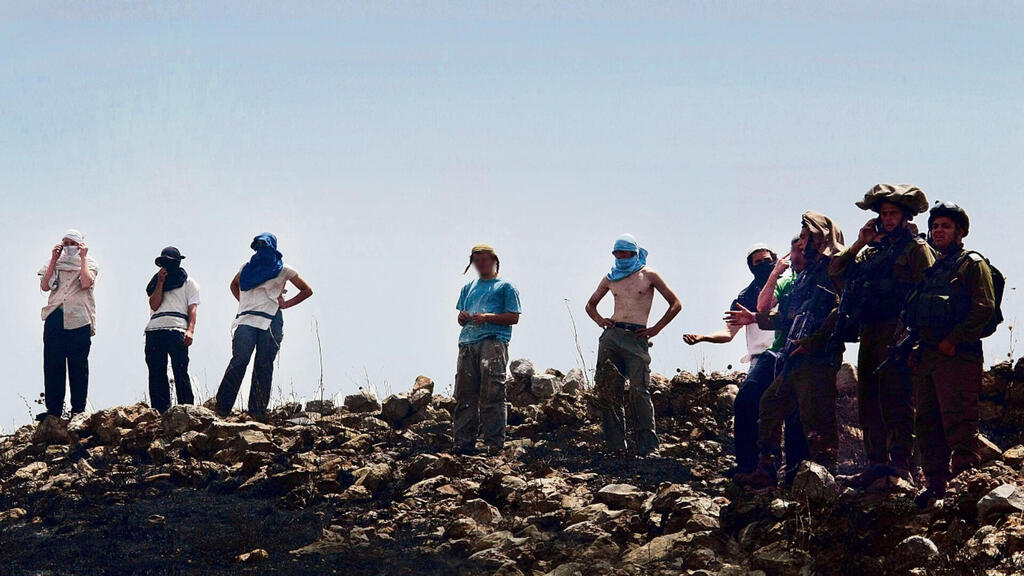
(Photo: AFP)
“Most of these young people don’t even come from Judea and Samaria,” she added, using Israel’s official term for the West Bank. “They move around.”
The regional council official who spoke to Shomrim said the situation has nevertheless grown more violent.
“Looking back over a decade, the problematic youths today are much more violent than they used to be,” he said. “In my opinion, that is also connected to October 7 and to a period in which the overwhelming majority of Israelis no longer care what happens to Palestinians.”
A., 21, lives with his wife in an unauthorized outpost on a hill in the southern West Bank. He agreed to speak to Shomrim anonymously. He has been arrested several times and arrived at the hill three years ago after the military refused to enlist him.
He said a 14-year-old boy lives at the farm alongside several other high-school-age teenagers.
“The younger ones came here after spending time in other places, and they liked the place and the people,” he said. “There’s always something to do here: help families, help when an outpost is being evacuated, take care of infrastructure. You stand guard at night and herd sheep during the day. Sometimes you sleep three hours a night because there’s nobody else to keep watch. Even a 14-year-old does it if necessary.”
Asked about stone-throwing, firebombs and repeated violent confrontations with neighboring Palestinians, A. made clear that such conflict was also part of the environment.
“We live alongside Arabs who rise up against us,” he said. “God commanded us to conquer the land and take possession of it from the nations. Those aren’t just pretty words. Sometimes it also takes force.”
Children ‘fall in love with the idea of the farms’
Although officials disagree over the total number of hilltop youths, there is broad agreement that children are arriving at farms and outposts at younger ages.
At the Knesset Education Committee meeting in June, Carmit Harush, the Education Ministry’s Jerusalem district director, said officials were now seeing children begin visiting farms while still in seventh or eighth grade. The ministry has consequently sought additional funding for programs aimed at middle-school students.
“The dropout process begins when they start going to the farms on vacations and weekends,” she said. “After a few visits, they fall in love with the idea. Today we are seeing it happen at a younger age.”
An interministerial report led by the Justice Ministry and completed in September 2025, published here for the first time, sought to map the educational and therapeutic needs of hilltop youths in the West Bank. It found that some live on the hills permanently, while others come only during school vacations and weekends or arrive during exceptional events such as outpost evacuations or wartime periods.
Israeli settlers beat a disabled Palestinian man


Most, according to the report, are boys. Some come from West Bank settlements and others from elsewhere in Israel. Most come from religious-Zionist families, though some are from the ultra-Orthodox community. A large majority have a history of dropping out of educational frameworks.
“The central concerns regarding hilltop youths involve minors, some of them extremely young, living without basic conditions, usually without adult supervision and at times disconnected from their parents,” the report said. “In some cases, their actions also cross into criminal offenses, ranging from driving or using vehicles without licenses to nationalist offenses, including against military and police personnel and Palestinians.”
The conditions can also pose serious problems for the young adults who are supposed to act as the responsible figures.
Dov Morel, who was himself a hilltop youth about a decade ago and now occasionally joins activists providing a protective presence for Palestinians in the West Bank, recalled one case involving allegations that one youth had sexually harassed others.
“I was 18, together with others my age and younger,” he said. “We were the responsible adults who had to decide what to do. There was no clear hierarchy at the outpost. Some people had been there longer, others less. We had to make the decision, and the main challenge was figuring out whether people would obey us.”
The boy eventually stopped coming to the hilltops after realizing what others were saying about him, Morel said.
“You have to understand that this is an anarchic environment that believes it has the truth on its side,” he said. “When a 12- or 13-year-old gets to the hilltops, it is very difficult to make him leave.”
Morel recalled wanting to join protests against the demolition of nine homes at the Amona outpost when he was 12. His parents refused, so he threatened to run away and go alone, eventually persuading his father to accompany him.
“If at that age I had insisted on leaving home and spending my time at outposts, I don’t know what even a very committed social worker could have done,” he said.
Ronit Haimov-Zilberman of the group Social Workers for Democracy argues that the Welfare Ministry nevertheless has both the responsibility and the tools to do much more.
“When minors are involved, the Welfare Ministry has an obligation to determine whether they are at risk,” she said. “These are children who are outside any framework, without supervision, spending hours at a time in dangerous areas. According to the testimony, some of those in the field don’t have enough food or water and are neglected. There is a real concern that these are minors at risk. The Welfare Ministry should be investigating these cases thoroughly.”
‘They turned children who need help into soldiers’
West Bank welfare officials have been familiar with the phenomenon for years.
In March 2023, after the settler rampage in the Palestinian town of Huwara, Danny Brodsky, then an activist with Rabbis for Human Rights, told the Knesset Youth Committee about an encounter that year in the Jordan Valley.
“We came to accompany a Palestinian shepherd,” he said. “A settler who owns a farm in the area arrived, asked if we were Israelis, we said yes, and he drove away. After him came a boy, I would estimate about 15 years old, who said that the settler had sent him to drive the Palestinian shepherd away.”
Brodsky said he later spoke with a social worker in the area who told him some youths were going to such farms while completing their high-school matriculation requirements.
“No child should have to make that choice, driving Palestinians away in order to finish his matriculation certificate,” he said.
At a March 2025 meeting of a Knesset Foreign Affairs and Defense Committee subcommittee on marginalized youth living in the West Bank, officials made clear that state agencies were well aware of the issue.
Reut Lugasi, head of the Welfare Ministry department responsible for vulnerable and marginalized populations, told Sorek that she personally received and reviewed the letters activists were sending.
“I personally get the letters you send and check them,” she said. “I make sure the Jerusalem district checks those cases, that a youth-law social worker intervenes, contacts the parents and investigates. I can tell you that I read the letters you send.”
Yet many of the minors remain at the farms and hilltops.
At the same hearing, Yesh Atid lawmaker Ram Ben Barak asked Lugasi why.

Yesh Atid lawmaker Ram Ben Barak
(Photo: Noam Moskowitz / Knesset Spokesperson's Office)
“It’s like asking why the Welfare Ministry doesn’t remove teenagers from Kikar Hahatulot,” she responded, referring to a well-known gathering area in central Jerusalem, “or from city centers elsewhere. Teenagers go to all kinds of places. We have no control over where they go.”
She added that when officials identify a teenager who is at risk, poses a danger to himself or others, or is being harmed by the place where he is staying, the ministry will try to provide treatment tailored to his needs.
Ben Barak pressed her: “Don’t you recognize that some of these farms are dangerous?”
“We recognize it in the same way we recognize Kikar Hahatulot,” Lugasi replied. “That is also a dangerous place, and many youths there are exploited. We will do everything we can to treat these young people using the same principles, although the solutions will differ because farms and city squares are not the same.”
Ben Barak later offered a harsher assessment.
“We need to tell the truth,” he said. “Someone recognized the potential and turned children who need treatment, who genuinely need treatment, into soldiers for these farms. They are exploiting them as soldiers.”
Yuval Ben-Ari, an activist who accompanies a Palestinian family in the village of Burin and was himself attacked by a group of settlers last November, said he had witnessed scenes that reinforced that concern.
Near Burin, south of Nablus, lies the Givat Ronen outpost. Human rights activists say groups from the outpost regularly enter the Palestinian village.
“There are tours every Saturday, sometimes Friday and on holiday eves as well,” Ben-Ari told Shomrim. “There is a group of 20 or 30 people. Sometimes there are two children who look about 10 years old walking inside the village, children who look a little lost.”
The activists watch them from the home of the Palestinian family they accompany, he said.
“One of the people in the group is Menachem Ben-Shahar, a rabbi who appears to lead the tour,” Ben-Ari said. “I can’t understand how a rabbi and a father takes children into a place like that. It is heartbreaking to see.”
About 10 days before an incident in which Ben-Ari was attacked, Ben-Shahar, a former rabbi at the Homesh yeshiva, was arrested on suspicion of incitement over comments he made in a 2023 interview with the Jewish Voice website calling for the Palestinian town of Huwara to be erased and describing such an act as “effective, moral and acceptable.”
He was released under restrictions and later petitioned the Jerusalem Magistrate’s Court to return computers seized during his arrest. In his petition, Ben-Shahar described himself as an educational counselor with a master’s degree who had worked for years in schools in the West Bank and Jerusalem.
Shomrim asked Ben-Shahar whether, as an educator, he saw a problem with minors participating in the village tours. He did not respond.
Sorek also raised questions about Gabriel Kalish, the security coordinator for the settlement of Mevo’ot Yericho, and his relationship with children and teenagers at nearby farms.
“He’s very friendly with these kids,” Sorek said. “We see the relationship he has with them.”
Until July 2025, Kalish also worked for the Jerusalem Municipality as a youth coordinator, while serving as the settlement’s security coordinator, according to city council member Laura Wharton. In separate legal disputes with activists from Looking the Occupation in the Eye, Kalish has described himself as someone who works with at-risk youth.
Kalish declined to address Shomrim’s questions directly.
“I ask that you no longer contact me in any way. It is bothering me,” he said. “If you publish things about me that are untrue, you will expose yourself to a defamation suit. I hope you publish good things and help people find hope and light in life.”
The Binyamin Regional Council said its social services department operates in accordance with Israeli law and Welfare and Social Affairs Ministry procedures and is supervised by the ministry.
“That is how we operate in every case referred to us under the Youth Law and in general,” the council said. “Naturally, we cannot comment on individual cases because of the confidentiality we are legally required to maintain.”
The Jordan Valley Regional Council did not respond to Shomrim’s request for comment.