

On Monday, August 3, Col. Yoav Schneider marked 20 years since what he calls his second birth.
He was 21 at the time, a young platoon commander in the IDF’s 74th Armored Battalion, only weeks out of officers’ training.
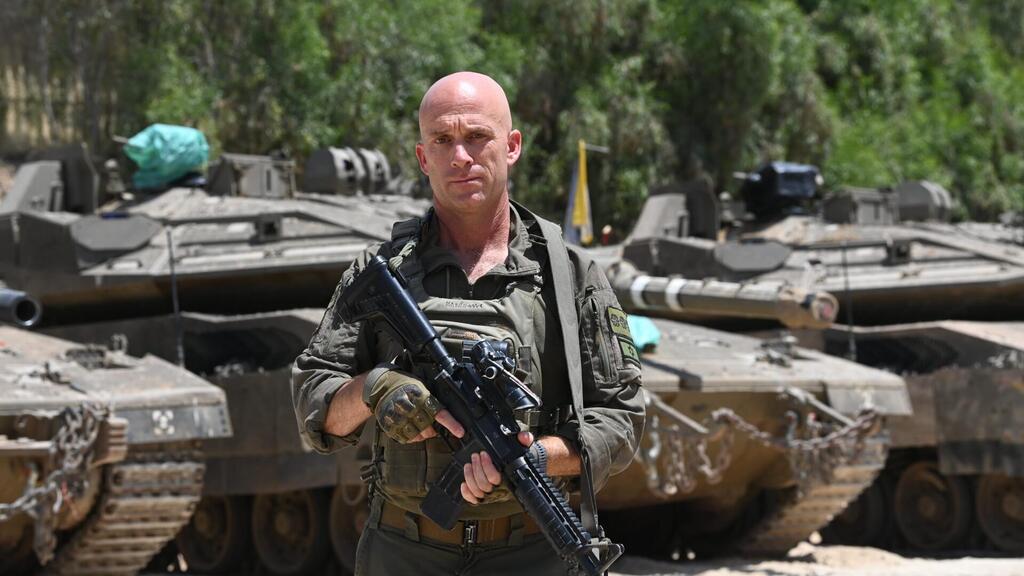
“Gilad Shalit was kidnapped during our final week of the course,” Schneider recalls. “I finished the course, received a platoon command and we went down to Operation Summer Rains in the Gaza Strip. On July 12, 2006, after a few weeks in the role, the Second Lebanon War broke out.”
During the war, 74th Battalion was transferred from Gaza to Lebanon.
“We were in the western sector, around Jabal Blat and the village of Marwahin, operating under the Alexandroni Reserve Brigade,” Schneider says. “Seventy-two hours after entering, we took a direct hit from an anti-tank missile.”
The missile was fired from Majdal Zoun.
“There were four of us in the tank. I was the commander. With me were Andrei Brodner, the gunner; Alon Pintuch, the loader; and Itamar Tzur, the driver. After the hit, I understood that I was very seriously wounded and started extracting myself from the tank. I also tried to get Alon out.
“Despite the injury, I managed for about 10 minutes to direct forces toward us, until my vision disappeared completely. From there they evacuated me to some improvised landing zone, a helicopter arrived and took me to Rambam Hospital in Haifa, and I was sedated for two days.”
And when you woke up?
“The first thing I asked my mother was what happened to the crew. I knew their condition was bad, but in the field, while they were treating me, I did not dare ask. My mother answered me with a question, gently: ‘What do you think?’
“I told her: ‘I think they all died.’
“And she said: ‘Yes.’
“Alon, the loader, died four hours after reaching the hospital.”
Schneider was classified as seriously wounded.
“I did not have orthopedic injuries, but I had a lot of burns and small shrapnel wounds,” he says, showing difficult photographs from those days on his phone.
“My rehabilitation was mainly treatment for the burns and respiratory system. But it was not only physical rehabilitation. It was psychological rehabilitation too. It is not simple for a 21-year-old platoon commander to lose three crewmen.
“I attended the 30-day memorials for all three of them. I went to each family to tell them about their son’s final moments.”
After six months of recovery and rehabilitation, Schneider decided to return to the IDF.
“We live in a society where returning to service after an injury like that looks obvious,” he says. “But it really is not. It is a very deep decision psychologically, morally and of course physically. It is not something you do casually.
“I returned as an instructor in the armored officers’ course, and afterward I went to study at the IDF Tactical Command College.”
The call from Canada
Twenty years later, Schneider found himself fighting in Lebanon again, this time as commander of the 401st Brigade.
He assumed command after his predecessor, Col. Meir Biederman, was critically wounded in the village of Debel in southern Lebanon.
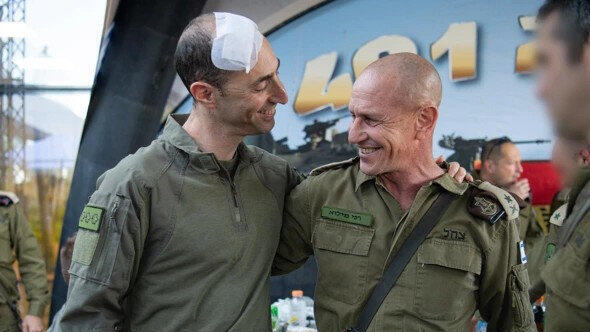
Col. Meir Biederman with Maj. Gen. Rafi Milo at the 401st Brigade change-of-command ceremony
(Photo: IDF)
Biederman himself had replaced Col. Ehsan Daxa, who was killed by an explosive device in Jabaliya in Gaza.
Schneider had already been selected for the 401st Brigade command in September 2025. Biederman’s injury simply accelerated his entry into the post.
It happened on May 20, while Schneider was studying at the Canadian Forces College.
“I got a phone call in the middle of the night,” he says. “‘Biederman was very seriously wounded in the head by a drone. Come take command of the brigade in his place.’
“It was clear to me that I was packing up and coming back to Israel immediately.
“After serving as a reserve brigade commander during the war, Brigade 205, you feel like you have already done it. But when an opportunity like this came, to return to war as commander of a regular armored brigade, I grabbed it with both hands. I knew there was still significant operational work ahead of us.”
After suffering such a serious injury yourself, you take command of a brigade whose previous commander was killed in Gaza and whose replacement was critically wounded in Lebanon. How did your family react?
“Not without concern,” he admits. “But they supported me. I explained to them that I had already been wounded. Lightning does not strike twice.”
Schneider cut short his studies in Canada more than a month before they were due to end and returned directly to the fighting in Lebanon.
“Taking command of 401 and moving into the brigade commander’s office was the easy part of coming back,” he says.
“I returned straight into Operation Lion’s Crown,” he adds, referring to an operation in which IDF forces surrounded Hezbollah centers of gravity, particularly around Bint Jbeil.
“We operated in Debel, Rshaf and Qawzah. After a week of fighting, I got a call from the commander of 91st Division, Brig. Gen. Yuval Gaz.
“‘In six hours there will be a ceasefire,’ he told me. ‘How quickly can you reach and establish yourselves on your most forward lines?’
“We surged forward, and before the ceasefire we were already deployed on the lines. We took Haddatha and the Sylvester Ridge. We created a very significant Yellow Line area.”
Around 10 days ago, after eight months of fighting, the 401st Brigade left Lebanon.
After a short period of recovery, the brigade is expected to return to the Gaza Strip within the coming month.
But Schneider’s brief period commanding the brigade in Lebanon left a permanent mark on him, particularly the death of Lt. Col. Dor Ben-Simhon, 32, commander of the 52nd Battalion and a close friend.
The 52nd Battalion belongs to the 401st Brigade but operated in Lebanon under the Givati Brigade combat team.
“When I was commander of the training battalion at Shizafon, Dor was a company commander under me for eight months,” Schneider says.
“He took command of the 52nd Battalion after the previous commander, Or Yol, was wounded in Bint Jbeil by shrapnel to the head. And he did it very well.
“Yol was an admired battalion commander. Dor entered the position, and under his command they also went up to Beaufort. It was a major challenge, and he handled it very impressively. When I was appointed commander of the 401st Brigade, I was happy he was in my brigade. It was obvious to me that this was the kind of battalion commander I wanted.”
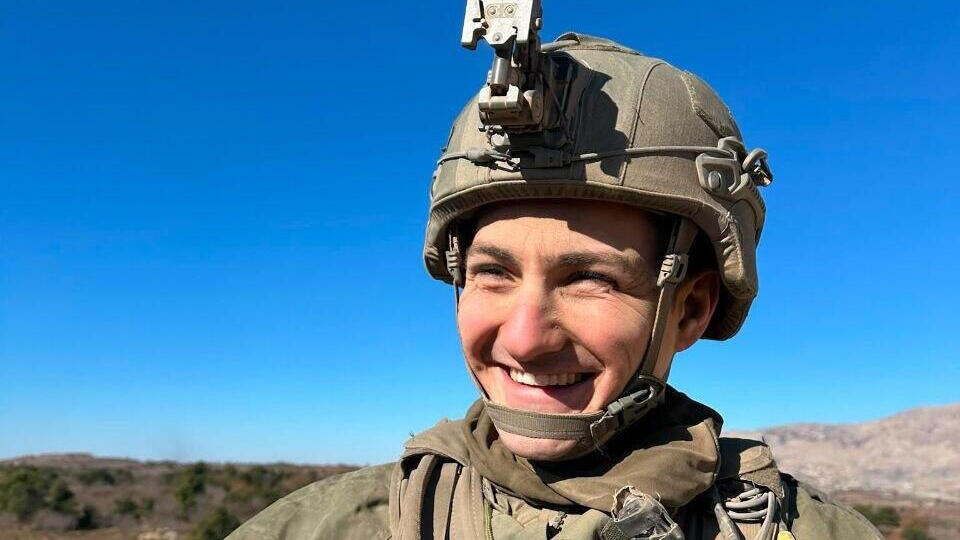
Lt. Col. Dor Ben-Simhon
(Photo: IDF)
Schneider remembers his last conversation with Ben-Simhon on June 19, only hours before his death.
“I called him on video to hear how things were going. He was not under my direct command there, but I make sure to stay in touch with all my battalion commanders, even when they operate under other brigades.
“He told me the fighting was very difficult. I could hear that he was carrying an operational, mental and professional load, but he was coping.
“A few hours later, the phone rang: ‘An explosive drone hit the battalion commander’s tank. There are no survivors.’”
What do you think about when you remember that last conversation?
“His smile. Even during that conversation, the moment I saw him on the screen, I smiled. He had a smile that always made you smile too.
“He was charismatic, very dominant, professional, deep and thorough.
“I also said at Dor’s 30-day memorial that the Ben-Simhon family is deeply invested in 401. He has one brother who is an officer studying from the brigade, another in officers’ training from 401, and another brother who served in the brigade.”
Schneider remains close to the families of the three soldiers killed alongside him in the tank during the Second Lebanon War.
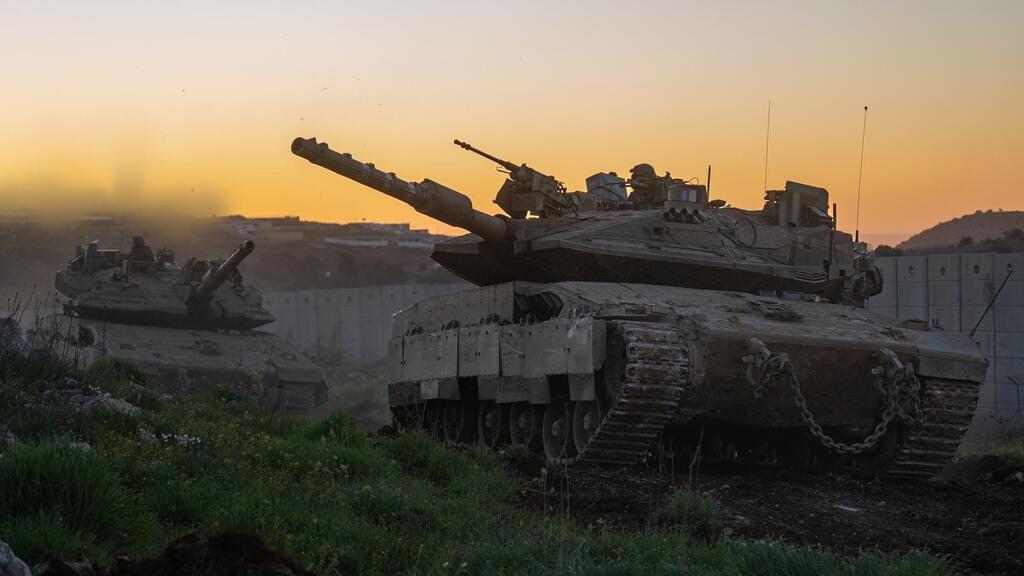
The 401st Brigade operates in southern Lebanon
(Photo: IDF)
“This week was the final memorial. Twenty years. I was at all three memorials. I spoke at all three.
“It was very difficult for me to be the one who did not bring their sons home. And it was difficult for them that someone survived and it was not their son. That is a very human feeling.
“But they overcame it with courage, and I received a huge embrace from them. That relationship is very important to me.”
‘One of the best decisions I ever made’
Post-trauma may be one of the most common injuries of war, but when you were wounded there was much less awareness of it.
“This is something that absolutely has to be in our awareness,” Schneider says.
“It is important for me to say that after my injury I spent a year in psychological therapy, by my own choice. I felt I needed it, and that is what helped me get back on track.
“I went through a crisis on an enormous scale, both the injury and the loss of three subordinates and friends, and the decision to seek treatment was one of the best decisions I ever made.
“I speak about it openly and encourage my soldiers to get help. In Brigade 401 there were several incidents in which commanders were the only survivors, and I accompany and support them.”
‘Little Schneider’ and the paratrooper
Schneider, 41, was born and raised in the religious Kibbutz Shluhot in the Beit She’an Valley and still lives in the area.
He is the third of five children and the only tanker among them.
“My father, who immigrated to Israel from South Africa in 1972, was a tank driver in the 53rd Battalion. That is where the seeds of my connection to the Armored Corps began,” he says.
His youngest brother, already known in the IDF as “Little Schneider,” recently completed his command of the Paratroopers Brigade’s 202nd Battalion.
Schneider is married to Shir, a physiotherapist whom he met at Shizafon while she was serving as an armored corps instructor. They have four children.
He grew up professionally in the 188th Brigade, commanded a battalion at the Armored Corps training school and later the 82nd Battalion of the 7th Brigade. He also served outside the corps as deputy commander of the Nahal Brigade.
A few months before the October 7 attack, he was appointed commander of the 205th Brigade, a reserve armored brigade under Northern Command.
“It was at the end of the judicial reform period,” he recalls. “There were many command challenges. Budget cuts, fighting over reserve positions.”
Where were you on the morning of October 7?
“I was at home. I saw the photos and videos on Telegram. In my head I immediately thought: ‘This will happen in the north too.’ After all, we had always prepared for a scenario like that.
“I raced north without any order. I reached our emergency warehouses at Golani Junction, called up the brigade. Everyone arrived by noon and we moved north.
“For almost half a year we were on the defensive line, deployed with tanks around Kabri Junction and Ma’alot.
“During Operation Northern Arrows we fought and maneuvered. We were among the first to enter significant fortified, densely vegetated areas, exactly the same places where I had maneuvered before I was wounded in 2006.
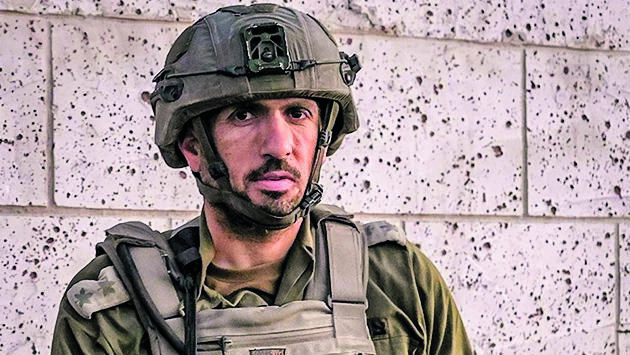
Col. Ehsan Daxa, who was killed by an explosive device in Jabaliya in Gaza
(Photo: Rabia Basha)
“We destroyed frontline villages such as Marwahin. At Jabal Blat we lost four soldiers to an explosive device. The troops reached a shaft inside the fortified area where a terrorist was trapped. He activated a suicide charge. The evacuation from there was also very difficult.”
At the end of November 2024, the 205th Brigade left Lebanon and its reservists were released, only to be called up again for a three-month deployment in Rafah from April to June 2025.
“Before going down to Rafah, I spent hours learning from Barak Hiram,” Schneider says, referring to Brig. Gen. Barak Hiram, now head of the IDF Operations Division and then commander of the Gaza Division.
“Gaza is completely different fighting from the north. We came with a concept of systematically clearing an area, above and below ground.
“In Tel Sultan, for example, six different brigades had passed through before we arrived. And every time there was an agreement, and under its cover the terrorists returned. We did not leave them anywhere to return to.”
The 401st Brigade paid a heavy price during the war, particularly the 52nd Battalion.
The three battalion commanders who preceded Ben-Simhon, Daniel Ella, Yehuda Shalev and Or Yol, were all wounded in combat. A long list of other commanders at every level were killed or injured.
“This is a decisive brigade, an operational, leading and offensive brigade, and that is what happens at the tip of the spear when the policy is that commanders lead from the front,” Schneider says.
“But the brigade knows how and is built to absorb events and crises like these. It does not stop, but it does not suppress them either.
“When I lost Dor, I felt enormous pain. The brigade command post felt it too. We were friends.
“But morning comes and you keep moving forward. For Dor and for the mission.”
It is also very difficult for the soldiers to lose the commanders who led them.
“We give that a lot of space in the brigade, the human strength. From the brigade commander to the last commander, we reach the soldiers.
“The brigade has absorbed so many blows during these years of war, and commanders have developed the ability to look their soldiers in the eyes. Humanity at every rank.”
Does that come at the expense of discipline? Afterward, when units leave combat, you see incidents like the revolt by Givati soldiers at the Sde Teiman base.
“It should not come at the expense of discipline and clear, rigid procedures, but it is very complicated after three years of war, when battalion and company commanders at the front are mainly occupied with missions and operational achievements.
“Naturally, there is less discipline than in routine periods, and during combat you focus primarily on values.
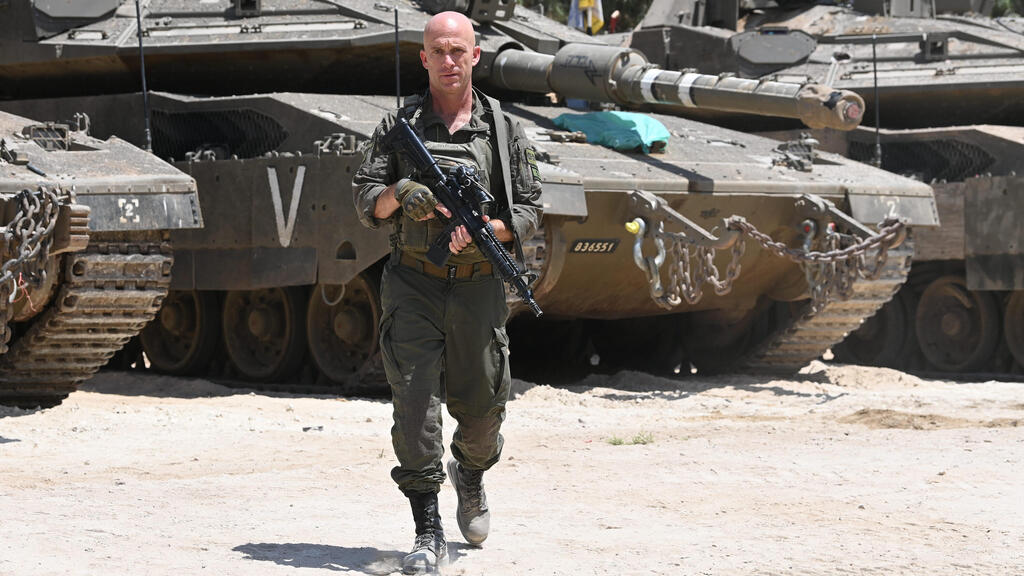
Col. Yoav Schneider
(Photo: Herzl Yosef)
“We prepared for this weak point, the transition back to routine, and planned for it at company and platoon commander level.
“We knew there would be friction when filling the command vacuum created over such a long period of fighting.
“Suddenly the commander wants to inspect the soldiers’ weapons. How is the soldier supposed to react? From his perspective, there is no doubt that he knows how to maintain and operate that weapon after he has already killed terrorists with it.
“So now, during this temporary routine, we are trying to rebuild. It is not easy. Suddenly you are teaching departure inspections, weapon checks, readiness.
“Inside Lebanon, the platoon and company commanders clean their weapons next to the soldiers. They do not inspect the soldiers’ weapons there.
“The concern is that this leads to many unacceptable practices resurfacing, such as veteran soldiers abusing younger ones. Discipline is one whole package.”
So how do you deal with it?
“We anticipated that complexity, and that does not mean we did not encounter phenomena we had to address.
“You have to understand that after three years of war, the norm has shifted.
“Now the soldiers training the new recruits are themselves people who grew up inside the war and never had time to learn the old norm.
“That is why restoring the norm is so important. We are still fighting, so we do not do it by banging our heads against the wall. We make adjustments.”
‘Haredim? I wish more would come’
On October 7, 2023, the 401st Brigade was deployed in the West Bank.
Under then-brigade commander Benny Aharon, now commander of Northern Command’s 146th Division, the brigade rushed to Be’eri and the Sderot police station and later fought in Gaza for two years from the beginning of the ground maneuver.
In January this year, after three weeks of recovery, it moved north and remained there until leaving Lebanon on July 27.
You are returning to Gaza soon. What will operating there look like under the agreements and the Board of Peace?
“There is no doubt the challenges will be different,” Schneider says.
“This is an enormous operational, professional and mental transition for the brigade, from a state of war to permanent defense on the Yellow Line.
“I obviously have no involvement in the diplomatic moves, but from the planning and approvals we have completed so far, the operational mission is clear: prevent enemy infiltration across the Yellow Line, and certainly into Israeli territory.
“We will be there until they tell us otherwise.”
And that comes after nearly three years of continuous fighting.
“For the soldier, the burden is managed. Even in war there are periods of leave and time out. He has someone directing him.
“But the burden on commanders is enormous. They have crazy responsibility in the field, both for the mission and for their soldiers. That is also why command terms are now shorter.
“It is an enormous burden on the family too.”
Schneider makes a point of praising what he calls the “women of iron,” the spouses of brigade commanders and officers who have carried much of the burden at home throughout the prolonged war.
“They are the leaders,” he says. “And they are beside us all the time. They visit wounded soldiers from the brigade, help organize whatever is needed and accompany bereaved families.
“My wife and all the battalion commanders’ wives came to Dor’s funeral. They are genuine heroes.”
What do you think about integrating women as armored combat soldiers?
“The pilot in the Border Defense Corps proved itself,” Schneider says.
“Soon, the 460th Brigade, the training brigade, is supposed to begin the pilot for integrating women as maneuvering armored combat soldiers.
“There is a strong desire for it to succeed, and it has also been determined that the women accepted will have to meet the standards required of maneuvering combat soldiers.
“There are serious people ready to receive and train them. The company commander designated to do it is from the 401st.
“I am definitely in favor of integrating women. I had many women serving with me in combat, medical officers, Sky Rider personnel, maintenance, communications and intelligence collection.”
And integrating Haredim?
“I wish more would come.
“There are no dedicated Haredi tracks in the Armored Corps. I hope there will be, but there are plenty of hesder yeshiva students who are excellent soldiers and excellent officers.
“The corps has excellent relations with the yeshivas, which place great trust in it.
“Even when there was a dispute about integrating women and threats that yeshivas would stop sending students to the Armored Corps, it was resolved through understanding and trust.”
This week, Schneider spent two days at the IDF’s induction base during Armored Corps recruitment.
“I explained to the recruits that they need to understand that when an infantry soldier meets a terrorist, it is M16 against M16, or Kalashnikov.
“But the tank is the decisive striking force.
“Especially when we are fighting terrorist organizations and guerrillas rather than Syrian armored columns.
“Every ground commander knows the tank is the game changer. And today, after three years of war, we understand that more clearly than ever.”