

'I live now for four' — Lt. (res.) Nataniel Kogel
On June 15, 2024, a Merkava 3 tank from the IDF’s 8th Armored Brigade moved through the northern Gaza Strip as part of an operation to expand Israel’s control near the Netzarim corridor. The four-man crew had trained and fought together for months. Only one would return alive.

Lieutenant (res.) Nataniel Kogel, 25, was the loader on the tank from Battalion 129. He was severely wounded when a powerful explosive device detonated beneath the vehicle. The blast killed his three crewmates: Capt. (res.) Eitan Koplovich, 28, married and father to a seven-month-old baby; Staff Sgt. (res.) Elon Waiss, 49, a father of seven and grandfather to one; and Sgt. (res.) Nir Hadad, 28, married and father to twin four-year-old girls.
“The last clear memory I have of them,” Kogel says quietly, “is the briefing before we went out. Eitan gathered us and said he trusted us. Then Ilon and Nir went to get something from the quarters, and Eitan and I went to the tank. I remember counting shells with Elon. Then we went to rest. The last thing I remember is putting my weapon on the lower part of the tank and climbing up. My next memory is waking up in a hospital.”
Kogel completed his regular service in 2022, most of it spent on a Merkava 4 tank. After the Hamas-led terrorist attacks on Oct. 7, 2023, a friend told him about retraining for the Merkava 3. He didn’t hesitate. “I passed the course and re-enlisted on Oct. 15,” he recalls. His new crew — Koplovich, Waiss and Hadad — became close during their months together. “They were older, experienced, people with their heads on straight,” he says. “I learned so much from them. The long time together connected us in a crazy way.”
He had been planning a vacation in Barcelona on June 1, 2024, but canceled after Koplovich called him. “They’ve mobilized three divisions,” the commander told him. “Just be ready.” Kogel says he couldn’t imagine his crew going into Gaza while he was on holiday. “It wasn’t even a question.”
Two weeks later came the explosion. “From what they told me,” Kogel says, “we left around 5:15 p.m. We made a turn, I probably pressed the accelerator, and we drove over a belly charge. My leg was right above it when it exploded. I had an open fracture in my ankle, two in my shin, and one in my knee. Because it was a penetrating charge, it went in at an angle and flew between Ilon and Eitan, who were killed instantly. Nir was trapped inside when the cannon collapsed, blocking the hatch. I remember trying to get out and then nothing.”
The tank was dragged to safety before rescuers approached, to avoid additional casualties. “They pulled me out after about fifteen minutes,” Kogel says. “They thought they were lifting a body. They realized I was alive only when I moved my mouth.” Hadad, suffering burns and smoke inhalation, was extracted 50 minutes later. Kogel was flown to Ichilov Hospital in Tel Aviv in critical condition. “They thought I wouldn’t make it and that he would,” he says. “The doctors said if they had delayed even a little, I wouldn’t have survived.”
He did survive, but at a heavy cost. Blood flow had stopped to his hands, causing gangrene. After six weeks, surgeons amputated his fingers while he was sedated and intubated. “My parents had to sign everything,” he says. “There wasn’t even time for consultation.”
Four months later, Hadad died of his injuries, making Kogel the only survivor of the crew. He learned about the others gradually. “At first my parents, together with a social worker, told me,” he says. “I didn’t ask too much. I was in survival mode.” Eventually, an older reservist — “Nehemiah, the ‘grandfather of the platoon’” — sat by his hospital bed and told him the full story. “I remember having no words,” he says.
Kogel keeps in touch with the families of his fallen comrades. “On Memorial Day I was at Eitan’s grave,” he says. “On the anniversary of the incident I was with Ilon’s family, and at the 11-month mark for Nir, I was with his.” The families, he says, have become part of his life. “The Waiss family came to see me right after the shiva. All seven children came with food. They’re incredible people.”
He refuses to let survivor’s guilt take over. “I don’t feel guilt,” he says. “What happens, happens. I couldn’t have done anything differently. What really bothers me is not knowing every detail — the last conversation, the last moments. I miss them terribly. Sometimes I open our WhatsApp group and listen to their voice messages.”
The experience, he says, has given him purpose. “Since the incident, I always tell myself — I live now for four, not for one. When I don’t have energy, when I’m tired, I say: you started something, finish it. My friends who were killed give me strength. Because of them, I feel responsible to live a more meaningful life. I haven’t found that meaning yet, but when I do, I’ll see it through.”
'Why was I the only one left?' — Lt. Natai Avizemer
On Oct. 7, 2023, terrorists stormed southern Israel in the deadliest assault in the country’s history. At a training base of the IDF Home Front Command near Zikim, the recruits of Company “Tavor” were starting their day. By dawn’s end, nearly the entire officer staff was dead. Only one survived.

Lt. Natai Avizemer
(Photo: Nimrod Glickman)
Lt. Natai Avizemer, now 22, was then a newly commissioned platoon commander. “At 6:29 a.m. the sirens began,” he recalls. “Very quickly we started seeing videos of what was happening on the border.” His company commander, Maj. Adir Abudi, decided to replace the recruits on guard with experienced officers. It was a decision that likely prevented the base from being overrun.
In the fierce battle that followed, six commanders and one recruit were killed: Abudi; his deputy, Capt. Or Moses; platoon commanders Yannai Kaminka and Adar Ben Simon; Sgt. Maj. Omri Niv Firshtein; Sgt. Maj. Eden Alon Levy; and recruit Neria Aaron Nagari. From the entire officers’ team, Avizemer was the only one who survived.
The night before, on Oct. 6, the staff had gathered for a “Friday schnitzel” dinner to celebrate Simchat Torah. “We made schnitzel, eggplant, fries and onion rings,” Avizemer says. “It was just us, the staff. We had fun. I remember Yanai insisting that one of the soldiers in kitchen duty eat while it was still hot. Less than 24 hours later, it all ended.”
When the attack began, Avizemer and Moses were together. Their operations officer had been shot by a sniper. “Or and I decided to run and pull him to safety,” he says. “We counted one-two-three and ran. She was right next to me, shoulder to shoulder. While we were pulling him, the sniper fired. She let go, put her hand on her vest and said, ‘I was hit.’ She fell on her knees. I yelled, ‘Get up!’ I didn’t realize she’d been killed. In retrospect, Or took the bullet for me. She saved my life.”
The fighting lasted through the next morning. “We evacuated toward Ramla,” Avizemer says. “It was dark, no reception, no power. There were bodies — terrorists, civilians, soldiers. Really hard sights.” He says the funerals that followed were overwhelming. “A day earlier I’d eaten schnitzel with these people. Then I was standing with their families.”
At first, he didn’t have the courage to approach the bereaved parents. “At Or’s memorial in Ashdod, I came with my parents,” he says. “Her mother, Yochi, took me aside and said, ‘Tell me everything.’ I broke down. I couldn’t even speak. It was a terrorist’s choice — to shoot her, not me.”
Like many survivors of Oct. 7, Avizemer struggles with the question of why he lived. “That I came back to my family while another family’s child didn’t — how can I look them in the eye?” he says. “But every family I visited hugged me. They wanted memories, pictures, anything.”
He chose to stay in service even after a mental health officer told him he could go home. “I couldn’t leave,” he says. “Not when friends were fighting in Gaza. Not after what happened.” A year later, he received the President’s Medal of Excellence for his actions that day. “It was a great honor,” he says, “but also hard. Why only me? Everyone did everything. Some gave their lives for me.”
He avoids certain reminders. “I can’t eat schnitzel anymore,” he says. “For a long time I couldn’t look at pictures. I never opened our Oct. 7 WhatsApp chats. I can’t delete them, because they have voice messages from people whose voices I still want to hear.”
When Memorial Day or Oct. 7 anniversaries come, he says, the pain returns. “I see the pictures, hear the names — Or, Adir, Yannai, Adar, Eden, Omri, Neria — and I ask again: why was I the only one left? What did I do wrong to stay alive?”
'I got life as a gift' — Sgt. 1st Class Dor Almog
On Jan. 22, 2024, in an operation near the Gaza border, a combined IDF force of infantry, engineers and reservists from Battalion 8208 was searching and clearing ground when an RPG struck the tank covering them. Two soldiers were killed. A second rocket hit a nearby pair of houses that had been mined to collapse. The explosion triggered the mines and brought down both buildings on dozens of soldiers inside.
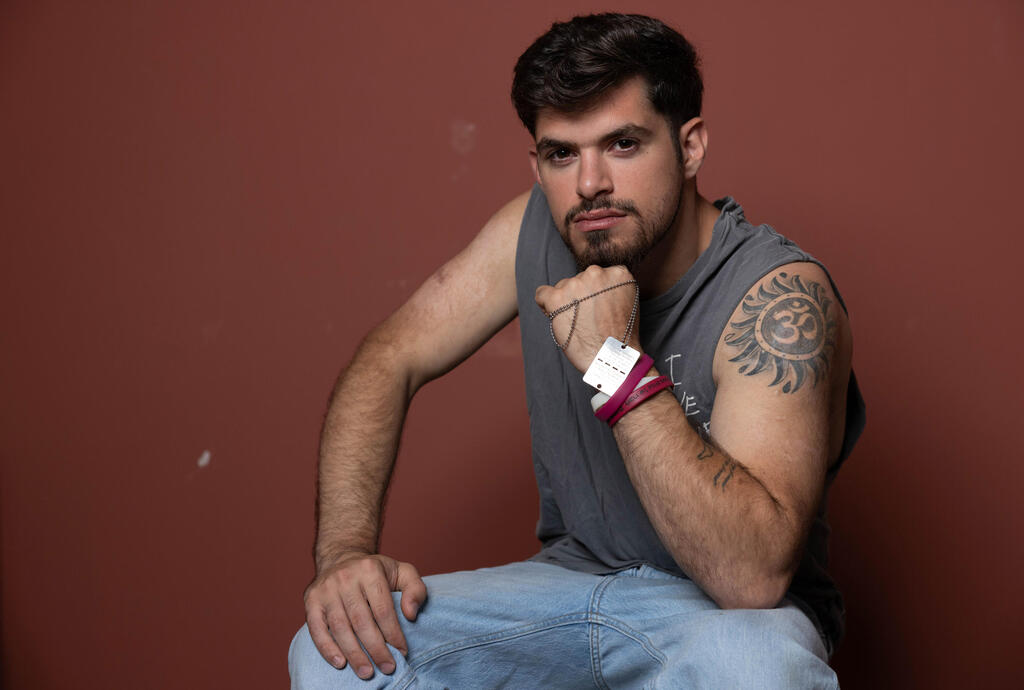
Dor Almog
(Photo: Oz Moalem)
Twenty-one were killed, including 14 from Almog’s platoon and five combat engineers. Sgt. 1st Class Dor Almog was the only one who survived.
Almog, a reservist, had already brushed against death before. On Oct. 6, 2023, a close friend invited him to work at the Re’im music festival. He declined, saying he needed to study. The next morning, terrorists massacred hundreds there, including his friend Amit Maganzi.
When the war began, Almog was called up on Nov. 8. His original unit had been mobilized on Oct. 7, so he joined what he calls a “mixed company” — soldiers of different ages and backgrounds. “There were guys my age and others my parents’ age,” he says. “The veterans showed us what professionalism means. They’d fought in three or four wars. I respected that a lot.”
He says the group became like family. “We had a Bedouin, a Filipino, a Russian — it sounded like the start of a bad joke, but it worked,” he says. “When everyone was talking about division in the country, we were the most united.”
During the Jan. 22 mission, Almog’s platoon was inside one of the buildings when the RPGs hit. The next thing he remembers is a “white screen.” “I felt like I was floating,” he says. “I felt Amit wrapping around me and protecting me. Then I woke up in darkness. The smoke was choking me. I tried to breathe — everything burned. I took off my vest and helmet and crawled toward the exit.”
Outside, two soldiers found him and gave first aid. He was evacuated by armored carrier and then helicopter to Soroka Hospital in Be’er Sheva. “They were waiting for dozens of wounded,” he says. “Only I arrived.” He was sedated for five days, with burns over 70 percent of his body, some down to the bone, and fractures in his face and eye sockets.
“When I woke up, I asked the question you’re not supposed to ask in the army — ‘Where is everyone?’” he says. “The deputy battalion commander read out the names one by one. It took me a long time to process it.”
Technically, doctors told him, he survived because he fell under the main support wall of the building. “That’s the most technical answer,” he says. “There’s no real explanation. I was in the same place, at the same time, as everyone else.”
He dislikes being called “the only survivor.” “In rehab at Sheba, everyone is a survivor,” he says. “Some were shot nine times, some hit by missiles. It’s as if all the miracles were in one room.”
Almog says he chooses to see his survival as a gift. “If I see it as a burden, I don’t deserve it,” he says. “I don’t know why it was me, and I prefer not to know. I prefer to say thank you for life. When they told me to try moving my legs — and I did — that was the best gift. I’ll return to the army one day, but not yet. I want to prove to myself that I can jump, run, fire a weapon. I miss everyone. They were the salt of the earth. They fought so that our children could live without fear.”