

U.S. President Donald Trump has petitioned the Supreme Court, asking it to approve the presidential order he signed that imposes dramatic restrictions on Americans’ ability to vote by mail. The appeal filed last week to the high court came after a federal court blocked key parts of the order and a judge in Massachusetts ruled that “the Constitution does not grant the president specific powers regarding elections.” She underlined the word “does not.”
The order Trump signed at the end of March imposes tough restrictions on mail-in voting, a method that has become very popular in the U.S. in recent years — and one that has been at the center of the president’s unproven claims of alleged widespread fraud benefiting his Democratic rivals. The order instructed the Department of Homeland Security to create lists that would help determine voter eligibility, and required the U.S. Postal Service to deliver ballots only to citizens included on those lists. More than 20 attorneys general from Democratic-controlled states challenged the order, arguing that it violates the Constitution, including the principle of separation of powers.
Gallery
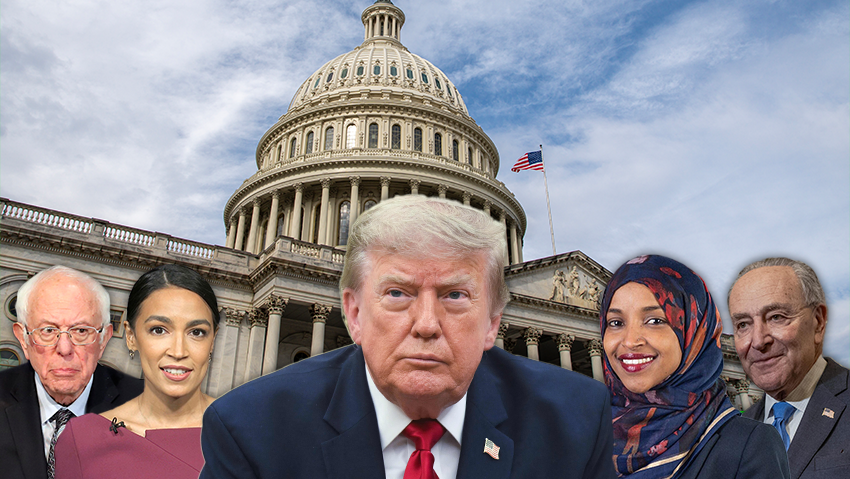
Trump and several senior Democrats - Chuck Schumer, Ilhan Omar, Alexandria Ocasio-Cortez and Bernie Sanders
(Photo: Shutterstock, Tasos Katopodis/Getty Images, Wikipedia, AP)
All the lower courts accepted the challenge, and Trump eventually reached the Supreme Court, which will now have to rule — three months before the November 3 midterm elections, seen as a referendum on the president’s term and in which control of Congress will be determined. In its appeal to the Supreme Court, which is controlled by a conservative majority, the Trump administration stressed the urgency of accepting the case, noting that for the new policy to affect the upcoming elections, it must take effect as early as August.
Soldiers seizing voting machines? Trump’s 'regret'
Trump’s ongoing fight against mail-in voting — a practice dating back to the Civil War and one that has existed in every U.S. state since the 1980s — is a central part of the all-out war the president continues to wage not only against the results of the 2020 election, when he lost to Joe Biden, but now also against the possibility that the Republican Party will lose the coming midterms or the 2028 presidential election. In Trump’s view, he can never lose unless there was a conspiracy against him.
And so, although he returned to the White House even after igniting the Jan. 6, 2021 Capitol riots, he continues to push the lie that the 2020 election was stolen from him. This obsession, as well as what his critics see as basic contempt for democratic government, is leading Trump to unprecedented, unconstitutional intervention in election processes. The fact that he himself votes by mail, as do all members of his family, does not matter to him. He is so focused on the election that was “stolen” from him that he ignores the fact that many Republicans — especially older voters who support the Republican Party at high rates — also vote by mail.
Last year, Trump told The New York Times that he regretted rejecting, after the 2020 election and before leaving the White House, his advisers’ proposal to send National Guard troops to seize voting machines in order to examine whether they had allegedly been used for widespread fraud, a claim Trump has repeatedly made in the past without any evidence. It was clear evidence of his willingness now, in his second term, to take far more dramatic steps than before to interfere in elections.
Last month, he delivered a special prime-time address to the nation in which he claimed that China had interfered in the election six years ago on Joe Biden’s behalf. As part of the address, the White House released classified documents, but those did not actually support the claim, and official sources in the U.S. intelligence community rejected it — but that is not the point with Trump. He is simply convinced that anyone who does not vote for him, or for his people, is cheating, falsifying or simply unworthy of voting.
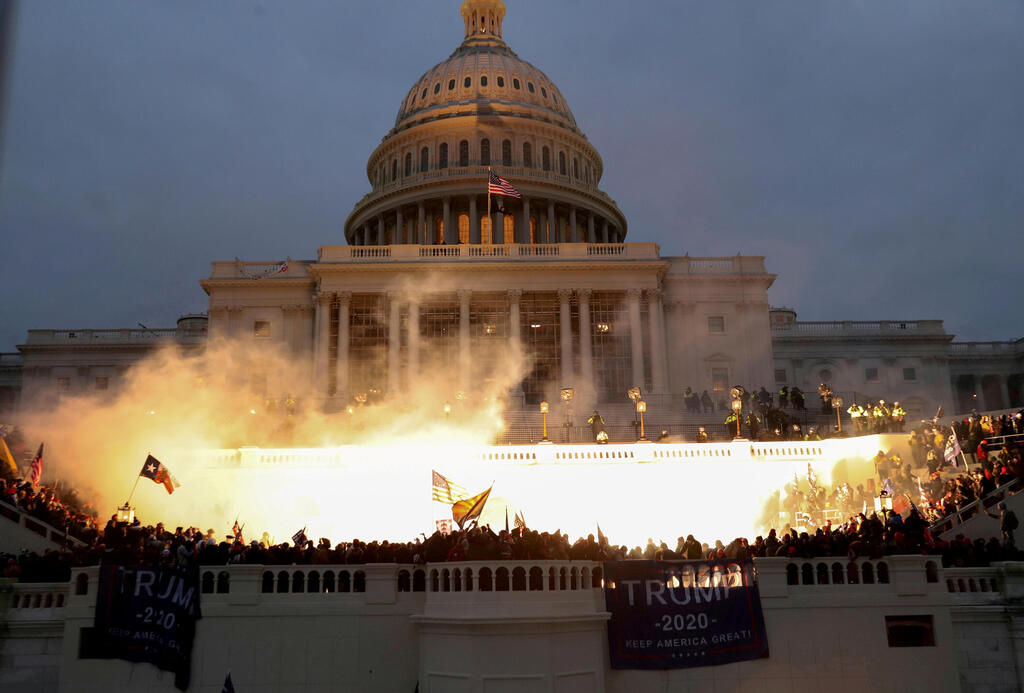
The storming of the US Capitol on January 6, 2021
(Photo: Reuters)
Trump has spent years using social media and campaign rallies to sow doubt about the integrity of U.S. elections. He continues to do so today, but now he has unlimited power to instruct Cabinet secretaries and political appointees in places such as the Federal Bureau of Investigation and the Justice Department to implement his agenda. Since returning to the White House, he has led feverish efforts to reshape the rules governing elections, and the courts have so far blocked many of his attempts to change laws and procedures through presidential orders. But he knows at least one thing: His most loyal supporters will not believe any result that is not a Republican victory in November.
The battle over ID: 'Millions will be hurt'
The U.S. Constitution gives the states responsibility for administering elections and allows Congress to pass federal election laws. What it does not do is give powers on the matter to the executive branch, meaning the president. Nevertheless, in early February, Trump said he wanted the federal government under his leadership to “take over” election administration. “A state is just an agent of the federal government in elections,” he said then, in a claim he invented out of thin air.
A year earlier, in March 2025, Trump had signed a presidential order granting himself, again entirely out of thin air, broad authority over election administration. The order required presentation of identification proving citizenship in order to register to vote, and required that ballots sent by mail arrive by Election Day. The issue of presenting a document such as a passport or original birth certificate is a long-running battle between the right and left in the U.S. In most states, an American citizen can register to vote using a Social Security number or driver’s license, and is approved after authorities cross-check the data and verify that the person is a citizen. On the right, they argue that presenting an identifying document is the only way to ensure that only citizens influence election results and that undocumented immigrants do not participate in voting.
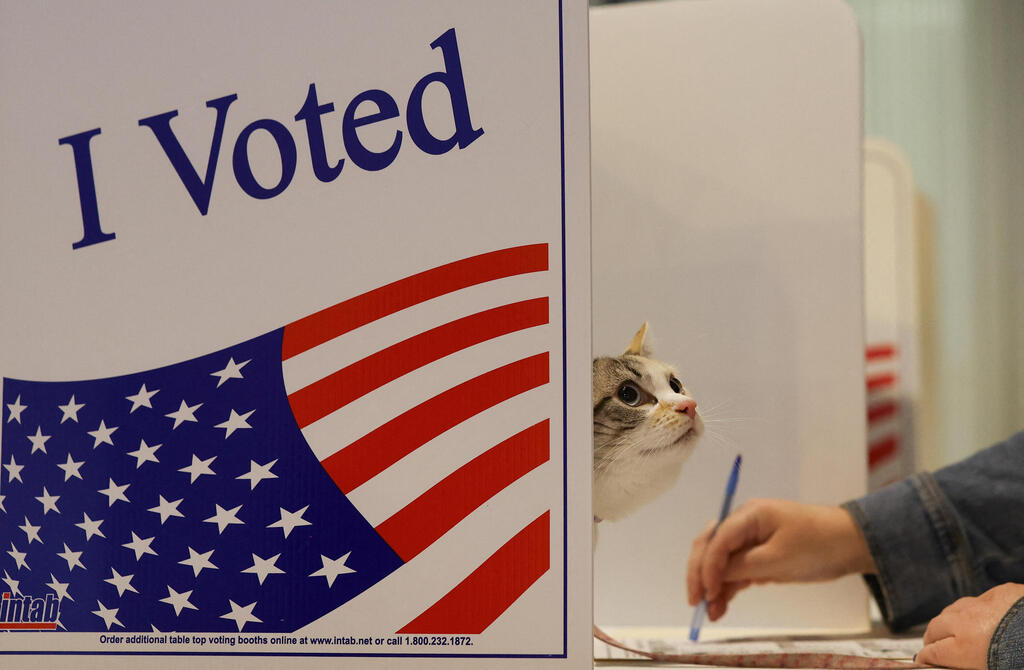
Voting in Pennsylvania
(Photo: Quinn Glabicki/Reuters)
Opponents of the ID requirement — Democrats and civil rights organizations — present data showing that voting fraud is an extremely rare phenomenon, and they warn that a requirement to present a physical document will harm millions of lawful citizens, mainly low-income populations, students and minorities, who lack access to or the money needed to obtain a passport or original birth certificate. In the U.S. there is no national identity card automatically issued by authorities to every citizen.
“Only half of Americans have a passport,” California Democratic Rep. Scott Peters warned, for example. “Millions of Americans do not have easy access to birth certificates. The cost and time involved in obtaining documents and traveling to different offices will deter millions of working-class Americans from voting.”
Either way, only Congress can determine election laws and procedures, and therefore both of Trump’s orders — the order from last March and the additional order from March this year restricting mail-in voting — were blocked by the courts, which ruled that he clearly violates the separation of powers and exceeds his authority.
Another Trump attempt to influence the voting process is through the federal Justice Department, which began demanding that every state turn over its full voter database. More than half the states — most of them under Democratic control, but also some Republican ones — refused to cooperate. The Justice Department sued at least 30 U.S. states and territories, and in the end about 16 complied with the demand.
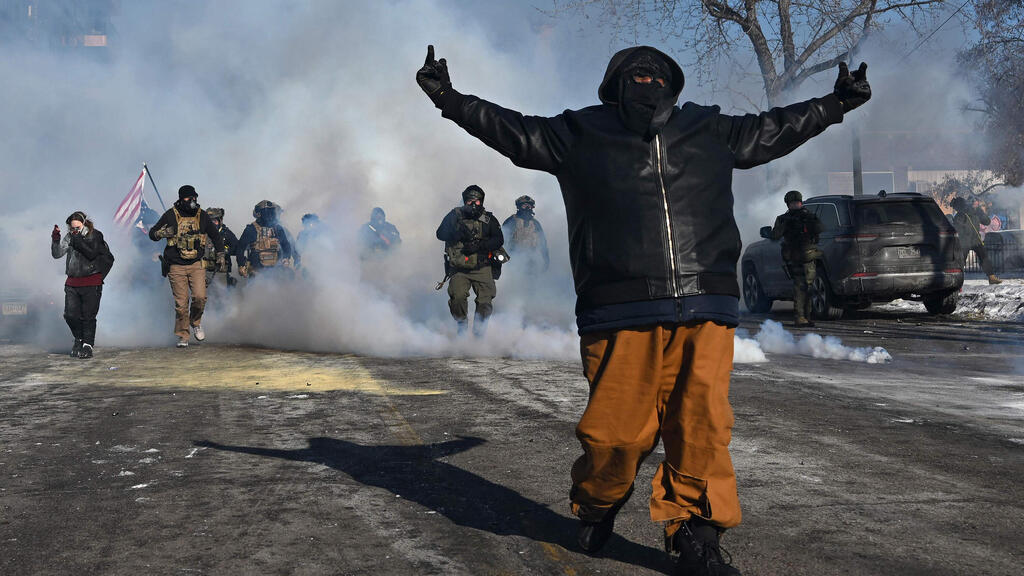
Clashes in Minnesota with immigration agents in January, during which the Trump administration demanded voter rolls
(Photo: Brandon Bell/Getty Images North America / AFP)
During the violent clashes between immigration agents and residents in Minnesota in January, then-Attorney General Pam Bondi demanded that Minnesota hand over its voter lists “to restore law and order.” That request was rejected outright, but a Department of Homeland Security scan of voter lists that were provided found no evidence of election fraud beyond anecdotal. Still, Homeland Security Secretary Markwayne Mullin recently threatened election officials in various states with imprisonment if they do not act to “secure” the elections in their jurisdictions based on information the federal government provides them.
Recently, Trump and the Republicans seized on a disclosure by the New Jersey administration — a Democratic one — that because of a software error in the Motor Vehicle Commission’s computers, 6,600 noncitizens had been entered into the state’s voter database, even though they themselves had not lied and had identified themselves as noncitizens when registering. Although according to New Jersey authorities only 400 of them actually voted between June 2023 and June 2024, Trump claimed that 35,152 noncitizens had been included in the voter database.
“These are only the ones who were caught. The real numbers will prove to be many times higher than this amount,” the president posted on his social media platform, Truth Social, last week, again without providing evidence for the claim. “They are all Dumocrats! Republicans, wake up and clean up our corrupt elections!”
It is unclear exactly what Trump based the figure he provided on, but it is likely an estimate of the maximum possible number of noncitizens who might be found in New Jersey’s voter database, an estimate from the Department of Homeland Security whose reliability is questioned by experts and whose methodology is unclear. And whether the number is 6,600 or 35,152, it is still a small number compared with more than 6 million registered voters in New Jersey.
Overall, Trump himself claimed in his special address to the nation about two weeks ago, which focused mainly on Chinese interference, that 278,000 noncitizens had been identified in the voter databases of four states: California, Pennsylvania, New Jersey and Nevada. However, the American media reported that, in practice, letters sent by the Department of Homeland Security to election officials in those four states said this was the maximum possible number of noncitizens who might be included in the records, and experts question the reliability of that estimate.
The law that will 'save America'
Either way, after a series of court losses, Trump apparently understood that he would have to go through Congress to advance the revolution he wants to bring about in the election system, and in recent months he has applied heavy pressure to force through legislation that would codify many parts of his orders into federal law. The law, called SAVE America, an acronym for Safeguard American Voter Eligibility that was deliberately worded, would require specific documentary proof of citizenship in order to register to vote, require states to submit their voter rolls to the Department of Homeland Security and, in the fine print, make it especially difficult for those whom Republicans prefer be unable to vote: minorities and women.
For example, the requirement to present a physical document such as an original birth certificate in order to register or update registration would make things very difficult for women who changed their last names after marriage, since for 80% of them, the name on the birth certificate does not match the current name on their driver’s license or in databases. To resolve the discrepancy, married women would be required to present original legal documents such as a marriage certificate. All of this would create a bureaucratic obstacle course that would ultimately cause many women, who had already been registered to vote, simply to give up on it.
As of now, this law cannot pass the Senate because it requires 60 votes, and Republicans do not have them. They hoped to pass parts of the law through the back door, using a special procedure that allows budget laws to pass by a simple majority, but so far there has been no progress there either.
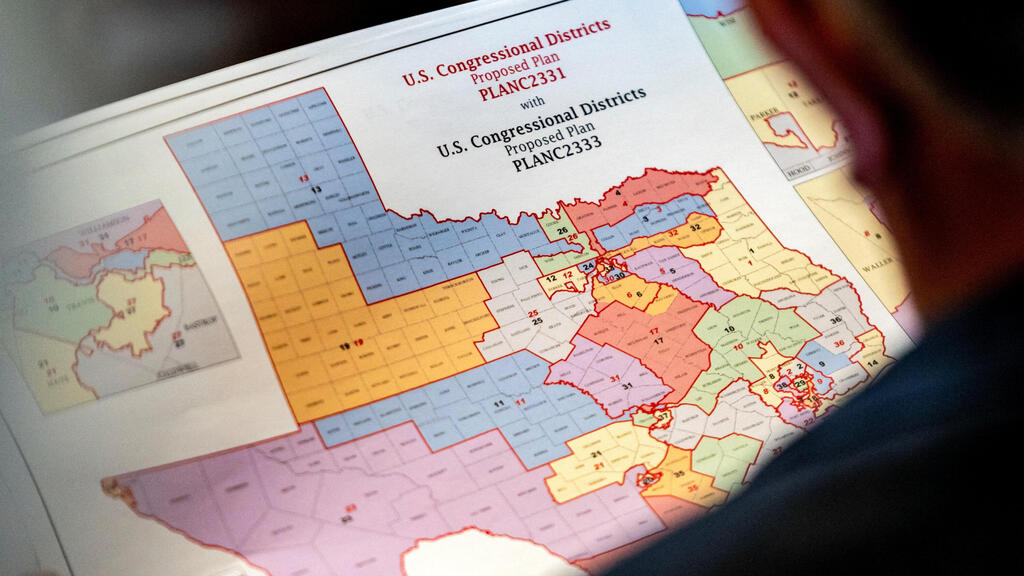
Texas district map: Democrats fired back in the "map war" - but Republicans appear to have won, gaining an important advantage
(Photo: Sergio Flores/Reuters)
In recent weeks, Trump has devoted a significant share of his time to this law, and he expressed his frustration that it has not yet advanced, for example, in his decision not to sign another law promoted jointly by Republicans and Democrats — a reform meant to help solve the housing crisis in the U.S. Republicans had hoped to present that law to their voters as an achievement in the fight against the cost of living ahead of the November elections, but Trump dismissed its importance and explicitly stated in a post published July 10 that he would not sign it as a “protest” over Congress’ failure to approve the SAVE America Act.
“Not passing it is c-r-a-z-y,” he wrote, repeating his call for Republicans to completely remove the rule requiring 60 votes to approve most legislation in the Senate. Paradoxically, that rule can be removed by a simple majority of 51. He warned that Democrats would do so the moment they take control of the upper chamber. “If and when they have the opportunity to do it, they will do it in their first hour — and I will no longer be able to call them Dumocrats! The title s-t-u-p-i-d will return to the Republicans who allowed this terrible disaster to happen to our party, and to our nation itself!”
But even without the law, Trump is using other ways to influence the elections, ones his rivals cannot challenge in court. For example, as soon as he returned to the White House, the Justice Department canceled all lawsuits related to voting rights violations that the Justice Department under Biden had filed against certain states. The number of attorneys working in the Justice Department’s Voting Section — which for decades served as a critical protection mechanism against civil rights violations in voting — shrank from about 30 at the end of the Biden administration to single digits under Trump.
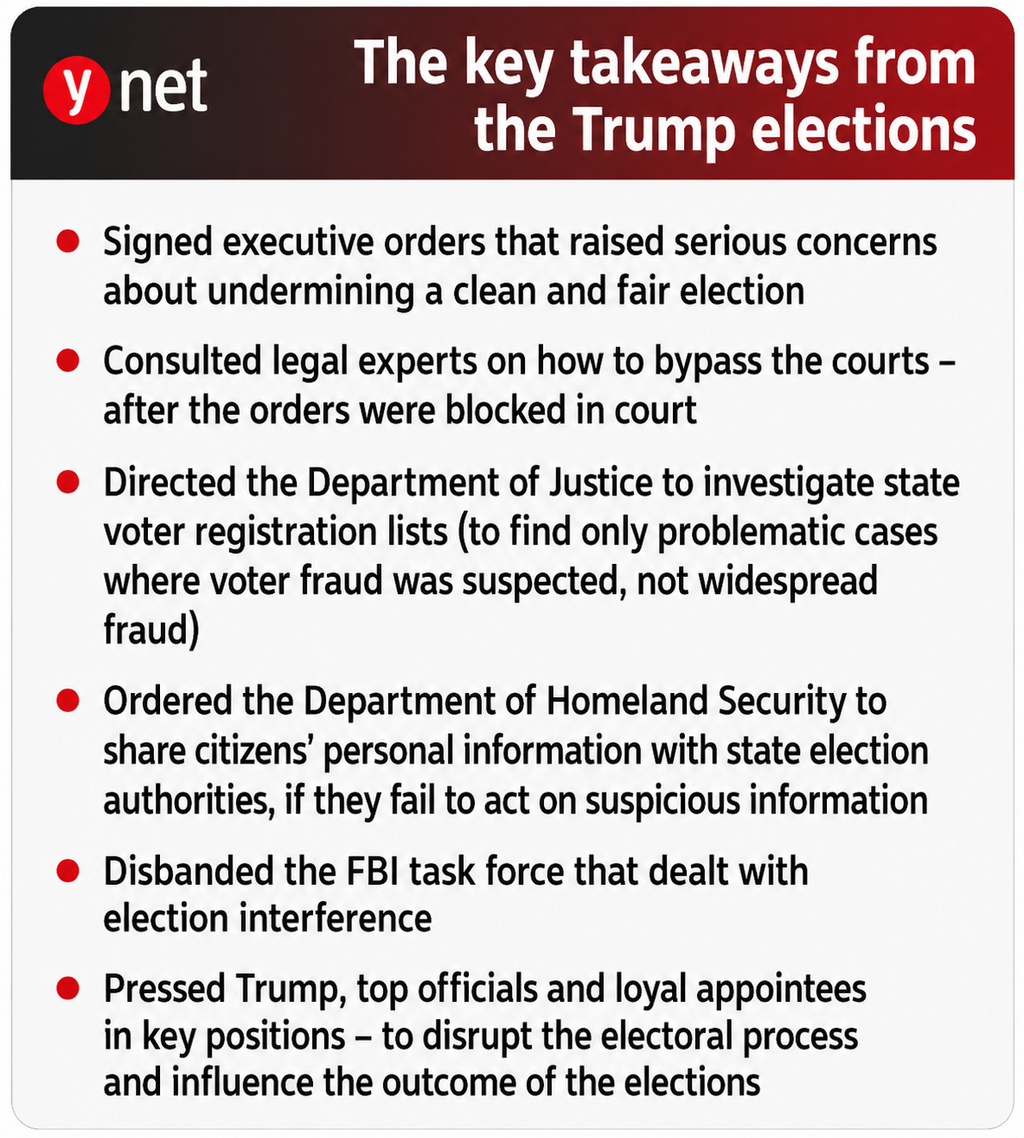
Another significant step the president took was damaging the country’s election security infrastructure: He weakened the Cybersecurity and Infrastructure Security Agency, canceled an FBI task force whose purpose was to fight foreign interference in U.S. elections and ended a program responsible for sharing intelligence threats.
The redistricting war which ended in a Republican gain
Trump’s most aggressive and perhaps most effective strategy, aimed specifically at preventing a possible defeat in the November House elections, is the “redistricting war” in the states. Federal law requires redrawing the map of electoral districts in every state — with one representative to the House elected in each such district — according to the results of the national census held once every decade. The next census will be in 2030. The census determines the size of the population in each state and dictates the redistribution of districts in the House: States that grew in population gain representatives, and vice versa.
Although there is no legal prohibition on redrawing maps whenever a certain state feels like doing so, state leaders in the past made sure to stick to redistricting only once a decade, out of an understanding that maintaining basic rules of fairness among states is necessary to preserve the “American experiment.”
But last summer, Trump began pressuring Republicans in Texas to redraw their congressional map in the middle of the decade in order to guarantee a larger number of Republican-controlled districts before the midterm elections. Texas quickly agreed, and North Carolina, Missouri and Ohio joined. Overall, nine new Republican-leaning districts were suddenly added.
Democrats responded by drawing new maps in California and Virginia, in what seemed to bring the redistricting wars to a draw. But then the Supreme Court weakened a central component of the Voting Rights Act — a provision that prevented drawing maps in a way that discriminates against voters on the basis of race — allowing Tennessee to eliminate the only Democratic-controlled seat in the state. Louisiana and Alabama joined with new maps, each of which eliminated a district with a large Black majority. In addition, the Virginia Supreme Court canceled the new map drawn there by Democrats, so Republicans are entering the midterm House elections in a far better position than they were less than a year ago.
In total, the estimate is that the map-drawing war added 10 theoretical seats for Republicans. This estimate is based on voting history, but because these are newly created districts, there can still be surprises. Either way, it is still unclear what their chances are of preserving their narrow majority in the House, which currently stands at 219 Republicans to 212 Democrats, with four additional seats now vacant. Historically, the party of the sitting president weakens in midterm elections, which are seen as a referendum on the president’s term. Trump’s popularity amid the war in Iran and the price increases it caused is now at a low point, about 32% according to a poll published this week by the Quinnipiac Institute — a recipe for catastrophe for Republicans.
Still, polls that generally ask whom Americans will support in congressional elections — a Democratic or Republican candidate — currently show a relatively narrow Democratic advantage of about 6%, equal to victory by about 10 seats in the House. The most recent Emerson College poll from this week showed an 11% advantage for Democrats, but it is likely an outlier.
In the Senate, by contrast, the Republican advantage today is significant, 53 to 47, and even if there is a “blue wave,” Democrats will need to “run the table” to reach a minimal majority of 51. In the event of a 50-50 tie, Vice President JD Vance would have the tie-breaking vote. That means winning in North Carolina, Maine, Ohio and Alaska, and not losing Democratic-held seats up for election in New Hampshire and Michigan. All those races currently appear close.
In the Senate, Republican control matters to Trump because appointments to senior administration positions and judicial nominations require approval by the upper chamber of Congress. But aside from that issue and the passage of his major legislation last year, which he called the “Big Beautiful Bill,” Trump has attached relatively little importance to Congress in the first two years of his second term. That will likely continue in the next two years, regardless of who controls it.
But Trump does fear that a Democratic victory in the House would lead to the start of additional impeachment proceedings against him. That fear has no basis, because even if Democrats approve impeachment in the House, under no scenario would they have the majority required for actual removal through conviction in the Senate, which requires two-thirds. Republicans in Congress refused to remove and convict Trump even after the Capitol riots in 2021, so it certainly will not happen now.
The Trump effect: Democrats hold 'war games'
Two weeks after the Jan. 6, 2021, riots, Trump left fortified Washington in disgrace. He refused to attend the transfer-of-power ceremony for Joe Biden, and only a few dozen family members and loyalists accompanied him to the airport. On that day, it seemed that the U.S. had finished that chapter in history and, in any case, would never again allow a person who tried to set its democracy on fire to return to the White House. The fact that Trump did ultimately return to power probably says quite a bit about the importance Americans attach to democratic principles — and mainly gave the president enormous confidence that he can do anything. He is acting exactly that way and does not forget for a moment the stinging defeat in the 2020 election.

Protester who became famous when he broke into the Capitol. He also received a pardon from Trump
(Photo: Getty Images)
On his first day in office, Trump pardoned nearly 1,600 people who were convicted of or charged with involvement in the attack on the Capitol, including those who assaulted police officers; he uploaded a page to the White House website accusing Democrats of approving the “stolen election”; he ordered Tulsi Gabbard, the former director of national intelligence, to help the FBI investigate his baseless claims of voting irregularities in Georgia — the same state where, in his famous phone call with its Republican election officials, Trump pressured them to “find” him the 11,780 votes he needed to defeat Biden there; he issued subpoenas for 2020 election records in Arizona, where he also lost to Biden; demanded access to voting equipment in Missouri; and filled his administration with 2020 election deniers. Whether he truly believes he won or it is only an act, Trump is preoccupied with 2020 without pause, and the cumulative effect of citizens losing trust in the electoral system is real.
Another sign of the obsession that still remains over his 2020 loss was the heated interview he gave to NBC reporter Kristen Welker about two months ago, which he stormed out of when the issue came up. The interview took place against the background of the vote count that was still underway at the time in the first round of the California gubernatorial election, when it was still unclear whether Republican Steve Hilton would advance to the second and decisive round in November against Democrat Xavier Becerra. California’s counting process is notorious for its slowness, partly because of the extensive use of mail-in voting there, and Trump quickly claimed — again without evidence — that Democrats were “cheating” to prevent Hilton from defeating another Democratic candidate who was competing with him for second place.
“These were rigged, dirty elections,” Trump said, referring to the 2020 election. “And it is happening again now in California,” he added — two days before Republican Hilton was, in fact, declared to have advanced to the second round. When Welker argued with him and stressed that there was no evidence of cheating, the angry Trump attacked moments before leaving the interview: “They are corrupt. Just like you are corrupt. Either you are corrupt or stupid ... The elections in this country are more like in a Third World country. The elections are fake!”
Watch: Trump walks out of the interview with Kristen Welker.
Democrats are now preparing for a real collision in November. At a meeting in Milwaukee in May, attended by staffers from the offices of Democratic attorneys general and secretaries of state — a secretary of state in a U.S. state government is the person responsible for running elections there — “war games” were held to prepare for hypothetical scenarios that could occur in the coming elections.
Nick Brown, the Democratic attorney general of Washington state, told The New York Times that they discussed scenarios such as a situation in which the FBI, under Trump’s loyal ally Kash Patel, suddenly shows up and demands election materials or equipment. They also discussed how they would act if federal forces or agents were deployed in different states in ways that intimidate voters, or if Trump tries to declare a national emergency connected to the elections.
“The grim reality is that now the federal government is our greatest concern — whereas in the past it was our No. 1 partner,” Brown said.
In 2000, Democrat Al Gore lost to Republican George W. Bush after a particularly close and scandal-ridden election in Florida. Ultimately, the Supreme Court, with a conservative majority, decided that Bush had won. Democrats are furious about that to this day, but immediately accepted that ruling, and Gore, who was then Clinton’s vice president, conceded defeat, attended Bush’s inauguration and shook his hand before the entire world.
The fragile American experiment depends on everyone agreeing to the rules and norms and behaving according to them even when they lose. Donald Trump is the only president in U.S. history who refused to accept a clear election defeat, tried to overturn those results and is now using all of his weight and the power of the White House to tilt the next elections in his favor. The damage done to American democracy will be felt for many years to come.