


“On our first Yom Kippur together, when he didn’t go to synagogue, I realized he wasn’t the religious man I thought I had married,” says Noa, 28, from Haifa.
She woke early to pray. Her husband, Yehezkel, remained asleep. When she returned home during the afternoon break, he was still in bed, and she found herself urging him to at least attend the Kol Nidrei service that evening.
Gallery

One fasts, one eats: Inside marriages where partners no longer share the same faith
(Photo: AI)
“A religious person doesn’t behave like that on Yom Kippur,” she says. “From then on, I had all kinds of fears, and they turned out to be justified.”
Noa, whose name has been changed, had discovered that her husband was gradually leaving religious observance without having told her.
The couple met five years ago through a matchmaker. They dated for three months before becoming engaged, a relatively long courtship in the ultra-Orthodox world in which they moved.
“Our first date was really good,” Noa says. “There was a strong connection and the conversation flowed. We didn’t talk much about religion, even though I knew it was important to make sure we both wanted to build a home based on shared Jewish values.”
Noa grew up in an ultra-Orthodox home. Yehezkel had once been Hasidic before moving toward a more modern ultra-Orthodox lifestyle, and as a couple they initially imagined themselves moving toward the religious-Zionist world.
“When we were dating, he put on tefillin and got up in the morning to pray with a minyan,” she says. “After we married, many religious differences emerged.”
Yehezkel says the warning signs were already there.
“Early in the marriage, we were already having conversations about questions of faith,” he says. “I told her I was angry with God for putting me through many difficulties in life, and I didn’t understand why. It was very hard for Noa to hear, but the penny really dropped for her on our first Yom Kippur together.”
“I stayed home most of the day and only went to synagogue in the evening, and even then because I didn’t want to disappoint her,” he says. “Later she saw that on Shabbat I wasn’t regularly going to synagogue either, because I had begun loosening my observance. Once she understood that, it created a crisis of trust in our relationship.”
‘Suddenly I realized the ground beneath me wasn’t stable’
Noa says the revelation devastated her.
“I took it very hard and didn’t speak to him for an entire week,” she says. “I was so shocked and hurt that I wanted to run away and live on my own. It was the hardest week of my life because suddenly I realized I was standing on unstable ground.”
Her rabbi and bridal counselor told her she had to decide whether to leave or stay.
“But they told me that if I chose to stay, I had to accept who he was and understand that every person has a different reality,” she says.
Yehezkel initially promised that the change was temporary.
“I told her I wanted to be religious, that I would improve and stop violating Shabbat, and I really did try,” he says. “I tried to convince both of us that it was a temporary crisis and that it would pass. But it didn’t.”
Noa began emotional therapy. Yehezkel says he mostly withdrew into himself.
Two years later, they were referred to Hitkashrut, an organization that helps families dealing with religious differences between spouses.
Eventually, Yehezkel formally left religious life. Noa chose to remain in the marriage.
“It was difficult, but I tried to be supportive and not show how shocked I was,” she says. “It is still hard, especially on Shabbat and holidays, because our lifestyles are different.”
“On Shabbat, it is hard for me to be alone at home, and it is hard for him to go out alone, but we still manage to enjoy being together. We have the meal together and sing Shabbat songs in the living room. When he wants to use his phone, he respects me, goes into another room and closes the door.”
“Sometimes I complain, but in the end, what do I really want? I just want him to be with me.”
‘I’ll knock before I come in’
Yom Kippur makes those differences particularly stark.
“We’ll sleep in separate rooms because of the prohibition on marital relations, and I don’t know what he’ll do in his room in terms of screens,” Noa says. “I’ll be in synagogue most of the day.”
“When I come home, I’ll knock on the door so he can let me in. I won’t take a key, because I want to give him advance warning so I don’t see him eating.”
They will still eat the pre-fast meal together, and Noa says she continues trying to persuade him to attend Kol Nidrei.
“He does help me observe my commandments,” she says. “He wakes me up for synagogue and buys the Four Species for me to make me happy.”
She expects the religious gap to become more complicated if they have children.
“We’ll have to work things out and agree in advance on how we do things,” she says. “But right now we’re in a healthy place. We have open communication, we say what we feel and think, we focus on the good things and we’re not frightened by our differences, because anything can be bridged if there is love and goodwill.”
‘A change in faith is not only an individual process’
Avital Baram, a social worker and couples therapist who co-founded Hitkashrut Zugiyit, says a change in religious identity can shake the foundations of a marriage when both partners originally entered it with the same level of observance.
“The spouse can experience it as a betrayal, because these were not the circumstances under which they committed to the relationship,” she says. “Now they are being forced to cope with a partner who lives a different lifestyle.”
“Many people tend to think that becoming religious or leaving religion is an individual process, but in practice it is a process that affects the couple,” Baram says.
 Avital BaramPhoto: Leora Orgad
Because such changes often unfold gradually, she says, the partner who did not choose them can experience a prolonged sense of loss and the collapse of a shared dream.
“On Yom Kippur, when one partner decides to stop fasting, that can be very difficult,” she says. “For a believer, it is hard to see a partner not fasting, especially when even many secular people fast.”
Religious differences reach far beyond prayer, she adds.
“A relationship with a religious gap is a complex relationship that brings challenges into daily life, certainly during the holidays,” Baram says. “For a religious person, faith is expressed throughout their lifestyle, from kashrut, Shabbat and family purity to children’s education, clothing, leisure and their overall worldview.”
But she says neither partner can take responsibility for the other’s level of belief or observance.
“Each person has to understand that faith cannot be forced on someone else,” she says. “A partner’s commandments or spiritual level are not the other spouse’s responsibility.”
‘The same soul that made different choices’
That principle of mutual religious tolerance also guides the relationship between Adi Naveh, 37, a secular woman from Tel Aviv, and Mendy Appelbaum, 31, a Ruzhin Hasid from Jerusalem.
The couple met at a Chabad house in Rishikesh, India.

Mendy Appelbaum and Adi Naveh
“I ended up at the Chabad house almost by accident because I felt lost and was looking for a sense of belonging,” Adi says. “I met Mendy there and told him I wasn’t enjoying Rishikesh. He offered to show it to me through his eyes, and the next day we went traveling together.”
“I didn’t think he was someone I would date because he was religious and I was secular, even though I felt that Mendy and I were the same soul that had made different choices in life.”
Mendy had traveled to India alone after a period of military reserve duty and work.
“When I met Adi, I wasn’t thinking about a relationship because I was two weeks away from returning to Israel,” he says. “But once I met her, I wanted to spend as much time with her as possible.”
One day, Adi asked whether he would ever date a secular woman. When he asked why, she told him she was interested.
“I was surprised,” he says. “But we sat down to talk and eventually decided to go for it.”
Mendy says he regarded the religious gap as part of a journey.
“I grew up in a Torah-observant family, but I always had secular friends too, and I knew that world,” he says. “I saw a light of faith and spirituality in Adi, and that is what I fell in love with. Otherwise, it probably wouldn’t have worked.”
When it was time for Mendy to leave India, Adi says she was heartbroken. He traveled to Delhi, then canceled his flight home and returned to her. They spent another three months traveling together before eventually returning to Israel and moving in together.
Shabbat, with Kiddush and Netflix
Back in Israel, Adi began to understand just how observant Mendy was.
“I knew he was religious, kept Shabbat and prayed, but I didn’t realize how deeply religious he was,” she says.
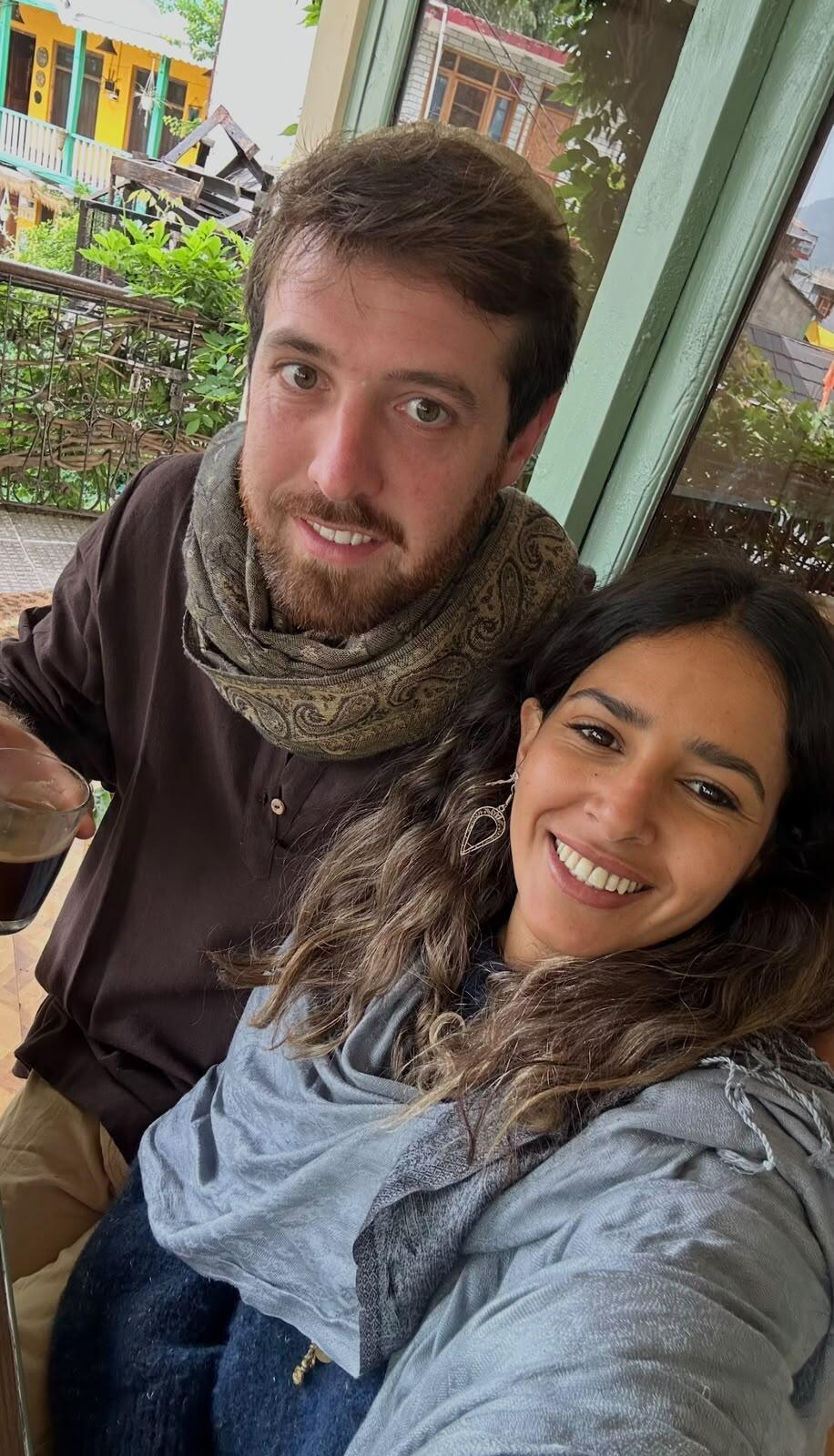
Mendy, she says, taught her that Judaism was not simply a list of things that were forbidden or permitted.
“He taught me that it was okay that I don’t dress modestly or keep Shabbat,” she says. “God still loves me, and that relationship is between me and God.”
Mendy describes their approach as respect for one another’s space.
“We live in two different ways, but we can find points of connection in our faith,” he says. “As we move forward, the gaps become smaller, we find common ground and there is a kind of mutual enrichment.”
The couple has also faced skepticism from others.
“People told us, ‘You’re naive, this will never work,’” Adi says. “Others questioned Mendy’s religiosity and asked when he would go off the path, even though he is as religious as can be.”
She acknowledges that in practical terms, the secular partner often makes more accommodations because Jewish religious law places limits on what the observant partner can do.
“I do it out of love and conviction,” she says.
Shabbat was initially difficult for her.
“I would use my phone and feel as if I were doing something low or forbidden,” she says. “Then I understood that God loves me as I am.”
Her version of Shabbat now includes rest, “so for me that can mean resting with Netflix.”
She barely uses her phone on Shabbat anymore, she says, but describes that as a personal choice rather than an obligation.
At the same time, she has embraced some of Mendy’s traditions.
“I always loved tradition and wanted to do Kiddush with family,” she says. “I saw Mendy making Kiddush and wanted to be part of it.”

Their home keeps kosher according to Jewish law. On Friday evenings, Mendy holds the Kabbalat Shabbat service and prays at home while Adi sets the table, prepares salads and places food on the hot plate.
Then they make Kiddush together, eat and talk.
“The Shabbat in our home may look from the outside like a religious Shabbat,” Mendy says, “but Adi can watch movies, use her phone or play music as much as she wants.”
“We chose to focus on the things that connect us. We drink wine together, read Pirkei Avot, and there is romance on Shabbat too.”
Two different Yom Kippurs
For Yom Kippur, however, they plan to separate for the day.
“I’m not into fasting or the traditional atonement rituals, and it even depresses me,” Adi says. “Mendy will go to his family because he loves the prayers there.”
“I have my own Yom Kippur and my own rituals. I think about the past year, where I went wrong and where I could improve as a person. I try to understand where I stand before God and where I stand before other people.”
For her, the day is about introspection and improving her character, rather than fasting and prayer.
Mendy says time apart does not threaten their relationship.
“Being together is not necessarily harmed when both partners are secure in themselves and secure in their relationship, and when they understand and respect one another’s choices,” he says. “So we’ll spend another day or two, or another half-hour, apart.”
Adi agrees.
“We have plenty of togetherness,” she says. “I tell him to go, and on Yom Kippur I’ll have a day with myself. It is an opportunity for space and genuine introspection.”
“It doesn’t really matter whether he goes to prayers at the synagogue here while I drink coffee at home, or whether we spend Yom Kippur separately,” she says. “In the end, it comes down to communication, love and the desire to keep peace in the home.”