

The gun was pressed against his forehead, right between the eyes.
In front of Master Sgt. Roderick “Roddie” Edmonds stood more than 1,200 American prisoners of war, lined up in formation outside their barracks at Stalag IX-A, a German POW camp near Ziegenhain. It was January 1945, deep in the final winter of World War II. The men were starving, exhausted and only weeks removed from the Battle of the Bulge, where many of them had been captured during Germany’s last major offensive on the Western Front.
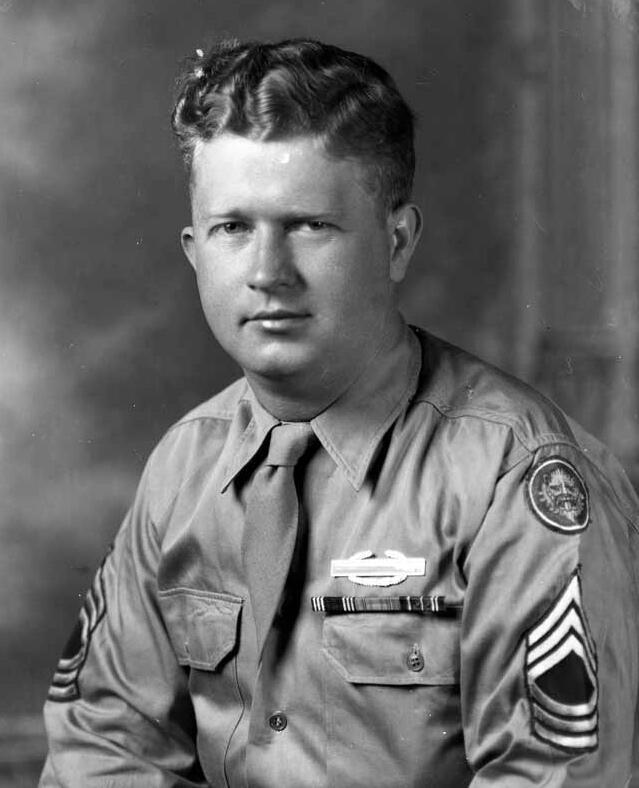
The German officer facing Edmonds had issued a simple order the night before: all Jewish American prisoners were to report separately the next morning.
Edmonds, the senior American noncommissioned officer in the camp, understood what that meant. Jewish POWs who were singled out by the Germans could be sent to forced labor, removed from the protection of the group or killed.
So Edmonds gave his own order.
When morning came, every American prisoner stepped out.
Jews and non-Jews stood together.
The German officer looked at the formation and turned to Edmonds.
“They cannot all be Jews,” he said.
Edmonds did not hesitate.
“We are all Jews,” he replied.
The officer demanded that Edmonds order the Jewish prisoners to step forward. Edmonds did not move. Under the Geneva Convention, he told the German, captured soldiers were required to give only their name, rank and serial number.
Then he raised the stakes.
If you shoot me, Edmonds told him, you will have to shoot all of us. And after the war, you will be tried as a war criminal.
The officer lowered his gun, turned around and walked away.
Roderick W. Edmonds was born on August 20, 1919, in South Knoxville, Tennessee. His mother died before his third birthday, and he was raised by his father’s sister and her husband. He came of age during the Great Depression, attended Flenniken Elementary School and Boyd Junior High, and graduated from Knoxville High School in 1938.
At Knoxville High, Edmonds excelled in JROTC. The Army seemed to sharpen qualities already present in him: discipline, steadiness and an instinctive sense of responsibility for others. After graduation, he worked as a stock clerk in a wallpaper store. In 1941, before the United States entered World War II, he enlisted in the U.S. Army.
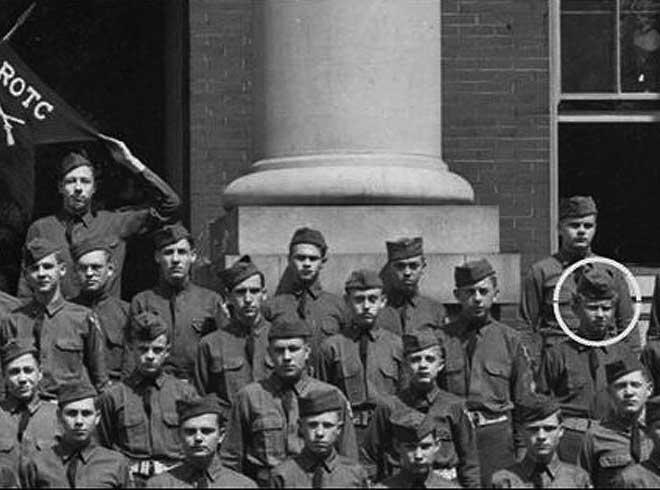
Knoxville High School JROTC cadets, 1936-37. The circled cadet is Roddie Edmonds
(Photo: courtesy of the Edmonds family)
By late 1944, Edmonds was a master sergeant in the 422nd Infantry Regiment of the 106th Infantry Division. He was only 25, but he already carried the authority of a much older soldier.
Lester J. Tanner, born Lester Tannenbaum, first knew Edmonds during training at Fort Jackson, South Carolina. Tanner was a 19-year-old recruit, and Edmonds seemed to him like the embodiment of the Army.
“For a new recruit of 19, he was ‘all Army’ and so proficient that I assumed he was 31,” Tanner later said.
Only decades later did Tanner learn that Edmonds had been just five years older than him. His authority had come not from age, but from competence.
“He did not throw his rank around,” Tanner said. “You knew he knew his stuff, and he got across to you without being arrogant or inconsiderate. I admired him for his command.”
That command would soon be tested in captivity.
In December 1944, Germany launched the Battle of the Bulge, its last major offensive on the Western Front. Edmonds and his division had only recently arrived in Europe when they were thrown into the fighting. On December 19, German forces captured Edmonds and many of his men. They were taken first to Stalag IX-B in Bad Orb, Germany.
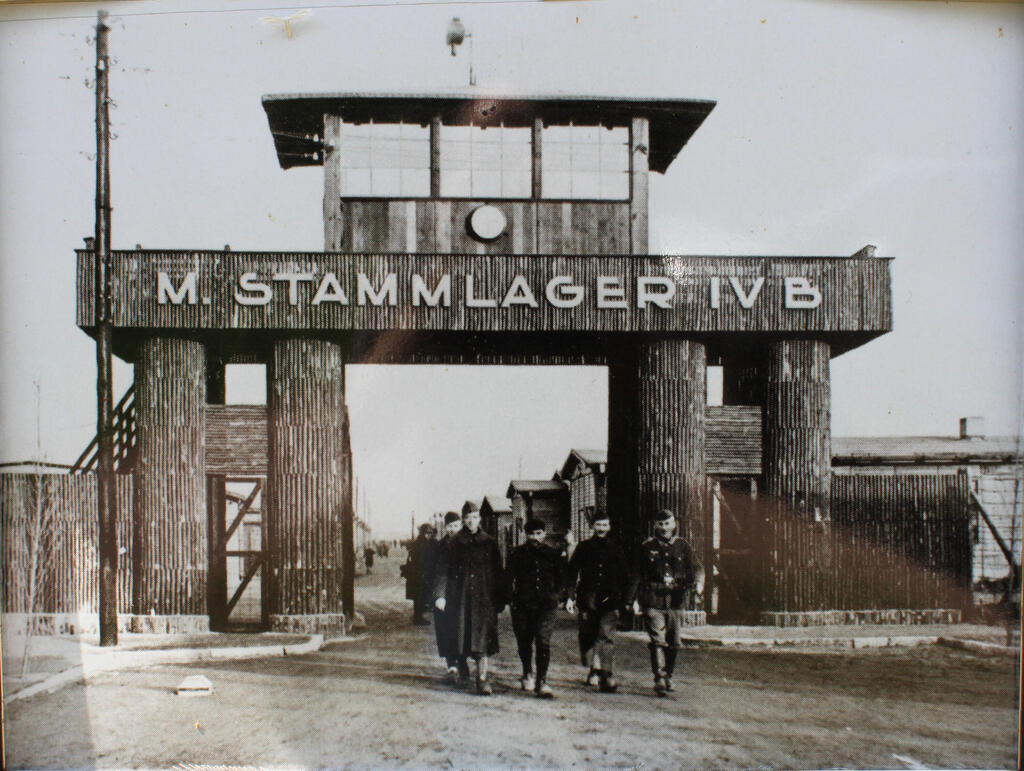
Stalag IV-B
Other American soldiers captured during the battle were sent there as well. Among them was Paul Stern, a Jewish combat medic from New York City who had been taken prisoner on December 17.
Stern later described the journey into captivity as four days of marching through bitter cold to a railway station. Some men died on the way. The survivors were pushed into boxcars and transported for days without food or water.
“For four days we were crammed into the box car, and ate snow, if we could get it because there was no food or water during this horrific journey,” Stern recalled.
At Bad Orb, Jewish American prisoners were forced to identify themselves and were placed in separate barracks. Stern remembered lice-infested straw mattresses, starvation rations, rotten potato soup and one slice of bread divided among six men.
The separation frightened them because it marked them. They knew the Germans were murdering Jews. They knew that being singled out could lead to something worse.
Stern survived in part because he was a corporal. As a noncommissioned officer, he was later transferred with other NCOs to Stalag IX-A. Lower-ranking Jewish prisoners left behind were sent to slave labor camps. Many did not survive.
On January 25, 1945, Edmonds and more than 1,200 other American noncommissioned officers were transferred to Stalag IX-A. They arrived the next day. Because officers and enlisted men had been separated, Edmonds became the senior American noncommissioned officer in charge of the barracks.
In a POW camp, that role was not ceremonial. The ranking prisoner had to maintain order, deal with the captors when possible and protect the men as far as he could.
The German order targeting Jewish POWs came almost immediately after the Americans arrived. Edmonds did not treat it as routine. That night, he summoned the senior American noncommissioned officers and told them that all the prisoners would assemble together in the morning.
Tanner was standing nearby when the German officer confronted Edmonds. He remembered the exchange decades later almost word for word.
“It was only a few seconds but I remember it as an eternity,” Tanner said.
Stern stood nearby too. He had studied German in college but concealed that fact from his captors, allowing him to understand more than they realized. To him, Edmonds’ action was not symbolic. It saved lives.
“With that one act of courage, Sergeant Edmonds saved my life, as well as all the Jewish prisoners at Ziegenhain,” Stern said.
That was not Edmonds’ only act of resistance at Stalag IX-A.
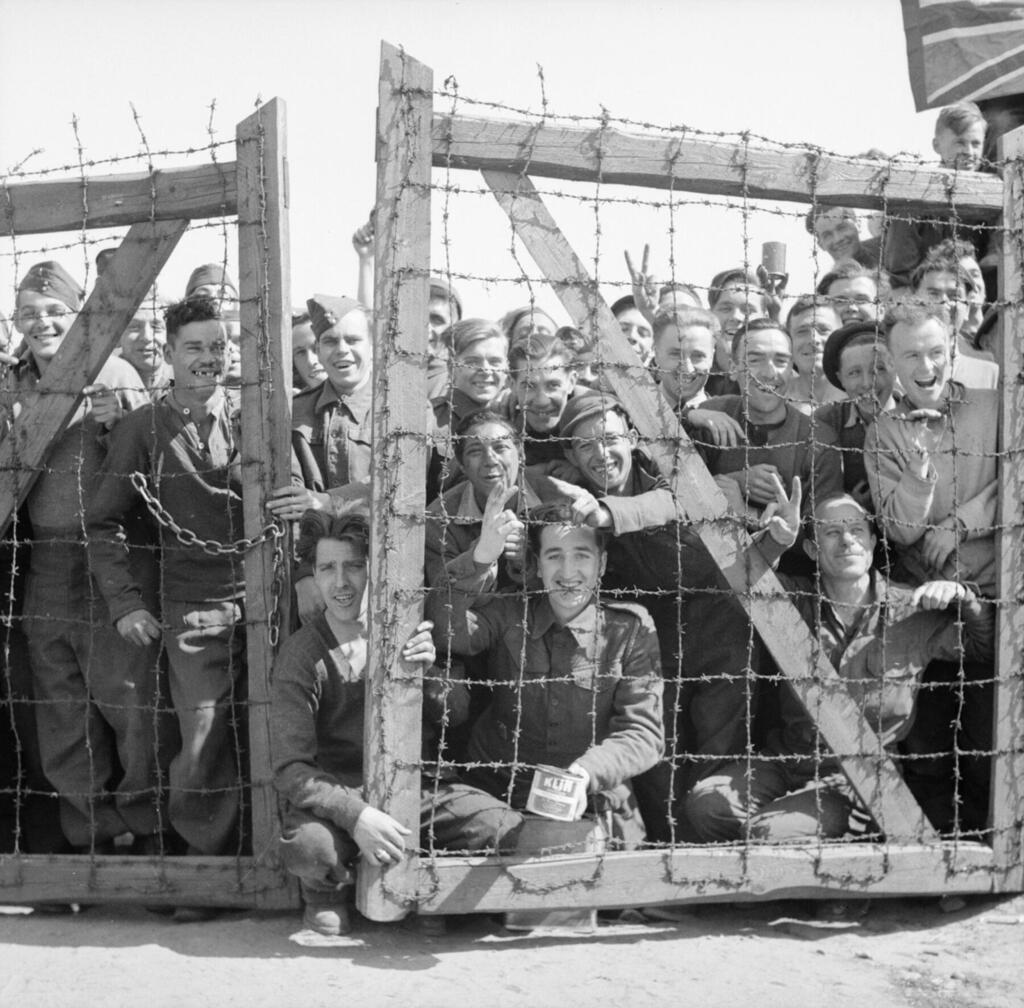
Stalag IV-B
By March 1945, Allied forces were closing in. The Germans ordered prisoners at the camp to prepare for evacuation farther east. For POWs weakened by hunger, cold and disease, such movements could be deadly. Men could collapse on the road or be moved deeper into Germany, away from liberation.
Edmonds again chose defiance.
Using information from a stolen radio to follow the Allied advance, he ordered the Americans not to cooperate. When the Germans tried to move them, he had the men form up, then break ranks and rush back into the barracks. He told prisoners to feign illness, hide, eat grass or dirt if necessary, anything to delay evacuation.
The Germans threatened them and used dogs, but Edmonds held the men together. Eventually, the captors abandoned the effort. The Americans remained behind. Soon afterward, forces from Gen. George Patton’s 3rd Army liberated the camp.
Stern later said that episode reflected the same sense of duty Edmonds had shown in January.
“His sense of duty, responsibility and devotion to the soldiers under his command went far beyond his own personal safety,” he said.
Edmonds returned to the United States in April 1945 and was discharged that October. Like many men of his generation, he did not turn his war story into a public identity.
He later returned to active duty during the Korean War, serving with Company B, 1st Battalion, 5th Cavalry Regiment, 1st Cavalry Division. Afterward, he came home to Knoxville.
In 1953, he married Mary Ann Watson. They raised two sons, Chris and Mike. Edmonds worked in sales and management for the Knoxville Journal and later in the modular home and cable television industries. He coached baseball, volunteered at nursing homes and homeless shelters, and remained active in his community.
Only later did his family begin to understand the full weight of what he had done.
Edmonds had kept a diary in the POW camp. He also asked other prisoners to write down their names and addresses. Hungry and imagining life after liberation, he and several friends once planned to open a restaurant together after the war. Edmonds, who had artistic talent, even sketched designs and a logo. The plan never came to pass.
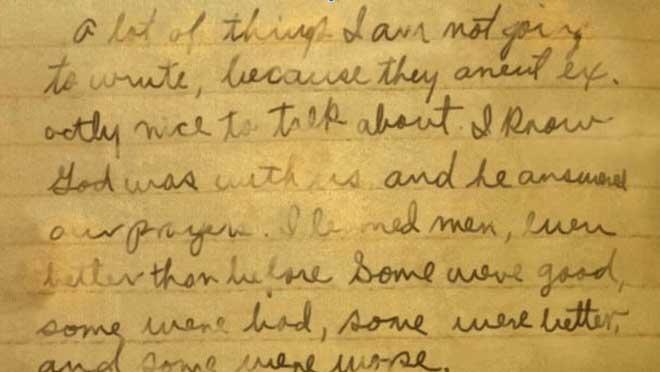
A portion of Roddie’s diary, which he kept at Stalag IX-A
(Photo: courtesy of the Edmonds family)
One surviving diary passage suggests why he may have spoken so little about the war afterward.
“A lot of things I am not going to write, because they aren’t exactly nice to talk about,” he wrote. “I know God was with us and he answered our prayers. I learned men, even better than before. Some were good, some were bad, some were better and some were worse.”
Edmonds died on August 8, 1985, in Knoxville. He was 65.
For years, the story of Stalag IX-A lived mostly in the memories of the men who had been there. Those memories eventually became testimony.
Stern said the moment never left him.
“Although seventy years have passed,” he told Yad Vashem, “I can still hear the words he said to the German camp commander.”
Lester Tanner also carried the memory for decades. He said Edmonds’ stand shaped his life and showed him that there are times when a person must take a calculated risk, however perilous, for those under his responsibility.
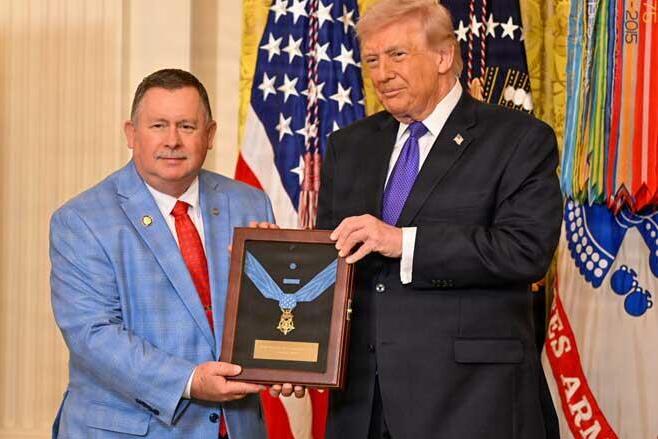
President Donald Trump presents the Medal of Honor to Chris Edmonds, son of Master Sgt. Roddie Edmonds
(Photo: US Army)
On February 10, 2015, Yad Vashem recognized Edmonds as Righteous Among the Nations, the honor given to non-Jews who risked their lives to save Jews during the Holocaust. His recognition was rare: an American soldier, himself a prisoner, honored for saving Jewish POWs from inside a German camp.
On January 27, 2016, a ceremony was held at the Israeli Embassy in Washington, D.C., where then-Israeli ambassador Ron Dermer and then-Yad Vashem Council Chairman Rabbi Israel Meir Lau presented the medal and certificate of honor to Edmonds’ son. Then-President Barack Obama attended.
On March 2, 2026, President Donald Trump presented the Medal of Honor to Edmonds’ son, Chris, at the White House. The next day, Edmonds’ name was added to the Pentagon’s Hall of Heroes.
It was a recognition that came decades after Edmonds returned to Knoxville, raised a family, worked, volunteered and died without seeing the full weight of his wartime act publicly honored.
Stern said the moment never left him.
“Although seventy years have passed,” he told Yad Vashem, “I can still hear the words he said to the German camp commander.”