


For nearly a year now, Eliran Ovadia has struggled to reunite with his favorite marine apex predators.
Since last April, following the fatal shark attack in which diver Barak Tzach, 40, was killed near the Hadera stream outlet, the city’s diving zone has been closed. The site, located near the Orot Rabin power plant, had long served as a magnet for sharks and the divers who came to observe them.
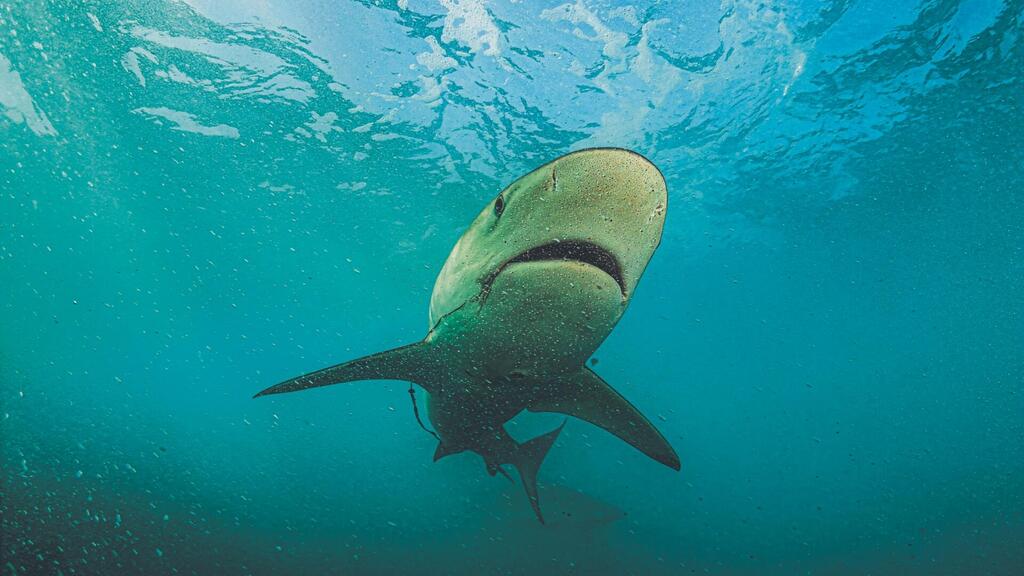
Despite the tragedy, Ovadia, a diving instructor for 27 years and owner of the “Middle East Divers” school, insists sharks are not inherently dangerous animals. In his view, their fearsome reputation is largely a public relations failure.
“It’s an injustice that Steven Spielberg did to them in ‘Jaws,’” he said. “Most of the population, here and worldwide, is afraid of this animal. Why? Because of the movies. People see sharp teeth and panic. The fear is not justified in relation to reality. For me, it’s a fish. Yes, a top predator, but still a fish.”
A big fish, and one that can be dangerous in certain circumstances.
“The gap between what people imagine and what actually happens is enormous,” Ovadia said. “Of course you have to learn about it, and I’m not recommending anyone go to a beach marked ‘Danger: Sharks’ and jump in freely. Absolutely not. Like anything in life, before you do it, you need to study it and train with professionals.”
Ovadia, 49, who lives in Moshav Ganei Yohanan, began diving at 21, shortly after completing his military service. His first encounter with a shark came while working at a fish farm in Ashdod.
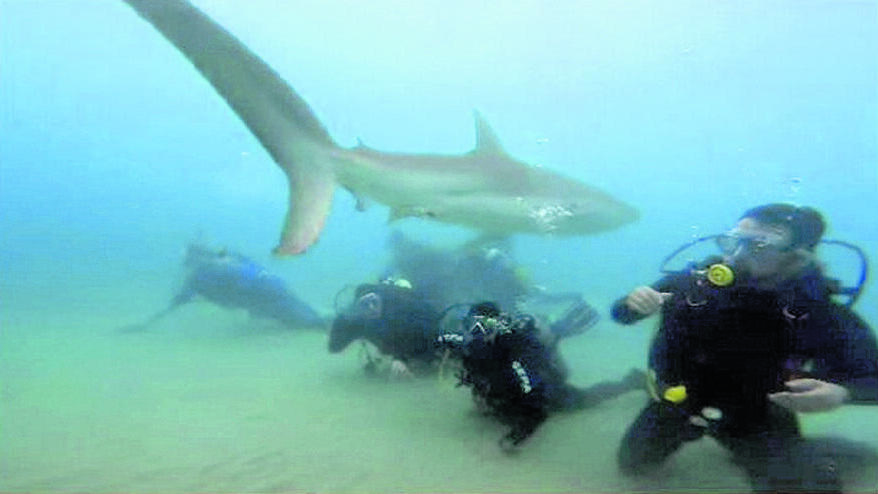
Diving with sharks in Israel
(Photo: Eliran Ovadia)
“We were a few guys there and didn’t really understand what was happening or how to behave, but it was fascinating. It just swam around us and disappeared. That day I realized it’s not such a big deal to dive with sharks. Everyone stays in their own world, even when you meet by chance in the depths.”
An apex predator with an ecological role
According to Ovadia, sharks play a critical ecological role that many people overlook.
“The shark sits at the top of the food chain and has a role in ecological balance,” he said. “If there are no sharks, we could see invasive species here, like lionfish from the Red Sea or sea urchins that start multiplying. The shark eats them. If there’s no predator for those just below it, they multiply and multiply.”
Hadera became Israel’s unofficial shark capital largely because of the Orot Rabin power plant. Warm water discharged as part of the electricity production process creates a relatively comfortable winter habitat. Schools of fish gather in the heated currents, providing a steady food source.
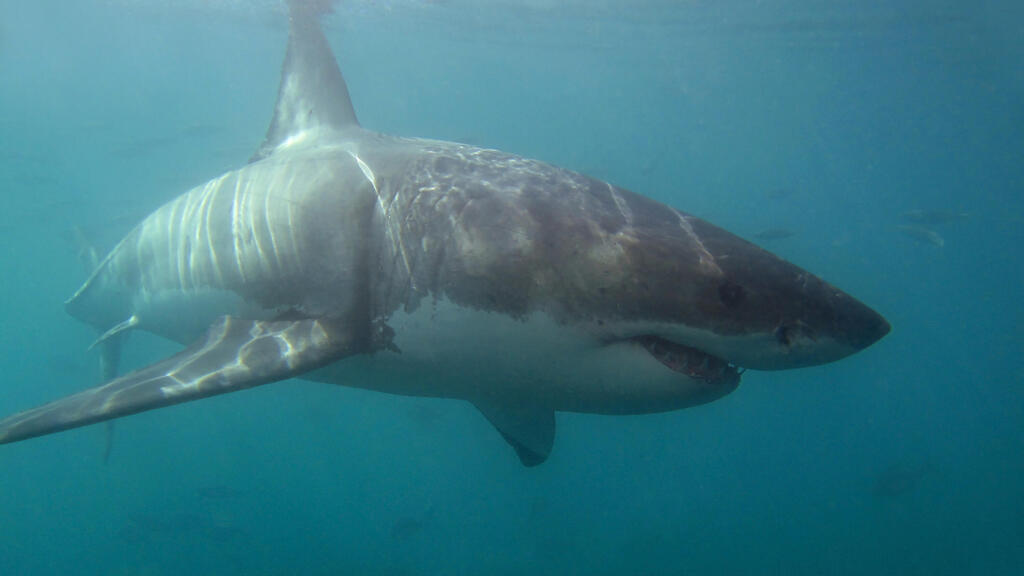
(Photo: Natursports/ Shutterstock)
“Because of the warm water, fish are there all year, so prey is available,” Ovadia explained. “The artificial current also allows sharks to live there more easily. A shark needs movement to survive. If you catch a shark and stop it from moving, it can die. Around the world, sharks live in areas with strong currents that keep them active.”
Most shark activity in Israel is concentrated off Hadera, Ashkelon and Ashdod, but Hadera has the largest aggregation. “Just recently I counted about 100 sharks there using drone footage,” he said. “We’ve been living this for 13 years as divers.”
The dominant species are the dusky shark and the sandbar shark, which arrive with the cold, typically from November and December through April, when water temperatures range between 20 and 24 degrees Celsius. In summer, when temperatures climb to around 30 degrees, they migrate onward.
From curiosity to catastrophe
For years, the site drew divers and curious onlookers. In November 2018, the Hadera municipality even issued a public call to regulate boat tours that would allow people to view sharks in a controlled and safe manner. The initiative eventually stalled.
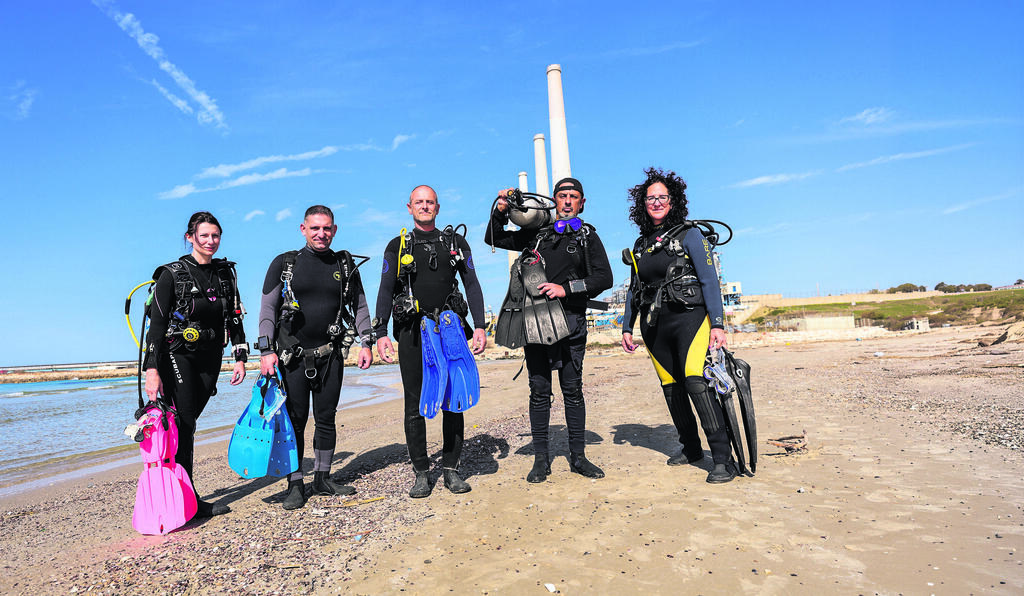
The divers, from right: Dafna Blum-Zeira, Shay Gispan, Eliran Ovadia, Adir Magen and Michal Nigkar
(Photo: Elad Gershgoren)
Everything changed after Tzach’s death. He entered the water near the stream outlet, where crowds had gathered to observe the sharks, and was fatally attacked. Since then, authorities have prohibited shark enthusiasts from entering the beach. Inspectors patrol the area and issue warnings to divers who attempt to go in.
The diving community refuses to give up. If they are blocked from shore, some reach the area by motorboat. Recently, enthusiasts organized, launched a petition and are considering a future class-action lawsuit to challenge what they call a sweeping and unjustified ban.
“There is no law that forbids seeing sharks, so why block us?” Ovadia asked. “We have regulated diving clubs under large international organizations. We teach shark history, species, physiology, reproduction, ecology and risk awareness. And yes, also about danger, even though most shark species today are not dangerous.”
He acknowledges that sharks are opportunistic animals and can become more active under certain conditions, such as before storms, when marine life enters a feeding mode. “But for us as scuba divers, I don’t want to say incidents don’t exist, but they are almost nonexistent. In nearly 100 percent of encounters, nothing happens.”
Still, as the fatal attack showed, it takes only one exception to cause tragedy.
“In Hadera, the dusky and sandbar sharks simply pass by you,” he said. “They have no interest in us. When we’re face to face, the shark sees our size, the bubbles, something unfamiliar. Through its senses, it understands we are not food and just swims on.”
‘A rare natural spectacle’
Israel’s shark enthusiasts number in the thousands. Among them is Dafna Blum-Zeira, 57, a divorced mother of three, two of them certified divers, who only caught the diving bug last year.
“When people ask why dive with sharks, I answer: Why do you go to Jerusalem? Because it’s beautiful and impressive,” she said. “It’s the same thing. This is a rare spectacle that happens under specific conditions. We have to be part of it.”
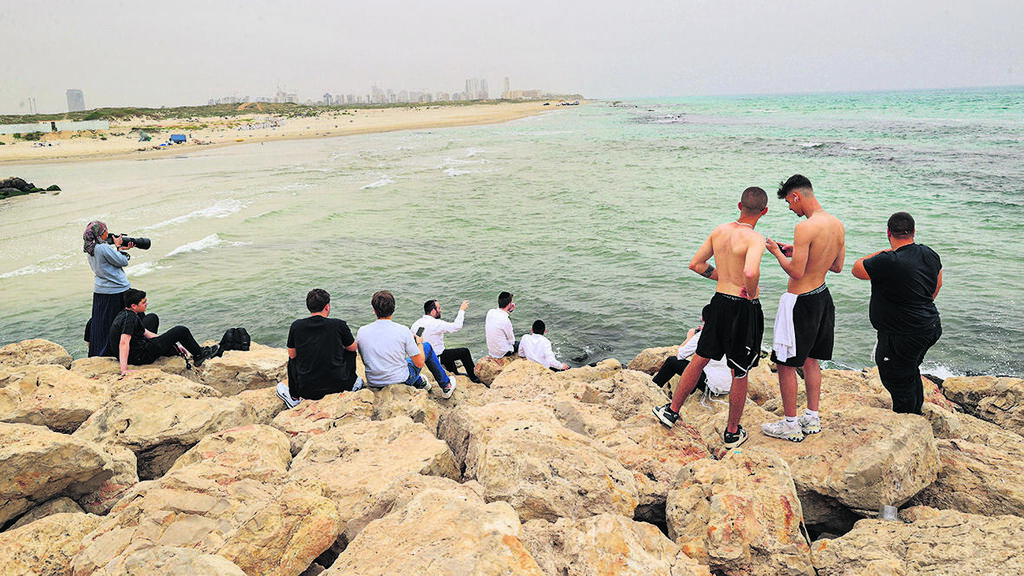
Hadera beach after the fatal attack
(Photo: Elad Gershgoren)
She describes diving in general as overwhelming. “You descend into deep water and suddenly see natural and archaeological treasures, and beautiful sharks. It gives you chills, not because of fear or cold water. When you come up after 40 minutes, you realize how little we know about the depths.”
Adir Magen, 47, a professional diver from Tel Aviv who often dives with his 17-year-old son, emphasized that enthusiasts are not encouraging the public to jump into shark waters freely.
“The sea is the sharks’ home, and we teach people how to protect them and nature,” he said. “There is risk, just like driving a car is risky, but we operate under strict safety rules. We go down with one instructor for every two divers and conduct proper briefings before every dive. Statistically, shark attacks on humans represent a tiny fraction. It’s not supposed to happen.”
Michal Nigkar, 40, from Ashkelon, encountered her first shark while diving in Sinai. “It was frightening for a moment,” she admitted. “I had a terrible fear of water as a child, but 11 years ago I decided to fight it. It’s about inner work and calmness. This isn’t about flirting with danger. Everything is supervised. Like birdwatching, we observe sharks.”
Waiting for next winter
As the shark season nears its end, enthusiasts know they have already lost this year. Soon the sharks will raise their fins and continue on, away from Hadera’s smokestacks.
The divers hope that next winter they will once again be allowed into the water — not from balconies or video screens, but face to face with what they see as a misunderstood marvel of nature.
“The death of the diver created trauma,” said Shay Gispan, 51, a diver and partner in a local diving club. “But it doesn’t justify an indefinite blanket ban. Diving should be allowed through clubs and professionals, not freely without supervision. With guidance and oversight, it becomes a completely different experience.”