

The UN decision to add Israeli bodies to the list of states and terrorist organizations suspected of committing “sexual violence in conflict areas,” alongside Hamas and ISIS, sparked shock in Israel, and rightly so. Israel was quick to condemn the decision and reject the allegations outright. This time, as in previous cases, the response focused on the flaws, biases and improper motives behind the decision.
Indeed, quite a few of the investigations and reports published throughout the war, including Nicholas Kristof’s column in The New York Times on sexual abuse and mistreatment of Palestinian detainees, and reports by the UN’s Independent International Commission of Inquiry, which determined that Israel is committing systematic sexual violence and even genocide, suffered from methodological failures, problematic evidentiary standards and one-sidedness.
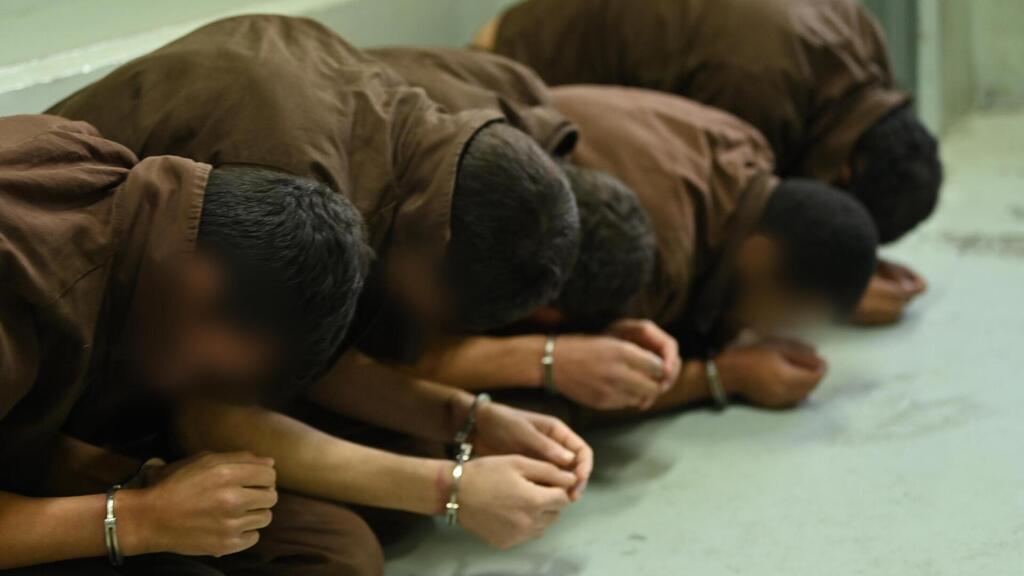
Hamas terrorists in Israeli prison
(Photo: Shin Bet)
And yet, the question is how Israel allows extreme and sometimes baseless claims to gain credibility in the international arena, and why it has such difficulty stopping them.
A significant part of the legal argument against Israel rests on the claim that Israel does not show a consistent and clear commitment to investigation and enforcement regarding suspicions of offenses allegedly committed by soldiers and members of the security forces. When a state does not investigate itself, the impression is created that there is a cover-up and concealment, and others investigate in its place.
That is exactly how Israel has behaved. It left the arena to journalists, international organizations and courts to determine the facts for it, and sometimes also the legal conclusions. In that vacuum, even baseless accusations begin to seem credible, and it becomes much easier to justify extreme reports and even arrest warrants against senior Israeli officials.
Israel could have significantly reduced the ground on which false claims grow had it acted more quickly, more clearly and more decisively regarding suspicions that arose during the war. Investigating suspicions against IDF soldiers does not create moral equivalence between Israel and Hamas. There is not, and cannot be, symmetry between a murderous terrorist organization and the army of a democratic state, and the ability to set limits on power and enforce the law is precisely what distinguishes them. Hamas does not investigate its crimes because its crimes are part of its method of warfare. Israel is judged precisely by its ability to do the opposite.
Part of a democratic state’s defense mechanism and a clear Israeli interest
Investigation and enforcement are part of a democratic state’s defense mechanism and a clear Israeli interest. They strengthen Israel’s ability to fend off claims and legal proceedings, and reduce the justification for external intervention. From a values perspective, they express the understanding that, even during war, there are lines that must not be crossed. And from the perspective of the IDF itself, they are a necessary condition for maintaining a professional army and for its ability to use force without losing control over it.
Credible suspicions of which Israel is aware require it to conduct a professional and independent investigation and prosecute those responsible. This is a basic duty of a state governed by law, even during war. The rule of law and purity of arms are tested precisely in the moments when it is easiest to give them up in the name of anger, fear and revenge.
 Tammy Caner
But in today’s Israel, the very demand to investigate suspicions is presented as a “blood libel” and perceived as betrayal of the IDF and the state. And when investigative and enforcement authorities are attacked more than the suspicions themselves, the message conveyed is that the problem is not the actions, but the very attempt to investigate them
This approach harms public trust that the IDF uses its force under the law and clear boundaries, weakens Israel’s legitimacy in the international arena, and invites precisely the same reports and legal proceedings that everyone later decries.
Above all, it abandons the reputation of all the soldiers who act lawfully. Those who try to prevent investigations are not protecting IDF soldiers, but casting a stain on the entire IDF.
- Dr. Tammy Caner is head of the Law and National Security Program at INSS.