

What excitement gripped what remains of the Israeli left this week as thousands of young people sang "Song for Peace" with devotion and danced enthusiastically in the closing moments of the InDNegev music festival. On the right, meanwhile, there was nothing but contempt and ridicule for these losers who never learn their lesson.
And the most important conclusion I am trying to draw for myself on the eve of the first elections since the October 7 massacre, just before we head to the polls for the first time since we have all changed, is not to go all-in on either side.
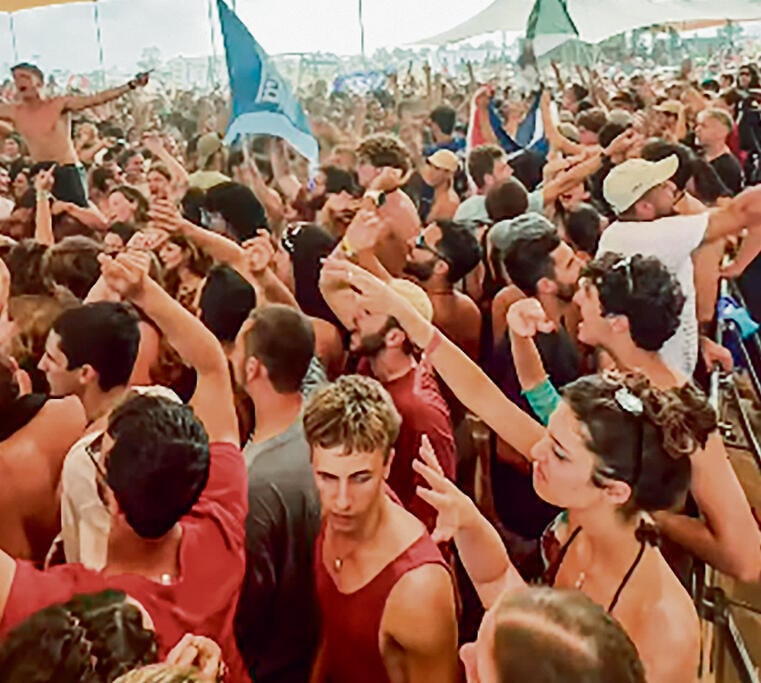
InDNegev
Sadly, these elections are more of the same. More automatic tribalism, more unconditional loyalty to one's political camp, and very little serious examination of the issues.
Yes, it's hard. It's far less comfortable and reassuring, and far more challenging, to hold a complicated position. But what can we do? Life is complicated. Singing "Song for Peace" today, if you genuinely believe peace is a realistic prospect right now, means you need serious help understanding reality. On the other hand, turning perpetual war into an ideal shows that you are disconnected from any spiritual existence, even from the Jewish ideal itself.
A brief recap of our history alongside this song: Until the wave of bombings that marked the beginning of the Second Intifada, there was a prevailing belief here that there was someone on the other side willing to dance this tango of peace. The Oslo years were romantic. Shimon Peres and Yossi Beilin were full of good intentions, but had absolutely no understanding of the region, Arab culture or the Muslim faith.
As if that were not absurd enough, they entrusted the mediation between Israelis and Palestinians to none other than the Norwegians. It was as though they had chosen the culture most disconnected from Middle Eastern life, the one least familiar with its languages, and specifically asked it to bring the two sides together.
In that atmosphere, "Song for Peace" became the anthem of an entire sociological camp, during one of the last periods in which that camp managed to secure a political majority.
"Song for Peace" embodies the heartbreaking innocence of the 1990s. But now that we bear the scars, we should at least try to understand the desires, aspirations and intentions of the other side.
During the Oslo years, there was criminal, institutionalized willful blindness in Israel. As Yasser Arafat stood on the White House lawn, he spoke of a peace of the brave. At virtually the same time, he addressed Arab audiences, openly preached the continuation of jihad and promised millions of martyrs on the road to Jerusalem. Here, we sang "Song for Peace." There, they sang, "With spirit and blood, we will redeem Palestine," and his audience understood the instructions perfectly.
More than 30 years and roughly 4,500 dead Jews later, the overwhelming majority of Jewish Israelis have come to understand that there is no one with whom to make peace. No matter how much we want it, there simply is no one. And if we now apply the lessons of the Oslo mistake, if we do the most basic thing and listen to our enemies, our potential partners for peace, we will easily see that they are still singing the same songs. We will hear that on every local front, all they talk about is jihad and martyrs, and even when they speak English, it is "Free Palestine." Make no mistake: they do not mean that only Elon Moreh and Kedumim, two Israeli settlements in the West Bank, should be "free" of Jews. They also mean Tel Aviv, Haifa and Ashkelon.
So what actually happened at InDNegev a few days ago? The Israeli right experienced déjà vu at those scenes. It saw the dancers, mostly young people in their 20s, most of whom, incidentally, had physically taken part, body and soul, in the hardest and longest war in the country's history. All of them carry the costs of that war in their bodies and souls, and the Israeli right was gripped by anxiety. Because you don't need to be a professor of logic to understand that the war these sweet young people have just returned from is the product of the innocence of the 1990s version of "Song for Peace." And I can very much understand the right's anxiety.
But how does the vocal right respond? As always with the loudest figures in both political camps, with contempt, ridicule, dismissal and rejection.
The thing is, peace really is a supreme value. It is a supreme human and universal value, and it is also an exceptionally important Jewish value. I just counted: in the weekday Shacharit morning prayer alone, the word "peace" appears 41 times. Every single day. But among those of us on the right, peace has become something to sneer at, because it has left us so deeply scarred.
And as always in Israel, our lives swing like a pendulum. After decades of reluctance to use force, even in situations where it was absolutely necessary, we have now spent three years under a policy that says only force can work. But that saddens me, and I say this as someone who has absolutely no pity or compassion for his enemies. Even so, the reality is that force has its limits. If only we could keep striking our enemies harder and harder until they finally broke. But in the adult world, we should understand that, at the very least, this does not always work.
Look at Gaza. Just this week, our completely right-wing government continued sending in hundreds of trucks loaded with all kinds of goods, thereby also providing Hamas with hundreds of millions of shekels in revenue. This despite the countless explicit promises from our uncompromising leaders to crush, flatten and pulverize. Force has hit a wall. Those of us on the right have had a hammer in our hands for three years, and sometimes every object in reality looks like a nail.
That is why, if we want to live our lives properly, we need to develop complex views that remain firmly grounded in reality.
It is perfectly legitimate to sing "Song for Peace" as the closing act of a music festival for young people in southern Israel. But the moment the singing ends, we must remember that other festival, the Nova music festival on October 7, also intended for young music lovers and also held in the south, whose closing number was the arrival of hundreds of bloodthirsty murderers on the dance floor.
On the one hand, we must know who is on the other side of the fence. We must remember and understand that until they undergo a profound process of deradicalization, a process for which there is currently not even the slightest sign of a beginning, peace will remain out of reach. And even when such a process begins, it will take decades. Until then, we can dance and sing "Song for Peace," but the party had better be surrounded by armed security guards.
On the other hand, we must remember that peace is one of the names of the Holy One, blessed be He, no less. Peace is, in fact, wholeness, the aspiration to a harmonious reality that embraces others and makes room for them. We must remember that this peace is absolutely an aspiration of ours as Jews. Even if we understand that it is very far away right now, we must dream of it. We can sing about it and dance to its music, but we must remember where we live. Until one day, with our help, with the help of force and the processes that complement it, one day, God willing, that will change.