


While the Israeli public is focused—justifiably—on whether a deal for the hostages will be partial or comprehensive, and as Prime Minister Benjamin Netanyahu meets with IDF Chief of Staff Lt. Gen. Eyal Zamir and the General Staff to approve plans for seizing Gaza City, events on the margins of the conflict demand urgent attention.
One was the firefight on Wednesday in Khan Younis, where Hamas terrorists breached an IDF stronghold. Another is unfolding nearly 2,000 kilometers away in the Persian Gulf, where Iran has launched a large-scale naval drill expected to last several days.
Iran's military drill


The Hamas assault began when 15 terrorists emerged from a tunnel shaft just 40 meters from an IDF fortified position manned by Kfir Brigade troops and armored forces. The outpost is part of the “Magen Oz” security corridor, intended as an additional buffer against incursions toward Israel from Khan Younis. From an IDF perspective, it was a classic defensive battle.
The terrorists' planning was meticulous: gathering intelligence, planting roadside bombs to block reinforcements, and preparing suicide charges to attach to tanks and APCs. They split into three groups—long-range suppressive fire, close-range cover fire from atop the dirt berm, and an assault team that stormed the position.
But the real failure was not tactical bravery—it was vigilance. A simple human lookout would have spotted 15 black-clad men advancing in broad daylight from just meters away. Instead, commanders relied solely on cameras, which the militants had scouted in advance and quickly disabled with a single shot. Without the swift and determined response of Kfir fighters and the 74th Armored Battalion, the outcome could have been far worse.
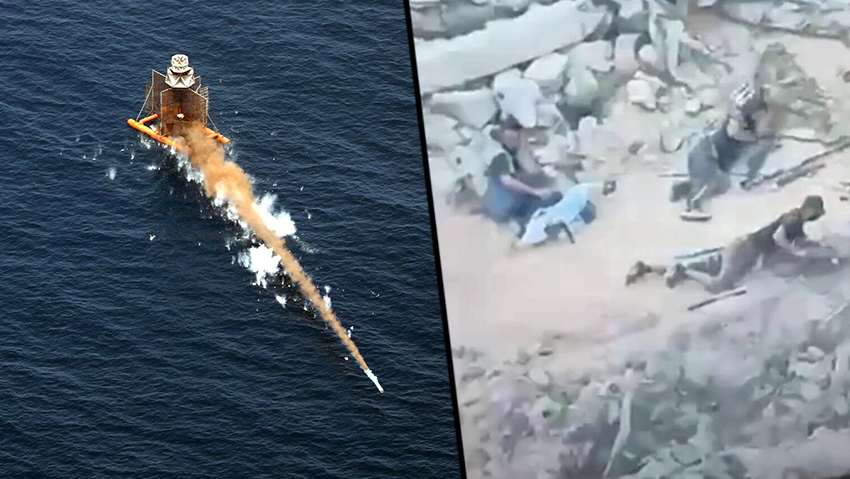
The Iranian drill, Hamas terrorists in Gaza
(Photo: Iranian Army/WANA (West Asia News Agency)/ Reuters)
The episode underscores that the lessons from October 7 were not applied. Outposts in hostile territory require overlapping human observation, barbed wire perimeters, and guard posts covering every access point. Instead, reliance on cameras and drones proved dangerously insufficient. Technology, with its limited field of vision, cannot replace human eyes and judgment.
Meanwhile, in the Persian Gulf, Iran’s military exercise sends another warning. Conducted amid severe water shortages and economic crisis, and while Tehran is still reeling from Israel’s Operation Rising Lion, the drill reflects deep anxiety.
Iranian propaganda videos show cruise missile strikes on naval targets and even a crudely staged clip of an Iranian jet downing an enemy aircraft. The message is clear: Iran wants the world to believe it can still threaten shipping and project power despite recent setbacks.
Most striking is footage of a massive container ship at the end of one such video—an unsubtle warning that Iran could disrupt global maritime trade in the Arabian Sea and Indian Ocean, complementing the Houthi threat at Bab al-Mandeb.
IDF eliminates Hamas terrorists in Khan Younis
(Video: IDF)
The timing suggests Tehran fears Israeli or U.S. strikes exploiting gaps in its degraded air defenses and ballistic missile shortages. With European powers preparing to reimpose “snapback” sanctions at the end of the month, Iran is signaling it can retaliate by endangering civilian shipping.
This signal should not be dismissed. Iranian fears could lead to miscalculation—and a real attempt to act on these threats. Israel, for its part, has no reason to ease Tehran’s anxieties, as long as Iran refuses to negotiate over its nuclear program. But the IDF must prepare for escalation in the maritime arena as well as from Houthi forces in Yemen.
Both the Hamas raid in Khan Younis and Iran’s naval posturing are reminders that while the spotlight is on Gaza, Israel’s military and political leadership must not overlook dangerous blind spots—whether at the edge of a fortified position or across the seas.