

French President Emmanuel Macron landed in Damascus on Monday and shook hands with a man still flagged as a "jihadist." In Paris, this is being sold as history: the first Western head of state to set foot in Syria since Bashar Assad's regime collapsed in December 2024. In Israel, it looks like something else. It looks like the moment Europe laundered an Islamist takeover into a diplomatic partnership, sealed with a handshake and a delegation of French executives.
The man on the other end of that handshake is President Ahmad al-Sharaa, the former al-Qaeda commander who led the coalition that toppled Assad. The rehearsal for this scene came in April, when Macron and Sharaa met on the sidelines of an EU summit in Nicosia. Paris looked at a man in a tailored suit talking about pluralism and saw a statesman. The same man is the founder of Hayat Tahrir al-Sham, a group built on the same ideological scaffolding as the jihadist networks Israel has spent decades fighting.
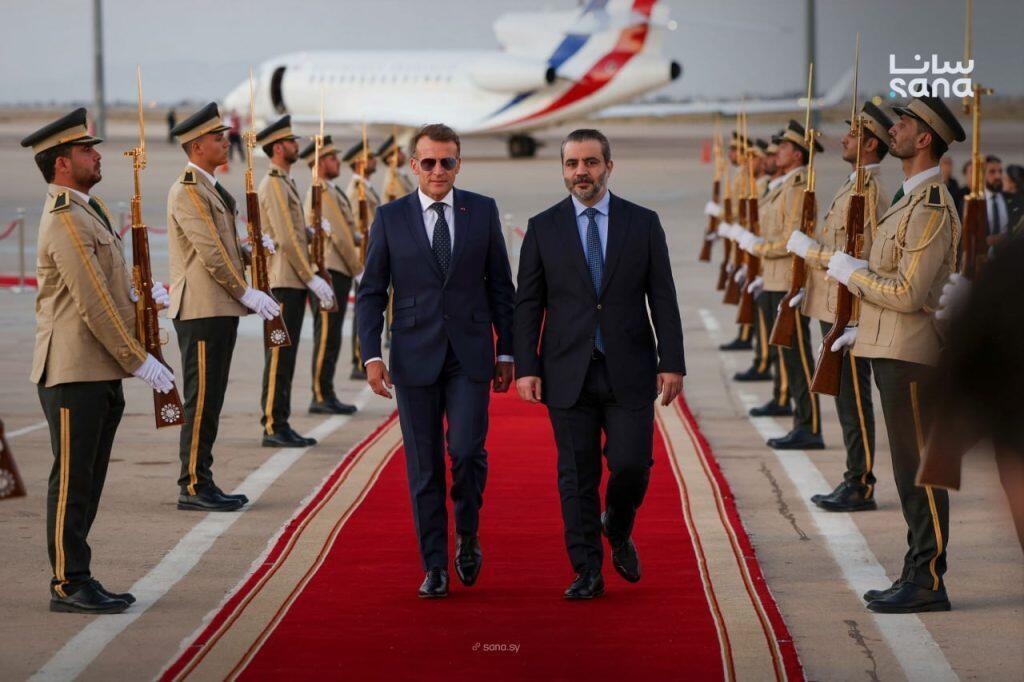
French President Emmanuel Macron (left) arrives in Damascus
(Photo: SANA)
France built its national identity on laicity, the strict separation of religion from state power. Yet it is now the loudest Western cheerleader for a government whose foundations run through a militia coalition and Sharia courts, not a constitution. Sharaa's Syria has had a year and a half to prove its talk of inclusion is more than talk. Instead the record shows mass killings of Alawite civilians on the coast in early 2025, a bloody crackdown on Druze communities in Suwayda later that year, and, just days before Macron's plane touched down, a bombing at a Damascus cafe that killed ten people. A government that cannot secure its own capital is not the stable partner France keeps describing to voters back home.
The money behind the handshake
French shipping giant CMA CGM signed a 30-year concession in May 2025 to run and expand the container terminal at Latakia, Syria's main port, a deal worth hundreds of millions of euros. TotalEnergies is circling energy contracts. Macron arrived with executives from both companies in tow, alongside investors hunting a share of a reconstruction bill that international estimates put in the hundreds of billions of dollars. Macron was also the Western leader who pushed hardest for the sanctions relief that made this rush of capital possible. Call it diplomacy if that helps it go down easier. It reads more like first-mover advantage in an emerging market, dressed up as solidarity with the Syrian people.
Lebanon is not Paris' to protect
Macron's other declared goal in Damascus is Lebanon. According to his aides, he told Sharaa directly that Syrian forces must never cross into Lebanese territory, and Sharaa agreed. On paper, that sounds responsible. In practice, it collides with Washington's approach. The Trump administration has floated the idea of Syrian forces actually helping dismantle Hezbollah's infrastructure, the same Iran-backed militia that has spent the past two years at war with Israel. France is not proposing a plan to remove Hezbollah from the equation. It is proposing to keep the border tidy and its historic influence in Beirut intact, while the threat to Israel's north stays exactly where it is. Lebanese President Joseph Aoun, who was in Nicosia too, understands better than Paris does that his country's stability now runs through decisions made in Damascus, whether France approves or not.
What Israel actually sees
None of this looks like stability from the Golan Heights. The vast desert region known as the Badia is still infested with Islamic State cells running guerrilla attacks. Foreign jihadist networks, including French fighters who never went home, remain active near the Turkish border, unreformed and unaccounted for. Israel has continued striking targets and holding buffer positions in southern Syria for one reason: nobody in Damascus, Paris or Brussels has given it a credible reason to stop. For Israel, a stable Syria is not measured in port contracts or summit photographs. It is measured in demilitarized border zones and dismantled extremist networks. Macron's visit produces neither. It produces goodwill for French companies and a photo opportunity for a president who needs one.
Macron did not invent this rush toward Damascus; he just joined it. Qatar's emir was the first foreign head of state to visit, back in January 2025. European Commission President Ursula von der Leyen followed this January. Ukraine's Volodymyr Zelensky came in April. Each visit added another layer of legitimacy to a government that has yet to hold a real election, whose new parliament is one-third handpicked by Sharaa himself, and whose treatment of women and minorities remains, by the West's admission, an open question rather than a solved one.
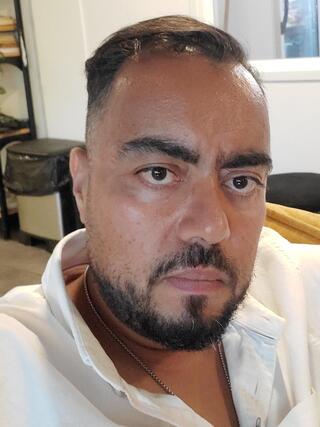 Amine Ayoub
Neighboring capitals are watching just as closely as Jerusalem is. Turkey, Syria's most influential outside backer, wants its fingerprints on whatever new order emerges. Gulf states are already buying in: an Abu Dhabi ports operator bought a stake in the Latakia terminal alongside CMA CGM last November, and a Dubai firm signed its own concession at the port of Tartus. Iran has lost its old client in Damascus and is watching a Sunni-led government build ties with the same Western capitals that once isolated Assad. Everyone at that table has a stake. Israel is the only one whose stake is measured in rocket range.
There is a domestic angle too, and it matters. Macron is unpopular at home and short on foreign policy wins. A historic trip to Damascus, timed just before a NATO summit in Ankara, offers exactly the kind of statesman imagery a beleaguered president needs. It is easier to sell French voters a story about opening a new chapter in the Middle East than to explain why a group with al-Qaeda's fingerprints on its founding is suddenly receiving red carpet treatment. Diplomatic activism photographs well. It does not disarm a single militia, and it does not answer the questions Israel has been asking since the day Assad fell.
Israel does not have the luxury of judging Syria by its press releases. It will keep watching the Badia, keep striking when it has to, and keep treating Sharaa's government as what its record shows it to be: a transitional, Islamist-rooted authority that has not yet proven it can, or wants to, control the extremists operating under its own flag. Macron can shake the hand and call it history. Israel will keep counting the threats. Diplomacy in Paris does not disarm a single fighter on the Golan front, and until it does, hard deterrence, not handshakes in Damascus, is what will keep Israel's north quiet.
- Amine Ayoub, a fellow at the Middle East Forum, is a policy analyst and writer based in Morocco. Follow him on X: @amineayoubx