

Moshe Adler, 82, was born in the Transnistria labor camp in Ukraine and was just a year old when the war ended. He immigrated with his parents to Italy and from there sailed to Israel on an immigrant ship. In his home, the Holocaust was never discussed. But one day, as a child, he sat with his mother over an old photo album and discovered a shattering truth: his father appeared there alongside another woman and four children — his first wife and children. All were murdered. His parents’ marriage was a second marriage. For him, it was a moment of rupture and a quiet understanding of a loss that never ends.
Master Sgt. (res.) Omri Ben Shachar of Givatayim was the embodiment of a young Israeli full of ambition and dreams: a youth movement instructor in the Scouts, an outstanding athlete, a fighter in the Paratroopers Reconnaissance Unit, a loving partner and a friend to all. Alongside all this, he also chose to volunteer — not out of obligation, but out of values. He turned to the Foundation for the Welfare of Holocaust Victims and asked to accompany a Holocaust survivor. That is how he met Moshe Adler.
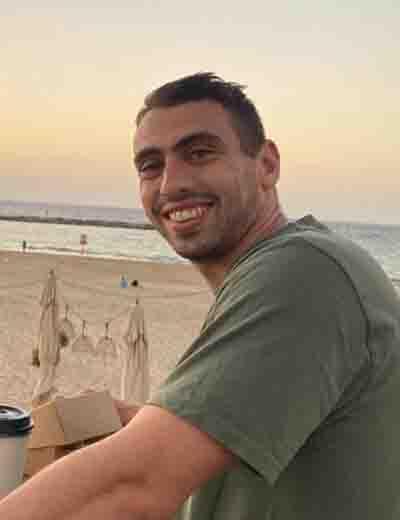
Master Sgt. (res.) Omri Ben Shachar
Their connection did not remain within the bounds of volunteering. It became a true friendship. They met weekly, played backgammon, went to theater performances, laughed and, above all, were there for each other, enjoying a genuine and meaningful bond. Omri gave Moshe something that cannot be measured: a sense of belonging, continuity and family.
All of this remained true until the first night of Hanukkah, Dec. 8, 2023. Master Sgt. (res.) Omri Ben Shachar, 25, was killed in combat in Khan Younis.
When Moshe heard the news, he broke down in tears and said to Omri’s father, Reuven: “You lost a son — I lost a grandson.”
This statement by Moshe carries profound meaning. It is testimony to the power of human connection — to the fact that volunteering with Holocaust survivors is not merely an act of kindness, important as that is, but a way of creating deep and meaningful bonds between the generation of Holocaust survivors and the generation of October 7.
Since Omri’s death, his twin brother, Nadav, has continued the connection with Moshe — a chain of mutual responsibility that has not been broken.
Today, about 109,000 Holocaust survivors live in Israel. Their average age is about 88, and many struggle with loneliness, physical hardship and a sense of insecurity. About a third have been victims of antisemitic harassment. At a time when Israeli society is grappling with immense pain — bereaved families, the wounded and evacuees — it is easy to focus attention on the most urgent needs. But precisely now, we must not forget Holocaust survivors. For many of them, the security reality we have experienced and continue to experience has revived past trauma — the fears, the memories and the sense of helplessness.
It is the state’s duty to care for them. But the responsibility does not end there. It is also ours as a society. The story of Omri and Moshe teaches an important lesson: volunteering is not only giving — it is a bridge between generations. It is how we ensure that Holocaust survivors not only survive, but live and age with dignity.
This is the unwritten legacy of Master Sgt. (res.) Omri Ben Shachar — not only to remember, but to be there for them.
Limor Livnat serves as volunteer chair of the Foundation for the Welfare of Holocaust Victims.