

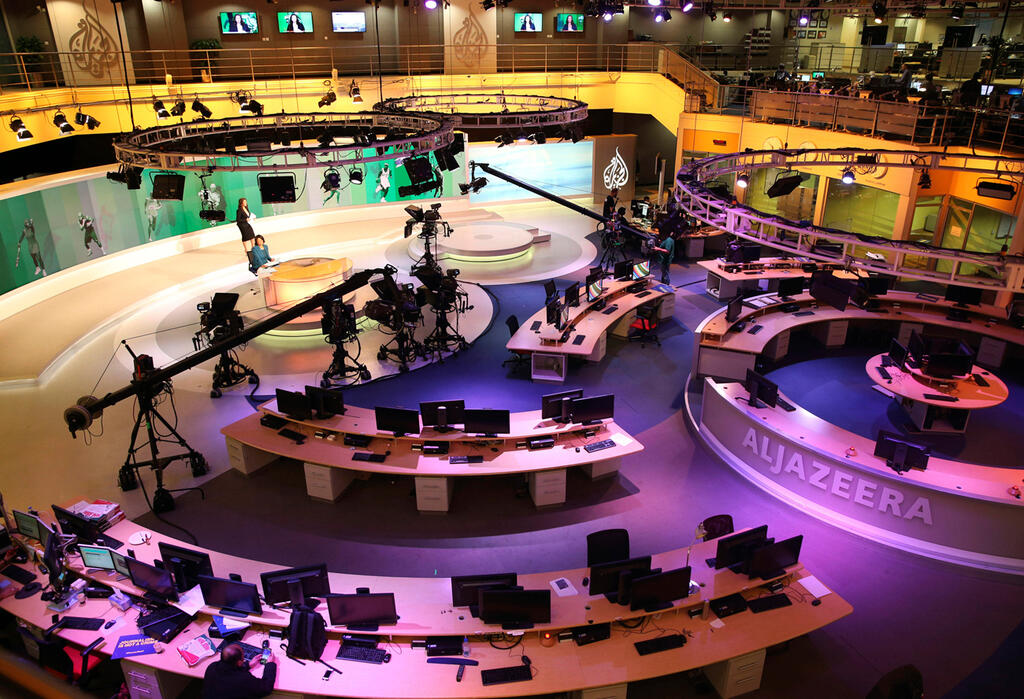
When Al Jazeera Media Network announced a new AI-integrated newsroom built with Google Cloud, the reaction in Western media was restrained. The development was framed as routine modernization. Another newsroom incorporating artificial intelligence. Another attempt to improve efficiency and scale. That framing holds only if the announcement is read in isolation.
Al Jazeera operates within a system that predates artificial intelligence. The ideological architecture comes from the Muslim Brotherhood. The state that adopted and industrialized that architecture is Qatar. The media instrument that carried it outward is Al Jazeera. The AI system now being announced fits cleanly into that sequence. It does not interrupt it.

The Brotherhood’s doctrine was not designed for rapid victory. Its strategy was generational and institutional. Universities, media, law, civil society, and culture were treated as the terrain on which legitimacy is formed. The objective was not to defeat opponents directly, but to shape the environment in which judgments are made. Over time, ideology ceased to appear as ideology and began to function as professional common sense. This approach was patient by design.
Qatar recognized the value of that doctrine early. As a small state with exceptional financial resources and limited military reach, it invested where influence compounds. It funded universities and cultural institutions. It built global media platforms. It positioned itself as a mediator in regional conflicts while maintaining relationships with Islamist actors. Western military basing provided security. Mediation provided leverage. These elements formed a coherent influence system that allowed Qatar to project power disproportionate to its size. Al Jazeera became the central delivery mechanism.
State-owned and state-aligned, Al Jazeera did not rely on overt messaging. Its influence emerged through framing and repetition. Arabic output mobilized regional audiences. English output adopted the moral language of rights, grievance, and legitimacy familiar to Western institutions. Coverage differed by audience. The underlying orientation remained consistent. This pattern has been documented repeatedly in reporting on Israel, political Islam, and Western power.
For years, this influence remained visible because it appeared in text. Articles could be read, criticized, and attributed. Bias appeared where language appeared.
The AI system changes where that work occurs. According to Al Jazeera’s own description, the system generates questions, retrieves archival context, summarizes events, translates narratives, and assists in framing before editors engage. These functions operate at the point where relevance and context are normally determined. The system does not assist judgment. It resolves it.
(Photo: AP)
When a journalist queries such a system, relevance, background, and synthesis are delivered together. The output arrives complete and authoritative. The step where a journalist decides what matters does not occur in the same way. It has already been processed. This represents a shift from influence to epistemic substitution.
The significance of this shift becomes clearer when the system is no longer confined to Al Jazeera’s newsroom. The announcement includes an “Academic and Knowledge Arm” intended to train journalists on these AI workflows using Google’s enterprise tools. This indicates an external-facing model. Not a closed internal stack, but a system designed for broader professional uptake.
Once journalists outside Al Jazeera rely on the same AI to retrieve context and generate summaries, attribution weakens. The output does not present itself as Al Jazeera’s perspective. It presents itself as journalistic explanation.
This is not a question of persuasion or belief. Teaching implies discretion. System output removes discretion at the moment premises are set. Relevance is delivered rather than selected.
This outcome aligns closely with the Brotherhood’s institutional doctrine. That doctrine did not depend on constant instruction or centralized messaging. It depended on embedding its moral grammar into institutions until it no longer appeared ideological. AI enables that embedding to occur procedurally. The worldview no longer requires explanation. It only needs to be present when questions are asked.

(Photo: Reuters)
The role of Google Cloud is consequential here. Enterprise infrastructure carries an assumption of neutrality and reliability. Its outputs are trusted as tools rather than arguments. Once integrated into professional workflows, the underlying assumptions become difficult to isolate or interrogate. This is how influence migrates into architecture.
Distributed systems rarely remain bounded. Content is reused. Summaries circulate. Translations propagate. AI models trained on public data ingest what they encounter as reference material. Over time, framing logic becomes ambient. It is encountered repeatedly without a clear point of origin.
At that stage, contestation becomes harder. There is no single article to rebut. There is a system output that appears to describe reality rather than argue for it.
Western institutions have encountered similar dynamics before. Platforms such as TikTok are now widely understood as strategic tools rather than neutral spaces. The concern was not limited to explicit messaging, but to normalization and habit formation. Recognition followed prolonged underestimation.
Al Jazeera’s AI system applies comparable logic to journalism itself. When Western outlets adopt AI tools, they do so within a shared institutional and civilizational context, however contested. When a Qatari state network operating within a Brotherhood-derived framework exports a system that determines relevance and context before journalists decide, alignment becomes a material factor. Qatar’s record of hosting Hamas leadership, financing Islamist networks, and leveraging mediation is documented. Al Jazeera’s editorial posture reflects that alignment consistently.
 Guy Goldstein Photo: Courtesy
No conspiracy is required to identify the pattern. The components align because they were assembled to align.
Soft power has always depended on patience and institutional presence. What has changed is the layer at which that power now operates. Influence no longer depends primarily on published narratives. It operates through systems that answer questions.
Nothing in this process requires censorship. Nothing requires suppression. The mechanism functions through removal of friction and reliance on technology. It is “efficient,” it is “easy,” and it is a trap.
If this development is treated as another media organization adopting new technology, the structural shift will be missed. The issue is not what Al Jazeera will publish next. It is how relevance, context, and explanation are increasingly delivered to journalists before editorial judgment begins.
My fear is that by the time that distinction becomes widely apparent, the system will already be in use, shaping how reality is assembled across the profession in ways that are difficult to trace and harder to unwind.
- Guy Goldstein is a strategist, advisor, writer and producer. He is the CEO of Revenue Path, a consultancy that helps leaders design the strategies and processes that generate growth.