

The sweeping victory of the far-right Alternative for Germany, or AfD, in the eastern state of Saxony-Anhalt earlier this week reflects a broader Western trend. Populist far-right movements are gaining strength across Europe, and in Israel as well.
One of the clearest signs is the gradual movement of ideas once confined to the political fringes into the mainstream. The important question is not only why this is happening, but how democratic societies can recognize the process before it becomes entrenched.
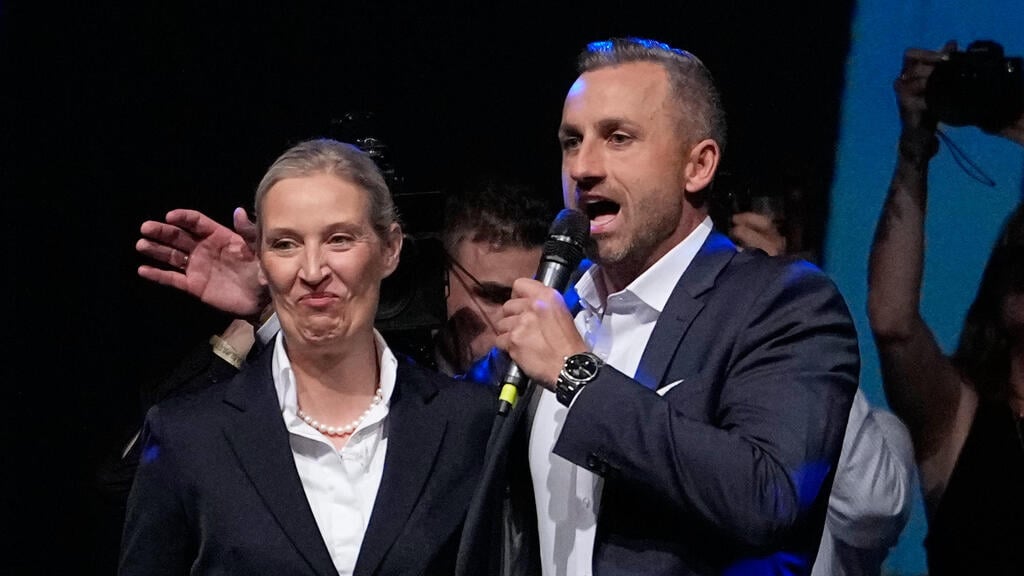
Ulrich Siegmund, AfD leader in the German state of Saxony-Anhalt, alongside national party leader Alice Weidel
(Photo: AP Photo/Matthias Schrader)
History can help, not because it repeats itself mechanically, but because similar political patterns can emerge under very different circumstances.
Far-right movements sometimes declare openly that they want to dismantle democratic institutions. Often, however, they do not. They present themselves as democratic, constitutional and respectable political forces, as victims of elites and the media, and as the authentic representatives of the "real people." Gradually, they begin to undermine the legitimacy of their opponents and of democratic institutions themselves.
Anyone seeking to understand how this works can learn from the history of the Nazi Party between 1928 and 1932, precisely during the period when it was still forced to operate inside a democratic system and exploit that system for its own purposes.
The Nazis did not campaign by simply announcing that they wanted a dictatorship. They adapted their message to different audiences, used acceptable political language and portrayed themselves as the movement that could rescue Germany from disaster.
The comparison with today’s AfD sits at the center of an increasingly heated debate. AfD is not the Nazi Party, and present-day Germany is not the Weimar Republic. Precisely because the two are not identical, however, it is worth asking what patterns do resemble one another.
Among them are the construction of an "internal enemy," the claim that one party alone represents a nation betrayed by its elites, attacks on political establishments, and the portrayal of democratic institutions as corrupt or no longer representative of the people.
The German case offers another lesson: far-right radicalization does not stop simply because it learns how to appear respectable.
Over the years, AfD has become more radical and, at the same time, more normalized. Moderate voices within the party were pushed aside while figures from its harder wing, including Björn Höcke and ideologue Götz Kubitschek, gained influence.
The strategy has been to move the boundaries of acceptable discourse gradually. Rather than say everything at once, radical movements establish linguistic and political footholds, allow the public to become accustomed to them, and then push further.
When Höcke described Berlin’s Holocaust Memorial as a "monument of shame," he was testing the limits of what could be said about Germany’s culture of remembrance.
Extremism does not need to disappear in order to become normal. It can remain extremist while increasingly being treated as a legitimate political position.
Democratic society itself also plays a role in that process.
In Germany, AfD’s radicalization occurred alongside a broader normalization of increasingly aggressive rhetoric about immigration and Muslims. The migration crisis of 2016 and terrorist attacks were used to direct collective blame toward the Muslim minority.
At times, mainstream democratic parties adopted some of the far right’s themes and arguments in an attempt to compete for its voters. That may have helped them recover some support, but it also contributed to moving far-right issues and language closer to the center of public debate.
A century ago, newspapers and Hitler’s public appearances helped accelerate the normalization of extremist discourse. Social media now makes the process vastly faster.
An extreme statement can trigger outrage, which quickly becomes a debate about freedom of speech, followed by attacks on those criticizing the original statement. Soon, the original statement itself is almost forgotten.
The outrage machinery does not have to persuade everyone. It only has to repeatedly determine what the public is talking about.
Höcke also demonstrates another method of normalization.
On the podcast Ungeskriptet, or "Unscripted," he spoke for hours about his private life, bicycle rides, walks through German forests and family life. His far-right ideas were woven into that ordinary conversation.
That is an effective way to normalize radical politics: not always presenting it as ideology, but integrating it into discussions about family, nature, identity and everyday life.
In Israel, the question of what happens when the far right reaches government or gains substantial political power is still not asked seriously enough.
How will democratic parties respond? What will state institutions do? How will the media react? And what will citizens accept?
These are not theoretical questions.
History shows that democracies do not necessarily collapse at the moment an extremist party announces that it wants to destroy them. The more dangerous process may begin when that party succeeds in presenting itself as an ordinary and legitimate part of the political system.
The lesson from history, then, is not that Israel is Weimar Germany, or that AfD is the Nazi Party.
It is simpler, and more troubling.
Democracy should fear not only the extremist who says extreme things, but the moment when everyone has become accustomed to hearing them.
The most important historical question is therefore no longer how far the far right wants to go, but how far democratic society is prepared to allow it to go.
- Oded Heilbronner is a historian and cultural researcher, a professor in the History and Philosophy Unit at Shenkar College, and also teaches at Reichman University and the Hebrew University of Jerusalem