

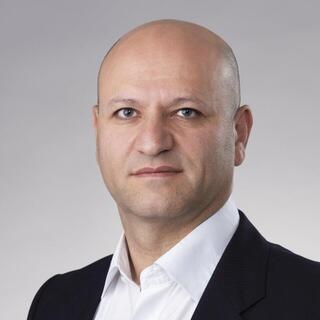
Yoav Segalovitz’s move to join Ra’am marks a dramatic precedent in Israeli politics. There have been, and still are, political alliances between Arabs and Jews, but these have generally taken the form of parties built around a shared ideology — particularly the communist movement that served as the political “womb” from which Hadash emerged — or symbolic representation of Arabs in Zionist parties and Jews in anti-Zionist Arab parties such as Balad, usually in low-ranking positions with little chance of winning a Knesset seat.
Segalovitz’s case is fundamentally different. He is an avowed Zionist with an extensive security and law enforcement background — credentials that have traditionally been viewed with reservations in Arab society — who is being placed in a realistic, potentially winning position on the slate of a party closely affiliated with the Islamic Movement.

Yoav Segalovitz and Mansour Abbas
(Photo: Avihu Shapira)
Bringing Segalovitz into Ra’am, the United Arab List, represents another step in party leader Mansour Abbas’ effort to break longstanding political conventions. Most notably, Abbas led Ra’am into a governing coalition and has stressed the need to recognize that Israel is a Jewish state, in contrast with the Joint List’s demand that it become a “state of all its citizens.”
This is another stage in the political “experiment” Abbas has been leading — one that has produced successes but also severe setbacks, foremost among them the collapse of the governing coalition in which Ra’am participated.
Abbas’ bold approach enjoys broad support within Ra’am. At the party’s general conference last week, delegates unanimously authorized him to place candidates in high positions on its electoral slate, with everyone understanding that Segalovitz was the candidate in question.
Ra’am sees the move as an important step in its effort to broaden and diversify its base of support, opening the party to all sectors of Arab society, including Christians and Druze, while advancing a partnership with Jewish Israelis — all without sacrificing its original character.
Meanwhile, Segalovitz’s inclusion is likely to provide ammunition to Abbas’ critics within Arab society, who accuse him of becoming increasingly “Zionist.” Recently, some have escalated their rhetoric further, openly accusing him of “betrayal.”
Segalovitz’s move is no less audacious than Abbas’. His agreement with Ra’am stipulates that he is not a member of the party and is not bound by its constitution, and that he will have freedom to vote according to his own views on issues involving national security and religion and state.
But at a time when Ra’am faces an intense campaign of delegitimization — particularly over the possibility that a future government could rely on its votes to form a coalition — such a move will inevitably draw fierce criticism.
That argument is being made by all the parties in the current governing coalition, but also by many leaders of the anti-Netanyahu bloc who themselves served alongside Abbas in the coalition that governed until the end of 2022.
The fact that Segalovitz is a retired police deputy commissioner who recorded significant achievements as deputy public security minister in the previous government, particularly in efforts to combat crime and violence in Arab communities — work that earned him considerable goodwill there — will not shield him from harsh criticism from Jewish Israelis.
Meanwhile, he is likely to encounter suspicion from parts of the Arab public at a time of profound alienation from the state.
Despite fierce attacks on Abbas alleging that he “represents the Muslim Brotherhood” and is advancing “malicious schemes through deception,” many Jewish Israelis were impressed by his political courage before the Hamas-led Oct. 7, 2023, attack and continue to be impressed today, finding his approach sincere.
In the last election, Abbas attracted several thousand Jewish votes. Ra’am now harbors cautious hopes that adding Segalovitz will strengthen the party’s legitimacy among Jewish voters and perhaps even deliver an electoral boost beyond the four to five Knesset seats it is projected to win in most polls. Such support would probably come from voters who might otherwise have backed the Democrats or the Joint List.
On the eve of a fateful election, as Israeli political discourse is increasingly characterized by systematically branding political opponents as “enemies” and is saturated with hostility, division and sweeping boycotts, Segalovitz’s inclusion on the Ra’am slate is a breath of fresh air — and perhaps even a modest source of hope.
It is a display of leadership that could challenge the dominance of suspicion and hatred that has taken root since Oct. 7. It offers the possibility of a partnership that does not require either side to surrender its identity or demand that the other change. Instead, it emphasizes common ground and presents a clear-eyed model of tolerant coexistence.
- Dr. Michael Milshtein is a senior researcher at the Moshe Dayan Center for Middle Eastern and African Studies at Tel Aviv University.