

Israel’s obsessive and meticulous focus on the similarity between the eagle emblem of the technocrats’ committee slated to administer Gaza and that of the Palestinian Authority, while far more dramatic moves are advancing in practice, mirrors Israel’s loss of direction regarding the enclave.
Beyond the quixotic struggle to prevent Palestinian Authority involvement in Gaza, even as a liaison committee between it and the technocrats’ committee was established the day before yesterday with the blessing of the Board of Peace, a widening double gap stands out: between the objectives Israel set in Gaza and the reality on the ground, and between Prime Minister Benjamin Netanyahu’s approach to Gaza and that of the rest of the world, including President Donald Trump.
(Photo: Ziv Koren)
Last week’s Board of Peace meeting signals the direction likely to emerge soon, as well as the dilemmas and problems it will create. Discussions about a multinational force are accelerating, although it is unlikely to disarm Hamas. Funds are being raised to rebuild Gaza even without demilitarization, and Qatar is returning to center stage — to Israel’s displeasure, as it would prefer to see other Arab states, foremost Saudi Arabia, take the lead, while simultaneously opposing their core condition of advancing negotiations on the Palestinian issue. A technocratic government is expected to arrive in Gaza, but it appears likely to serve as a cosmetic cover behind which Hamas will try to operate according to the Hezbollah model.
In the face of an international drive toward a new order in Gaza, even if imperfect, Israel is offering only one solution: a return to war, often accompanied by declarations about occupying the enclave and remaining there for an extended period. Some in Israel even promise resettling the area with Jews and emptying it of Gazans.
As throughout the war, there is still no in-depth public debate in Israel about the day after. As usual, fantasies and slogans are replacing sober policy. Israel continues to cultivate dubious militias and clans on the claim they could serve as an alternative to Hamas. Slogans about “de-radicalization like in Germany and Japan after 1945” are raised, even though Hamas remains dominant in Gaza, controls the education system and shapes Palestinian consciousness. In the background, Turkey is building new mosques in Gaza, one named for Abdullah Azzam, the spiritual mentor of Osama bin Laden and a figure admired by Hamas. That is hardly a sign of advancing moderation and tolerance.
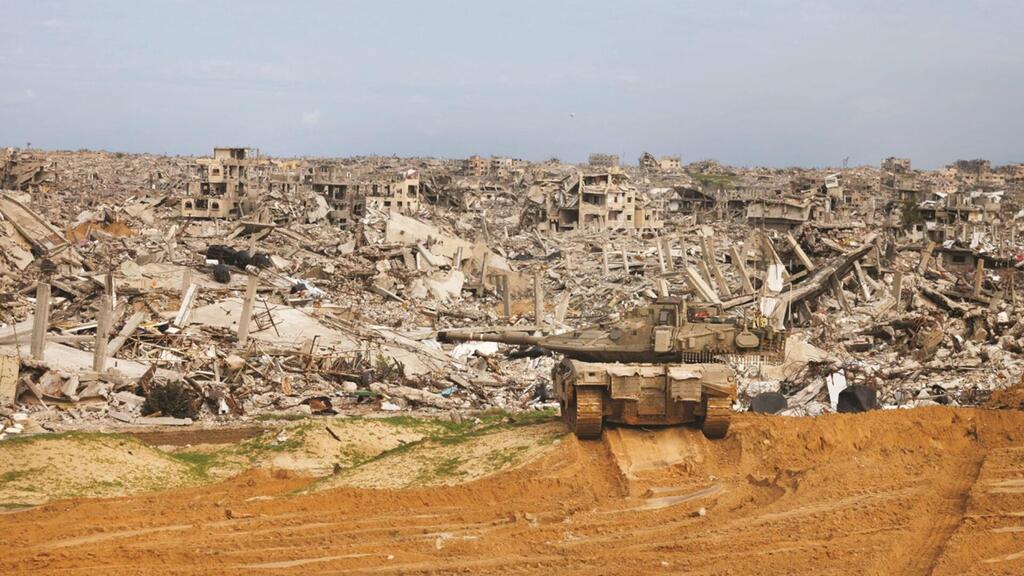
Meanwhile, Israel is entrenching itself along the so-called Yellow Line dividing the enclave, which many describe as the new border. This amounts to a partial implementation of a new security doctrine requiring a presence deep inside enemy territory to defend Israel’s borders. On its face, this may sound logical. But a new security doctrine requires a thorough process and cannot be led by a leadership that created flawed conceptions and bears responsibility for failures.
Moreover, that doctrine rests on the assumption that Israel will face no external pressure and will be allowed at some point to resume intensive fighting. In practice, Trump continues to signal a red light to Israel and may soon demand a deeper withdrawal.
Holding the Yellow Line without an orderly strategy, including defined goals and timetables, is producing negative phenomena inherent in a static, prolonged presence in enemy territory: routine clashes, serious ethical violations such as the smuggling cases in which Bezalel Zini and others are suspected, and reckless adventures such as civilian incursions into Gaza to establish settlements — as has also occurred in Syria and Lebanon. As in the tragic incident in which soldier Gur Kehati was killed, these episodes reflect a sharp clash between messianic yearnings and operational needs and could end in heavy disasters that trigger deep internal rifts.
The father of IDF soldier Ofri Yafe, who was mistakenly killed by friendly fire in Gaza last week, gave voice to the emerging dilemma when he raised a pointed question about the purpose of remaining in Gaza since fighting in the area ended.
The insistence on avoiding the development of a structured strategy and on failing to investigate the roots of the October 7 debacle reflects a chronic inability to acknowledge failures and present a complex truth to the public. Instead, there is an effort to conceal or blur gaps and even present them as achievements.
Policymakers may know the truth in their hearts but do not convey it to the public — for example, that the end of the war was imposed on Israel against the government’s will; that a series of ill-conceived initiatives advanced in Gaza, chief among them the Gaza Humanitarian Foundation, have collapsed; that fantasies of relocating Gazans elsewhere are futile; that despite Israel’s wishes, Turkey and Qatar play a central role in shaping Gaza; and that because of stubbornness driven by political considerations, Israel’s influence in the enclave is shrinking amid creeping internationalization.
It appears Israel will soon be forced to accept further dictates from Trump, as occurred with the end of the war — twice — and the transition to the second phase. These will likely include demands to advance Gaza’s reconstruction, accept a multinational force and a technocratic government — which could limit Israel’s freedom of action — and possibly adopt a “complex” formula for stripping Hamas only of heavy weapons, alongside a deeper territorial withdrawal.
Instead of rigidity and slogans, Israel should focus on three vital objectives: preserving freedom of action, as in Lebanon; maintaining non-Palestinian control of the Philadelphi Corridor along the Gaza-Egypt border; and vetoing the entry of hostile forces into Gaza. There are no good options. Israel must choose the least bad, which is likely a technocratic government. This should be viewed as a temporary solution until Israel formulates a strategy to uproot Hamas, one advanced by initiative and enjoying domestic and international legitimacy — neither of which currently exists.
Dr. Michael Milshtein heads the Forum for Palestinian Studies at the Dayan Center at Tel Aviv University.