

There is almost nothing surprising about the grave events that have been unfolding for about a week in the village of Qusra in the northern West Bank: not the brutal violence by settlers against Palestinians, not the helplessness of law enforcement officials and the involvement of soldiers in the “siege” of homes in the village, not the silence accompanied by a wink from decision-makers and, to a large extent, not even the sharp American condemnation, which illustrates that Israel is gradually entrenching an image of a state in disorder.
The only surprise is the astonishment, and even outrage, among many in the right-wing camp, particularly those promoting the expansion of settlement in the West Bank, in the face of what they define as reckless acts that harm the entire enterprise. This is a strange effort to have it both ways: on the one hand, to support the establishment of farms, most of which have no legal basis and whose existence is accompanied by violent friction with Palestinians, as well as to call for the application of sovereignty in Judea and Samaria and support “Smotrich’s revolution,” whose goal is the establishment of one state between the sea and the Jordan River with two types of citizenship, without seriously grappling with the fate of 3 million Palestinians in the West Bank.
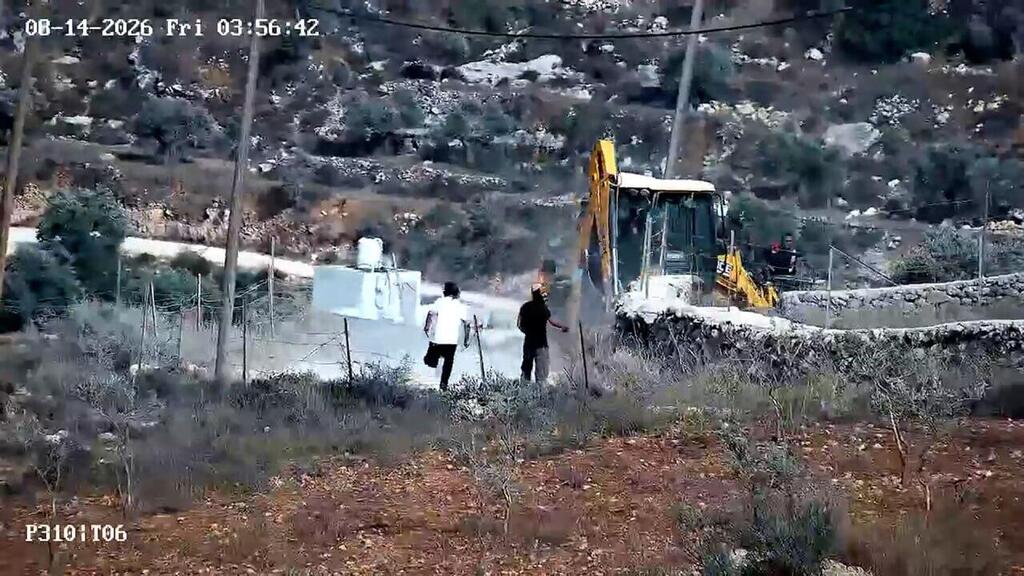
Jewish extremists attack men working to repair the water lines into Qusra
On the other hand, they express astonishment at other moves labeled illegal and immoral. One must look in the mirror: The events in Qusra are not a “historical car crash,” but a development directly linked to, and born of, the West Bank “revolution."
The events in Qusra, like those in the village of Tal, which began with a “hike” and ended with the death of a Jewish Israeli settler and an IDF officer, show the public the formation of an “extraterritory” with its own laws and values. What happens there is not “beyond the mountains of darkness,” but affects the entire state.
The time has come to state things clearly: What is happening in the West Bank under the cover of an unprecedented political spiral is a sectoral project based on faith and ideology that is effectively being imposed on the entire public, most of which does not understand or know what is happening in the West Bank, does not visit the area, does not identify with the vision of the “revolution” and probably does not want to live in a country whose “strategic goals” in the 21st century include advancing the construction of the Temple and the application of biblical laws.
The complex situation is possible to a large extent because most of the public remains in the trauma of October 7. The massacre carried out against Israelis seared into the collective consciousness an unwillingness to see Arabs or hear Arabic, total distrust of Arabs, including Arab parties in Israel, the normalization of terms such as transfer, or “voluntary migration,” and “there are no uninvolved civilians,” the belief that we must rely only on ourselves, or the “new Sparta,” support for the prolonged use of force and, of course, the rejection of a diplomatic settlement, particularly with the Palestinians.
The coming election is about many fateful issues, and one of them must be the future of relations with the Palestinians
Living inside an ongoing trauma without processing it, as embodied in a state commission of inquiry, prevents a complex understanding of reality. Thus, Israelis do not really think about the meaning that follows from the “sober” approach, and above all struggle to imagine what one state looks like when two peoples hostile to each other live without separation, guaranteeing a Balkan reality.
The promoters of the “revolution” identified the opening and seek to enter through it while presenting themselves as a clear-eyed correction and a solution to “what Amalek did to us,” all while presenting the sectoral vision as a national project that contributes to all of us and enjoys a collective consensus. This is done while obscuring the faith-based foundation underlying the “revolution” through ostensibly strategic arguments that are easier for the public to digest: The farms embody the lessons of October 7, a failure that occurred under the government in which the promoters of the “revolution” serve; taking more land enables security, victory and deterrence; and, of course, settlement everywhere is a national asset and eradicates terror.
The vision is, of course, legitimate, but it requires clarifying that its motives are fundamentally faith-based, as well as explaining the dramatic implications of its implementation for Israel’s democratic character and international legitimacy.
In this context, it is important to notice Trump’s growing intolerance toward Israel. He was captivated by its operational performance, but is gradually discovering that it is losing strategic balance, selling fantasies that create entanglements for Washington, particularly in Iran, and above all is addicted to the use of force and hungry for territory.
As a result, Trump is adopting external restraint and enforcement, as reflected in Lebanon and Gaza, and it could lead to an internationalization-style conclusion that it would be better for the Americans to impose order in the West Bank. In Qusra, then, the failure of the assumption that Trump is always with us and that we are the ones making the decisions was once again demonstrated.
The coming election is about many fateful issues, and one of them must be the future of relations with the Palestinians. In the shadow of October 7, discourse on the issue has become shallow, distorted, full of fantasies and devoid of complex examination, with any criticism immediately labeled “defeatism in the spirit of October 6.” Most parties present slogans on the Palestinian issue such as “managing the conflict,” which collapsed on October 7, while the public, for its part, does not demand a more developed platform from them.
A look free of illusions reveals two bad options in the complex situation in which the conflict now finds itself: moving toward one state, as is being realized every day through construction and the merging of infrastructure and procedures; or finding a path toward physical separation, which does not necessarily mean the establishment of a Palestinian state, a scenario whose feasibility and maturity are currently slim, while drawing a divide in a careful way that does not endanger Israel’s security and that includes maintaining control over the Jordan Valley and freedom of action in the Palestinian arena.
A sober separation is not an ideal alternative, and the troubles will not end if it is advanced, but it is preferable to a fanatical, bloody existence in one state.
Dr. Michael Milshtein is a senior researcher at the Moshe Dayan Center at Tel Aviv University