


IDF Chief of Staff Lt. Gen. Eyal Zamir drew a line in the sand. “You can’t keep debriefing yourself endlessly,” he said. “You need to fix things based on the lessons learned and implement them. But you also have to move forward and not sink into the past.”
Zamir made the remarks to about 20 members of the General Staff Forum, most of them major generals serving as heads of branches, regional commands and directorates, along with a smaller number of brigadier generals who sit on the forum by virtue of their roles. He convened them in a small auditorium at one of the IDF’s training bases for what was officially described as a General Staff cohesion day. The real goal, however, was to bring to a close the seemingly endless saga of internal investigations into the failures of October 7 and the war that followed, through an open and candid discussion of the lessons the General Staff and its leadership must draw from that day.
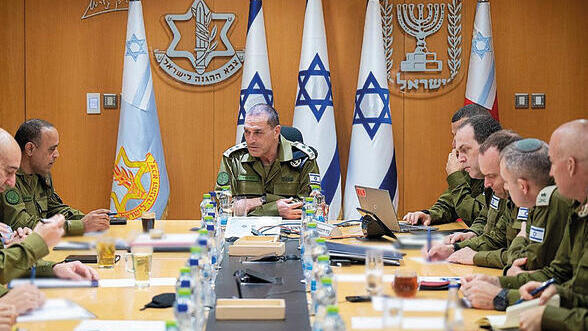
A veteran officer, Zamir was careful not to provoke Defense Minister Israel Katz or Prime Minister Benjamin Netanyahu and did not explicitly mention the term “state commission of inquiry.” He told the forum that the IDF had already investigated itself as thoroughly as possible, but that he still believed an “objective external commission, like after the Yom Kippur War,” was needed — one that would examine not only the military’s failures but also the interface between the political and military leadership before and after October 7 (in other words, the division of responsibility for the failures).
The forum responded in silence and moved on to address the substantive flaws that emerged in the thinking and functioning of the highest body running the military, and how to correct them. The basis for the discussions, which took place in four working groups, were the conclusions of a committee headed by retired Maj. Gen. Sami Turgeman, whom Zamir appointed upon taking office to examine the quality of the IDF’s internal probes. That committee produced important lessons and conclusions for improving General Staff performance, but they were largely drowned out by the media storm surrounding the controversial personal recommendations Turgeman made.
Problems of abundance
The first, and perhaps most important, issue discussed and presented to the full forum concerned methods of thinking and assessments that would allow the military to identify changes in the enemy and prepare for them. On this subject, the generals heard a lecture by retired Brig. Gen. Itai Brun, who replaced the head of the IDF Military Intelligence research division shortly after October 7 and who has been credited over the years with deep intelligence assessments that proved accurate.
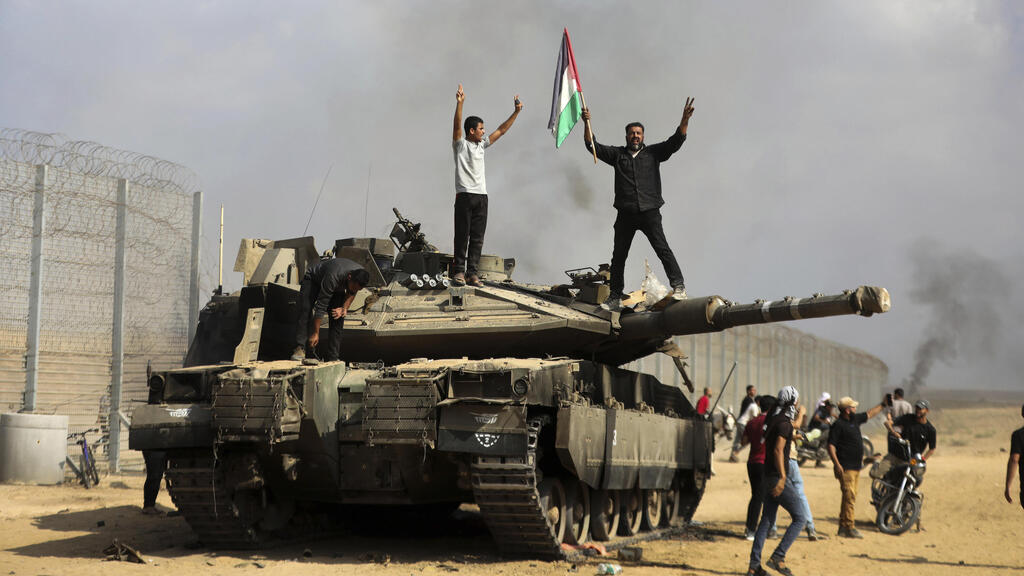
Palestinians who took over an IDF tank near Nir Oz on October 7
(Photo: Yousef Masoud/AP)
Brun argued that there is nothing inherently wrong with a “conception” that organizes thinking — as long as it is based on facts on the ground and on the underlying currents in the enemy’s thinking. The real challenge, he said, is identifying changes in facts and in the enemy’s mindset that undermine the prevailing conception and require renewed preparation.
Brun also tried to outline characteristics of surprise that can be identified in advance, but acknowledged that this is not always possible. Zamir summed up by saying the IDF must assume there will be surprises it does not detect ahead of time, and therefore must build and prepare itself, physically and mentally, to repel a surprise attack even without prior intelligence warning.
Another central issue discussed by one of the working groups was how senior commanders relate to intelligence. In the background were the Jericho Wall plan, the SIM cards activated in Gaza on the night of October 6-7 and other intelligence indicators that could have provided sufficient warning of the Hamas attack had they been properly understood by commanders, including the chief of staff and the Shin Bet head.
The conclusion was that the intelligence abundance the IDF enjoyed before October 7, largely due to cyber and digital technologies, turned into a curse. The sheer volume of information and its perceived reliability created a sense among commanders at all levels that they knew the enemy intimately and could understand its intentions without relying on experts — namely experienced intelligence officers familiar with the enemy’s culture, traditions and habits, capable of deep analysis based on historical context and nuance. The generals acknowledged that this abundance bred arrogance and intellectual rigidity, preventing commanders from accepting differing views, suggestions and warnings from intelligence officers under their command.
One working group examined the division of labor and authority between the General Staff and the regional commands. The conclusion was that the covert and overt “campaign between wars” waged by the IDF in the north and south since 2013 to thwart the buildup of Hamas and Hezbollah eroded the ability and motivation of regional commands — particularly Southern and Northern Command — to act independently and swiftly against threats in their areas.
That campaign was managed mainly from IDF headquarters by the chief of staff, Military Intelligence, the Operations Directorate and the Air Force. The regional commands handled intelligence and operational issues that were important, but ranked lower in priority than headline operations such as intercepting weapons convoys along the Iraq-Syria border.
Any unusual action required approval from the chief of staff. As a result, Southern Command, for example, waited for instructions from headquarters on the morning of October 7, even though there were actions within its authority that it could have taken before and after the massacre began. Zamir’s conclusion: authority and resources must be allocated to the regional commands so they can act independently, using the full intelligence and operational capacity available to them — as is happening today.
Where is the patch?
A pointed question raised for discussion was to what extent the General Staff functions properly as a group. Do the generals represent, in assessments and force-building discussions, the specific interests of the branch, command or directorate they head, or should the General Staff function as a body with shared responsibility and a single binding set of priorities?
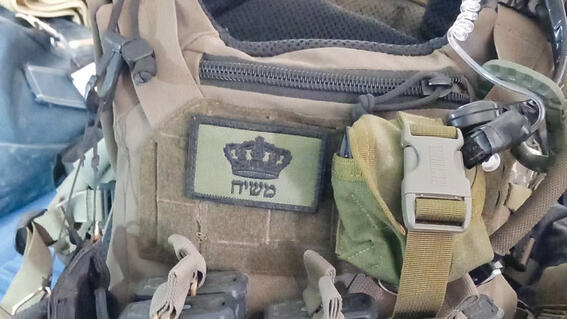
What happened to discipline? 'Messiah' patch on an IDF soldier's vest
The conclusion was that the General Staff must operate as a group with common goals and priorities. For example, on the night of October 6-7, the chief of staff should have held consultations in much broader forums.
At the same time, it was agreed that smaller forums within the General Staff should be established, each dealing with a specific issue, replacing the exclusive responsibility of certain generals for particular areas. It was also agreed that a clearer distinction is needed between a “situation assessment,” which requires brainstorming among participants, and a briefing, whose main purpose is information delivery with clarification questions. This distinction is important to make better use of the generals’ and the chief of staff’s time.
Erosion in “operational culture and discipline” was a fifth issue raised by Zamir. This ranged from patches bearing the word “Messiah” on soldiers’ uniforms, to unruly behavior reflected in videos posted by soldiers on social media in violation of orders, to operational and traffic accidents that claimed lives and left soldiers permanently injured. Members of the forum were briefed on the issue, but discussion was brief. All agreed the situation requires immediate improvement.
Zamir concluded the morning’s discussions, before the forum departed for a visit to the ANU Museum of the Jewish People, with two observations and one principle he said he personally adopts. Intelligence provided by collection units, he said, must be treated by commanders as a working tool and examined with skepticism, with the help of expert intelligence officers — not as absolute truth that merely confirms preconceived views. Commanders must also constantly worry and look for where surprise might come from, living by the maxim “happy is one who is always cautious,” but without falling into excessive alarmism that erodes forces and resources.
Finally, Zamir concluded: “Group cohesion and diversity of thought — that is what is required of the General Staff Forum.”