

In 15 Arab countries, at the State Department in Washington and in the two largest Muslim countries in Southeast Asia, Indonesia and Malaysia, foreign ministry buildings have become meeting places for working groups of academics, former and current diplomats, senior intelligence officers and business representatives. They meet once a week, and the item on the agenda is Israel’s political future.
What is striking is that these groups do not keep the content of their discussions to themselves. On the contrary, they maintain close contact with representatives of Israel’s Arab sector, Israeli diplomats from the not-too-distant past, military figures and journalists who cover the Arab world for Israeli media.
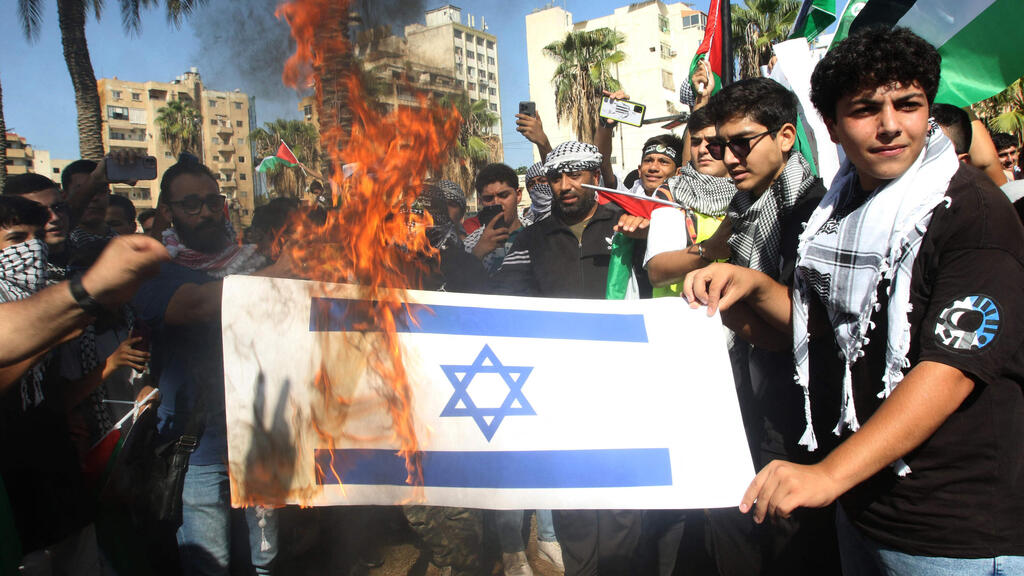
South Lebanon protesters burn Israeli flag
(Photo: Mahmoud ZAYYAT / AFP)
They make no secret of their interest in Israel’s political future, especially ahead of the next election. A consensus is already emerging: despite the reservations many senior Arab officials have about Prime Minister Benjamin Netanyahu, they are still betting that he will win again. They also do not understand why he, as well as Naftali Bennett and Gadi Eisenkot, are rejecting outreach to Israel’s Arab community.
That, in many ways, captures a central part of Israel’s relationship with the Arab world in the 1,000 days that have passed since the October 7, 2023, massacre.
Even in Arab countries that do not officially recognize Israel, including Saudi Arabia, Qatar, Oman, Algeria, Somalia, Djibouti, and of course Syria and Lebanon, the debate is underway. Every day, they follow the verbal battles between Netanyahu and his opponents in the opposition.
It is interesting to see that Avigdor Lieberman fascinates analysts in the Arab world because they view him as “a strong man with principles.” In Egypt, officials are unwilling to ignore his past threats to bomb the Aswan Dam. Still, some argue that “he maintains a practical relationship in Russia, and it should be taken into account that at the end of the process he will join the coalition if Netanyahu wins the election.”
In the working groups, I identify anger over the sweeping disregard in the Israeli debate for the future of the West Bank, and over the lack of interest in Palestinian Authority President Mahmoud Abbas and senior Palestinian Authority officials.
“The two-state solution is not even on your agenda,” a former Egyptian army officer, who is familiar with Israel’s former negotiators, tells me sharply. According to his insistent explanation, there is no chance of reaching an arrangement without a solution to the Palestinian issue, without bringing Palestinian forces into the Gaza Strip to crush Hamas and take its place. That, he stresses, can be done only through cooperation with Israel.
 Smadar PerryPhoto: Yariv Katz
From an Israeli perspective, it is worth watching which Arab country will lead the “solution initiative.” First, a consolidated position paper is sent to Washington. Later, it is distributed across Arab states and Europe, with the expectation that Trump will present an “Arab peace plan” focused on the Palestinian issue, the West Bank and Gaza. The emphasis is on connecting the two, through cooperation between intelligence services and military and police forces from the West Bank, alongside American forces, as planned in southern Lebanon.
So where does that leave Israel?
Israel has peace treaties with Egypt, signed in 1979, and Jordan, signed in 1994. Citizens from the other side are not allowed to visit Israel, and Israelis are “strongly advised” not to try. There are no direct flights. Israelis can enter Sinai without visas, but a bad atmosphere is beginning to blow even through the tourism areas there.
By contrast, dozens of Jordanian workers and service employees cross the border terminal at Aqaba every morning and are dispersed among the hotels. That is a lifeline for the Jordanians, while Israeli tourists have reduced their visits to Aqaba and Petra.
Thanks to the increasingly forgotten Abraham Accords, Israel has ambassadors in Morocco, Abu Dhabi and Bahrain. Sudan, the fourth partner, is out of the game, and Israel has no interest in bringing it back.
The great Israeli missed opportunity lies in the relationship that almost emerged between Riyadh and Jerusalem. Netanyahu was invited to a secret visit to the Saudi city of Neom in November 2020, while then-U.S. Secretary of State Mike Pompeo “dropped in” as well. The meeting was meant to remain secret. Who leaked it the next day and angered the Saudi host? It is not hard to guess.
Since the war, however, Saudi Arabia has hardened its position and is now making an unequivocal demand for a two-state solution between Israel and the Palestinians.