


President Donald Trump has managed to turn the tables and place the regime in Tehran on the horns of a dilemma. Whatever the Revolutionary Guards and the ayatollahs do now is likely to deepen their predicament, while the United States avoids risking its pilots and troops and gains time to bring in a third aircraft carrier strike group for continued operations in the coming days.
It can be said that when Trump announced the extension of the ceasefire and the continuation of the naval blockade, he forced the Iranians to swallow a full spoonful of the same bitter dish they had tried to serve the United States and the world when they closed the Strait of Hormuz. The regime in Tehran created an international energy crisis by shutting the strategic waterway, even driving up fuel prices in the U.S., believing that by refusing to yield to Washington and Israel and by triggering a global energy crisis, it would win the war.
Gallery
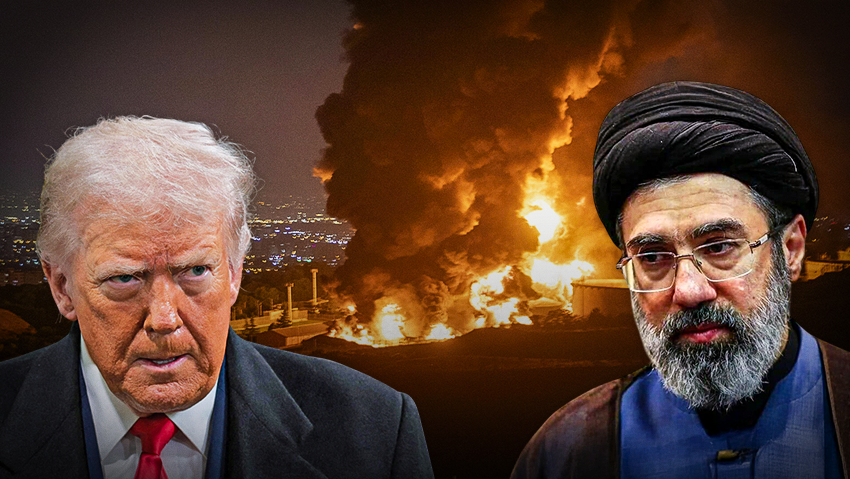
Donald Trump and Iran’s leader Mojtaba Khamenei; Trump forced the Iranians to swallow the same bitter tactic they used against the US
(Photo: Anna Moneymaker / AFP, Stringer / Getty Images)
That sense of euphoria was evident in Iran’s conduct during negotiations, in its disparaging statements toward the U.S., and in its attempts to break the naval blockade imposed by U.S. Central Command. But the global energy market has so far managed to cope through American and international reserves of crude oil and gas, even though the Strait of Hormuz has been closed for nearly a month and a half.
In addition, Iran has found that the Americans are enforcing the blockade by force, including the deployment of Marines and the seizure of vessels traveling to and from Iran, while Trump’s envoys in negotiations have not retreated from core demands, particularly regarding the nuclear issue. Trump appears determined above all to secure a nuclear agreement with Iran that would be markedly better than the 2015 deal reached by President Barack Obama, from which Trump withdrew.
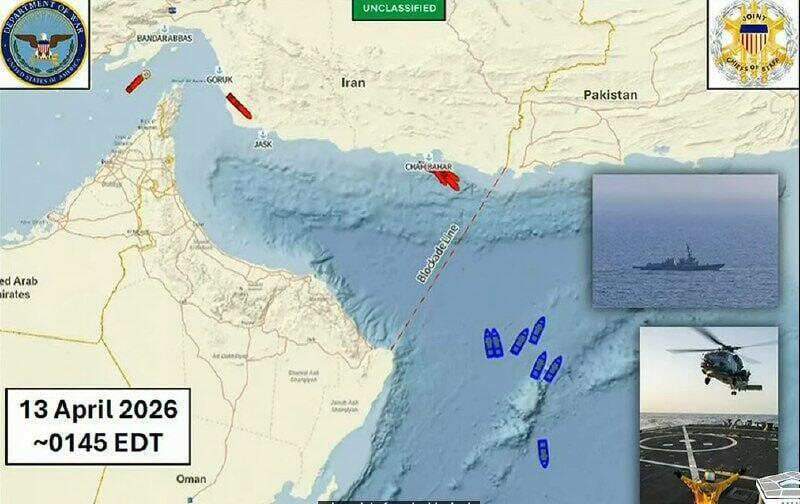
The US blockade line, as presented by Gen. Dan Caine. American warships keep their distance
Why Pakistan’s army chief returned frustrated from Tehran
What ultimately tipped the balance from the American and Israeli perspective, however, was what Pakistani mediators reported. According to a knowledgeable source, Pakistan’s army chief and prime minister provided detailed and credible accounts to the Americans of deep divisions within Iran’s leadership — a triangle involving the Revolutionary Guards and the Khatam al-Anbiya command, representing a hardline, uncompromising stance, and what can be described as the civilian-political leadership, led by parliament speaker Mohammad Bagher Ghalibaf, along with President Masoud Pezeshkian and Foreign Minister Abbas Araghchi. The third vertex of this triangle is Mojtaba Khamenei, the son of the supreme leader, who was killed.
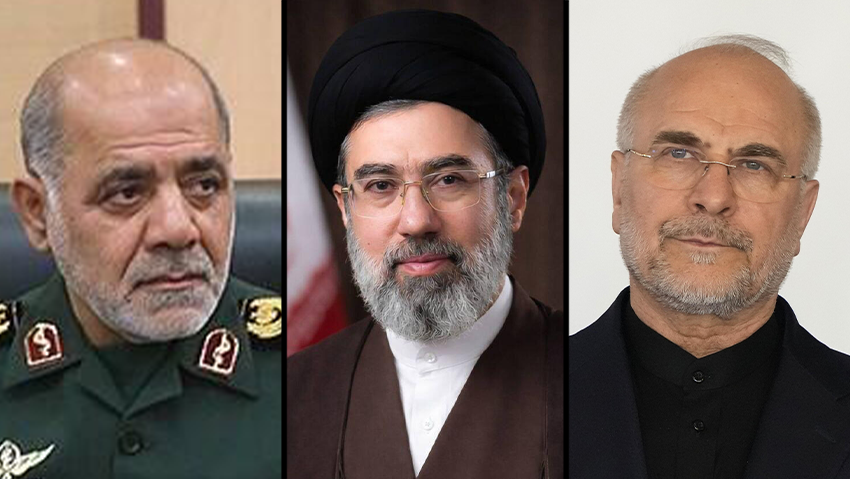
Iranian parliament speaker Ghalibaf, Supreme Leader Khamenei and IRGC Khatam al-Anbiya headquarters chief Aliabadi
(Photo: AP Photo/Eraldo Peres)
The regime, across its factions, is convinced that Israel will also attempt to assassinate Mojtaba, who is seriously wounded, and therefore is keeping him well hidden and largely avoiding communication with him for fear it could provide intelligence leading to his killing. Still, both factions view Mojtaba as the supreme authority whose decisions are decisive, and they consult with him, likely to resolve differences over negotiations. This process takes time and compels Iran to stall. Pakistan’s army chief, Field Marshal Asim Munir, experienced this firsthand when he traveled to Tehran to speak directly with decision-makers. He returned frustrated, according to American sources, by the divisions at the top and the long waits for decisions from Khamenei’s son.
As a result, Iranian officials did not attend scheduled talks in Islamabad. This scenario had been anticipated in Washington and Jerusalem, and the response was ready and straightforward: continue the naval blockade until Iran formulates a position in negotiations. There is no doubt that Trump is under time pressure to end the global energy crisis and the war with Iran, which is highly unpopular in the United States, as reflected in polls showing very low support for the president. This is particularly problematic ahead of the midterm elections in November.
The blockade is as effective as bombing
Trump, however, is unwilling to compromise on demands regarding enriched uranium already in Iran and its continued enrichment, signaling he will not yield on these issues. What matters most is that the U.S. now views the naval blockade — costing Iran more than $400 million a day — as a pressure tool at least as effective as airstrikes, perhaps even more so. For Washington, it is a winning strategy: instead of deploying forces to Kharg Island or the Strait of Hormuz and risking casualties in a costly operation, U.S. forces can remain at a safe distance from Iranian missiles and drones in the Arabian Sea and Indian Ocean, enforcing the blockade and, when necessary, moving closer to ensure no oil tankers depart.
Iran no longer has a conventional navy but does possess shore-to-sea missiles with ranges exceeding 100 nautical miles, as well as explosive drones and anti-ship ballistic missiles. The U.S. Navy, therefore, stays beyond that range, roughly 200 kilometers away, enforcing the blockade with air support over Hormuz. American warships, along with Marines, have already seized two vessels linked to Iran, one of them part of the “shadow fleet” used to smuggle strategic goods, including chemicals for missile production.
Footage: Marines seize an Iranian vessel attempting to breach the blockade
(Video: CENTCOM)


Iranian parliament speaker Ghalibaf has explicitly said the naval blockade is equivalent to bombing, and Iran has made lifting it a condition for continuing talks in Islamabad. The regime fears the blockade far more than Trump’s threats to bomb power stations and bridges, as it is rapidly draining state coffers in a country dependent on oil revenues to support more than 90 million people.
Moreover, Iran has not committed to recognizing the extended ceasefire, suggesting a possible intent to resume attacks against Gulf states, Israel and U.S. bases in the region to pressure Trump into lifting the blockade. However, past experience shows Iran does not always follow through on its threats.
At present, Trump holds a strong card — the naval blockade — and all indications suggest he intends to fully exploit it. From an Israeli perspective, the fact that Iran skipped the talks and Trump extended the ceasefire while maintaining the blockade is close to an optimal outcome. It underscores Trump’s determination not to concede, particularly on the nuclear issue, and leaves Iran under dual pressure from the blockade and severe international sanctions.
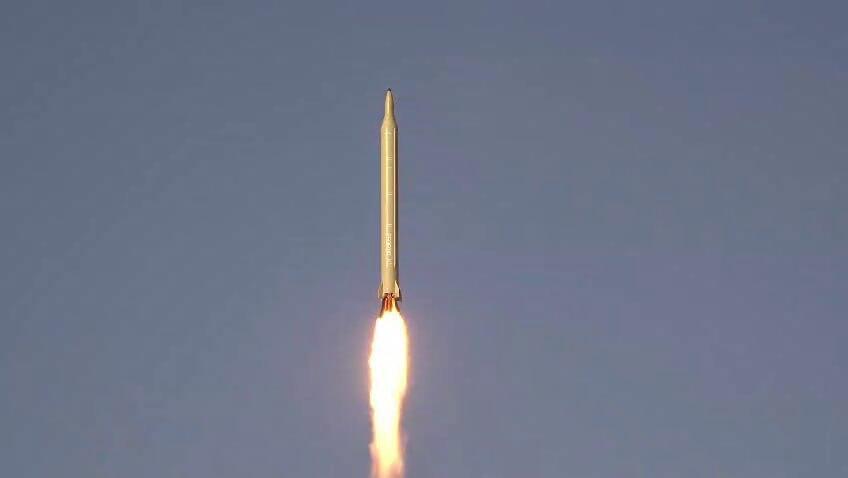
In Israel, concerns grow over a deal that could release Iranian funds, enabling the regime to rebuild missile capabilities and support proxies
Senior Israeli officials have long feared a U.S.-Iran deal only marginally better than the Obama-era agreement, one that could release funds allowing Iran to calm domestic unrest and rebuild its nuclear and missile capabilities and support for proxies such as Hezbollah and the Houthis. Such financial relief would undermine the gains of Israeli operations in Iran. Trump’s decision to continue the ceasefire alongside the blockade is therefore seen as positive, and if Iran refrains from renewed hostilities, it may also spare civilians from further disruptions.
Four possible scenarios for Tehran
It now remains to be seen how Iran will respond to what can be described as a strategic “ippon” — a decisive move in judo — delivered by Trump. Four main scenarios are possible:
The first is a renewal of hostilities using remaining missiles and those recovered from underground storage, along with hundreds of explosive drones. Iran would likely target Gulf states, whose oil and gas facilities are highly vulnerable. Tehran hopes such attacks would pressure those countries to influence the U.S. and deepen the global energy crisis.
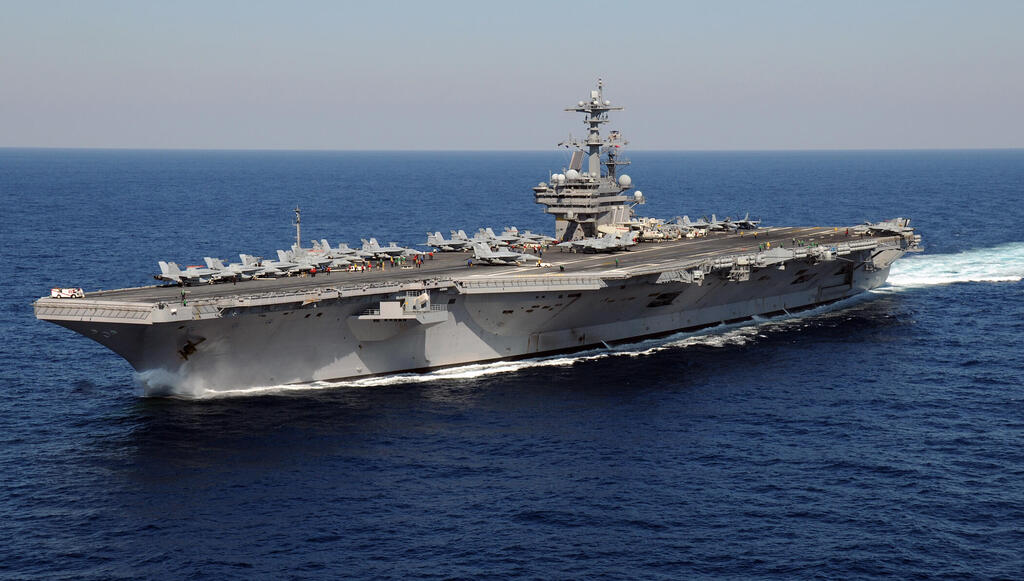
The USS George H.W. Bush aircraft carrier. It is en route and could respond if needed to a Houthi attack
(Photo: MC3 (SW) Nicholas Hall/Wikipedia)
However, resuming attacks would likely trigger a massive response from Israel and the United States. A third U.S. aircraft carrier, the USS George H.W. Bush, is expected to join the USS Abraham Lincoln in the region within days, with the USS Gerald Ford already in the northern Red Sea. Each carrier group includes destroyers equipped with Tomahawk missiles and dozens of fighter jets. Such a force has not been seen in the region since the 2003 Iraq War and would be capable of devastating strikes against Iran’s remaining missile capabilities and infrastructure.
The second option is to use proxies — Shiite militias in Iraq and especially the Houthis — to target shipping through the Bab el-Mandeb Strait and strike oil facilities in Saudi Arabia, Kuwait, the United Arab Emirates and even Qatar. Some attacks have already been carried out, though with limited damage so far. A broader campaign, particularly if the Houthis close Bab el-Mandeb, would pose a significant challenge for the U.S. and Israel.
For now, the Houthis appear reluctant to escalate, likely aware that U.S. forces could quickly be redirected to counter them. Hezbollah is not seen as a viable pressure lever at this stage, as it would face heavy Israeli retaliation if hostilities resume after the current ceasefire. It remains unclear whether Trump will continue to restrain Israel in Lebanon, though he is likely to allow operational freedom to counter rocket and drone fire north of the Litani River.
The third option for Iran is to resume negotiations while the blockade remains in place — a humiliating step after declaring it would not negotiate under such conditions. Yet the effectiveness of the blockade as leverage may leave Iran with little choice.
The fourth option is to maintain the status quo, hoping time pressure on Trump — due to domestic opposition to the war and the global energy crisis — will force him to ease demands and lift the blockade. From Tehran’s perspective, however, this is risky due to the severe economic consequences, especially after damage to its petrochemical industry. Fuel shortages are already being felt.
For now, Trump holds a powerful card, one that requires time, patience and resolve. Iran continues to issue threats, but within a few days, it should become clear which course the regime chooses.