

The situation in northern Israel is intolerable. It is intolerable because 1 million Israeli citizens are living under a tangible threat to their lives, livelihoods and well-being. It is intolerable because the state placed them in this situation through an initiated military campaign without first ensuring their security.
It is intolerable because what the IDF is doing in southern Lebanon these days is not reducing the level of danger or anxiety in the north by even a centimeter. It is intolerable because, instead of confronting the cost of a military operation that has gone wrong, we are telling ourselves stories.
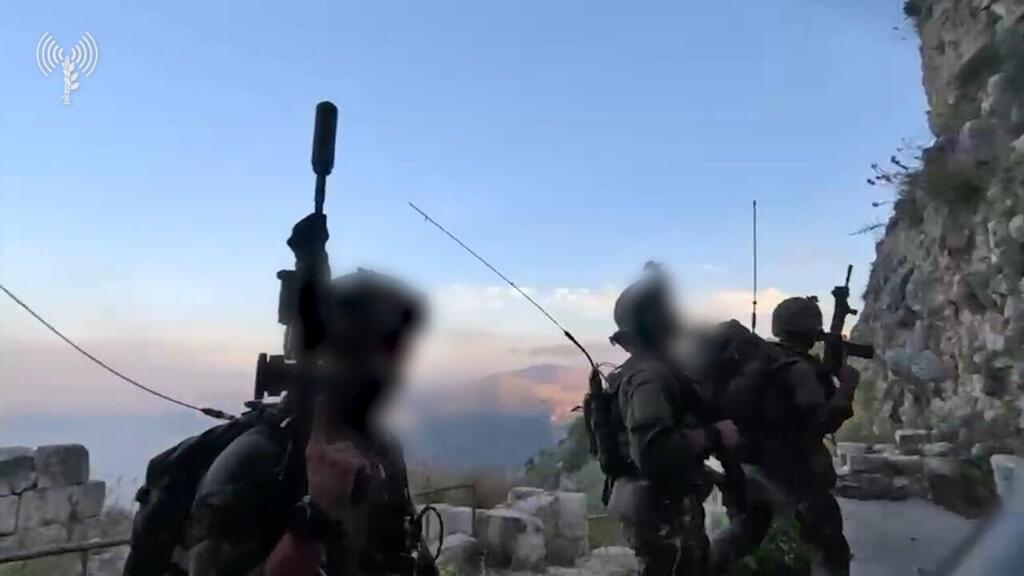
IDF forces capture Beaufort Castle
(Photo: IDF)
We crossed the Litani River, the headlines proclaim. We captured Beaufort Castle. Good for us. In 1982, we crossed the Litani and captured Beaufort. The battle for Beaufort entered Israeli consciousness as a tragedy because of the death of Maj. Guni Harnik, commander of the Golani Reconnaissance Unit. It later settled into public memory as a farce following a visit by Prime Minister Menachem Begin.
“Did they have machine guns?” Begin asked knowingly. “Machine guns?” The soldiers around him struggled not to laugh as the photographer snapped away.
Benjamin Netanyahu and Israel Katz will visit Beaufort as well and pose for photographs there, surrounded by anti-drone netting. “We will expand and deepen our operations into Lebanon,” Netanyahu will promise. We have been there before.
One of the sharpest scenes in the Israeli comedy film “Givat Halfon Eina Ona” brings together Victor Hasson, played by Shaike Levi, and a brigade commander.
“If the Egyptians come, what do you do?” the commander asks. “What we did in ’56,” Hasson replies. “What did you do in ’56?” the commander asks. “What we did in ’48,” Hasson answers. “What did you do in ’48?” the commander asks. “Thirty years ago — how should I remember?” Hasson says, ending the debriefing.
In Lebanon, we are now doing what we did in 1982. If force does not work, use more force: that is the doctrine. Sometimes it works. Sometimes it does not. Sometimes it takes 18 bloody, futile years before we understand that it does not.
The IDF offensive in Lebanon enjoys near-consensus support. Not only are the government and military leadership fully behind it, but so are Naftali Bennett and Gadi Eisenkot, the two leading opposition-bloc contenders for prime minister. In the posts they publish every day, they criticize the government for not doing more. In their view, the government is too restrained, too mindful of American dictates. The IDF should be given a free hand, they argue — move farther north, even into Beirut.
They are not alone. Channel 12, Israel’s dominant television network, seems eager to see Beirut burn. A day when smoke rises over Kiryat Shmona but not over Beirut is treated as an affront to national honor, a day of defeat.
I am not convinced this patriotic fervor stems solely from a deep analysis of strategic options. It is entirely possible that Bennett and Eisenkot are pushing for an expanded war because they believe that is what a certain segment of voters wants to hear. It is also possible that they are afraid: utter a single word of criticism about the offensive in Lebanon and they will be branded traitors, cowards or, worse, leftists. A similar message emerges from television broadcasts. We have one national campfire and everyone wants to bask in its glow.
Beaufort is a parable. The Crusader fortress perched on the Ali al-Taher ridge is not Masada, nor is it Iwo Jima. The ridge as a whole has some military significance because it overlooks communities in the Galilee Panhandle. That was true in 1982. It is less true in 2026. UAVs and drones can reach their targets without guidance from an observer on a mountaintop. What remains is the name, the symbol. It belongs to the world of marketing, not the world of warfare.
The original plan for the offensive in Lebanon did not include Beaufort or the Litani. The army was drawn there by the difficulty of dealing with the drone threat and by public pressure. It is hard to see how seizing additional territory in Lebanon advances a solution to the problem of drones and UAVs. It is easier to see how it could lead to a prolonged deployment with mounting casualties.
Bennett, who views the territory captured in Lebanon as a welcome temporary asset for future negotiations, forgets how difficult it has been for Israeli prime ministers to relinquish territory once it has been taken.
In different times, the military might have weighed an expanded campaign against the unreasonable burden placed on reservists and the erosion of the fighting force’s capabilities. Today, however, any such statement would place the chief of staff before a firing squad on social media.
War is a serious matter. It must not be left in the hands of the poison machine.