

The Hormuz memorandum was signed in mid-June, with a 40- to 50-day mine-clearance window built into its architecture. The conventional reading treats this window as a technical artifact: ordnance takes time to remove. The political reading treats it as the entire point. The agreement was not timed to the diplomatic clock or the market clock. It was timed to November 3, 2026, working backward.
American gasoline prices do not respond immediately to crude oil prices; a measurable decline at the pump trails Brent by six to ten weeks. The pipeline carries product already in transit, franchise contracts are reset quarterly, and retail pricing is famously asymmetric, with stations raising prices fast and lowering them slowly. Anyone designing a deal for political effect must therefore plan in reverse, and the reverse math is brutal.
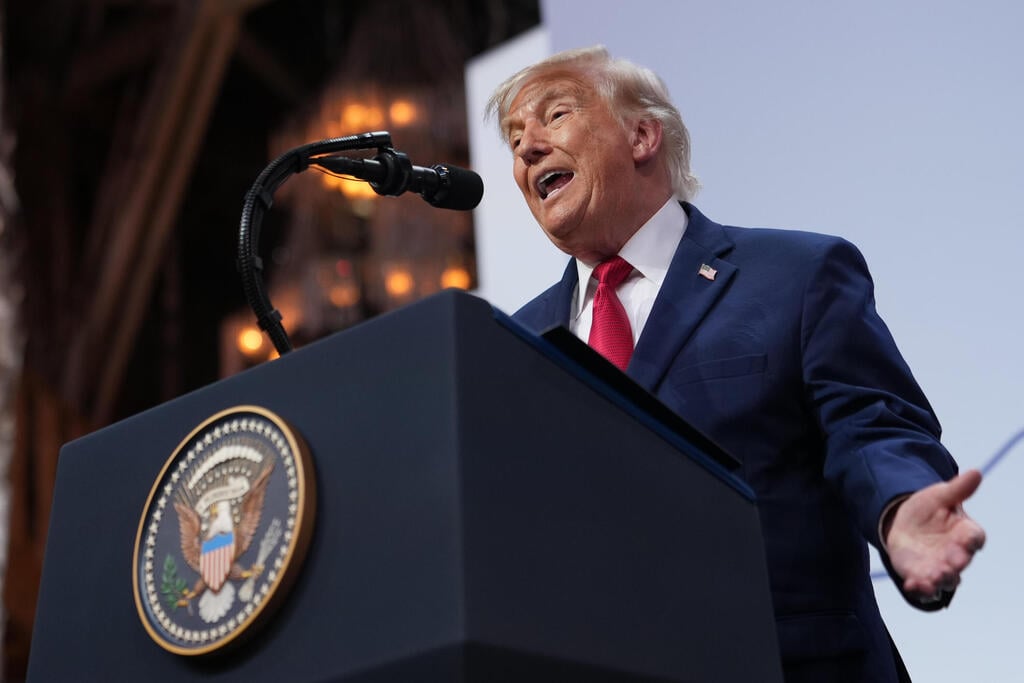
(Photo: AP Photo/Julia Demaree Nikhinson)
For a suburban voter in Pennsylvania, Michigan, or Georgia to feel relief in early October, wholesale prices must fall by late August. For wholesale prices to fall by late August, Brent must be in visible retreat by late July. For Brent to be in visible retreat by late July, the Strait must be in observable clearance by mid-June. The MOU signed on June 15 falls squarely at the early edge of that window. One additional week of delay would have pushed the perceived relief into October, too late to recondition voter mood. Two additional weeks would have handed the Democrats their cleanest economic narrative of the cycle.
The inverse problem is equally instructive. A deal in April would have produced a different outcome, and a worse one for the administration. WTI back at the $70 range by June would have compressed shale margins precisely when 2027 capital-allocation decisions are being made, decisions that flow directly into the 2028 donor base. The Permian and the Bakken would have lost their best quarter of the cycle. The agreement therefore had to be late enough to preserve at least two more quarters of shale economics, and early enough to land the gasoline relief on the right side of the midterms.
This is why the 40 to 50-day clearance window is a feature, not a bug. It begins wholesale price erosion in early August. It preserves shale margins through Q2 reporting and into Q3. It allows the President to appear at late-October rallies with two simultaneous trophies: the end of the war, and the return of the pump price to something close to normal. It also deprives the opposition of the one economic argument that polls best in mixed districts: the cost of filling a tank.
Two American constituencies pull the President in opposite directions. The donor base in the energy patch wants sustained oil prices between $80 and $90. The voter base in suburban swing districts wants sub-$3.50 gasoline. These are not minor frictions; they are structural to the coalition. A premature deal damages the first, a late deal or no deal damages the second. The mine-clearance window is the only span of weeks during which both can be satisfied simultaneously. The exact length, 40 to 50 days, is uncannily aligned with the operational time required to deliver relief at the pump without breaking the resource economy that funds the political machine.
 Dr. Bella Barda-Bareket Photo: Lia Yaffe
There is a further layer. By signing in mid-June, the administration also secured the symbolic value of ending the war ahead of the G7, the summer driving season's peak in the United States, and the Q2 earnings cycle, in which shale producers will report margins built on the very disruption the President is now resolving. Each of these calendars rewards the same week. None of them reward May, and none reward August.
Read this way, the Hormuz agreement is not a foreign-policy event with domestic consequences. It is a domestic instrument with a foreign-policy wrapper. The diplomacy is real, the mines are real, the stranded tankers are real. But the question of when, of the precise calendar week to sign, was answered in Pennsylvania and Michigan, not in Tehran or Geneva. Trump did not buy peace. He bought the one variable he could not produce by any other means: the convergence of pump-price relief and shale-margin preservation, inside a single political season. The MOU is the receipt.
- Dr. Bella Barda-Bareket is an entrepreneur and a macroeconomic and geopolitical analyst.