


When the government of Mauritania summoned Iran’s ambassador, Javad Abu Ali Akbar, in the capital city of Nouakchott on September 14, 2026, the diplomatic dispute attracted little visible attention in Israel. In the constant noise of domestic political debates, northern border tensions and the ongoing direct confrontation with regional proxy forces, a diplomatic dispute on the distant Atlantic edge of the Sahara barely registered in public conversation.
The official statement from Nouakchott cited activities inconsistent with diplomatic norms and national sovereignty, following the ambassador’s unannounced visit to a rural village in the Trarza region, where local news reporting indicated that three individuals were subsequently detained in connection with the encounter. While the full background of Iranian outreach in the country remains opaque, this public reprimand was not a trivial incident. The public rebuke is notable because it shows that Mauritania is willing to draw a visible line around the activities of a foreign diplomat. It served as a distinct and timely signal coming directly from a sovereign nation that once held formal diplomatic relations with Israel and occupies a strategic position at the crossroads of North Africa and the Sahel.
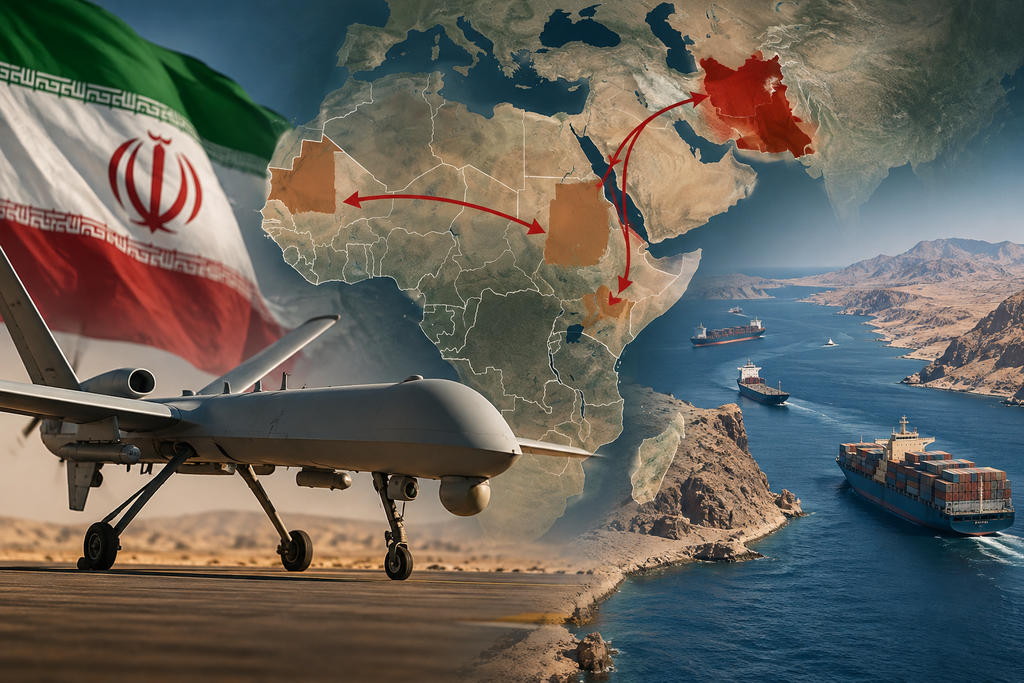
(Generated using AI)
For several decades, Israeli national defense and strategic planning have operated under a tight geographic framework focused primarily on immediate regional borders. Defense leadership concentrates heavily on the immediate array of hostile forces constructed by Tehran: Hezbollah in Lebanon to the north, armed militias in Syria to the northeast, powerful proxy groups in Iraq to the east, the Houthis in Yemen to the south, and Hamas in Gaza. This traditional perspective on regional threat architecture is dangerously incomplete. While public attention remains constantly fixed on the immediate Levant and the Persian Gulf, Iran has demonstrated an ability to exploit state fragility and conflict outside its traditional theaters, and Sudan shows how that approach can intersect with African instability. From the shores of the Red Sea to the vast expanses of North Africa, separate diplomatic and security developments risk becoming strategically connected over time if left unmonitored.
Consider the operational evidence that has emerged from Sudan. As the country endures a devastating internal war, Iranian military equipment has become a notable factor on the battlefield. Sudanese Armed Forces units have repeatedly deployed Iranian-made unmanned aerial vehicles, including Mohajer-6 combat drones, to target opposition forces. Detailed reports from Human Rights Watch and major international news agencies have documented the operational presence of these Iranian drone systems. The military relationship suggests that Tehran sees strategic value in maintaining influence in Sudan. Previous reporting indicated that Iran sought a permanent naval presence or dual-use logistical access at Port Sudan in exchange for military assistance. Although Sudanese authorities rejected that proposal and both sides publicly denied any base agreement, Iran's military relationship with Sudan keeps the question of whether Tehran could eventually seek durable Red Sea access strategically relevant.
A permanent Iranian naval presence or maritime intelligence facility on the Sudanese coast would alter the balance of power along critical maritime corridors. Combined with Houthi territorial pressure near the Bab el-Mandeb strait, an expanded Iranian footprint in Sudan would give Tehran and its partners a far more dangerous ability to pressure both sides of this vital gateway. Israel’s economic exposure to Red Sea volatility is often misunderstood in public debate. Even with limited direct export volume on Red Sea lanes, Bank of Israel analysis indicates that direct sea exports to Asia and Oceania account for roughly five percent of total Israeli goods exports, yet disruptions along this route carry major secondary economic consequences. Forced ship diversions around the entire African continent sharply increase transit durations, elevate global maritime freight rates, and raise insurance costs. On routes such as China to Israel, rerouting around the Cape of Good Hope increases shipping distances by up to one hundred and fourteen percent, significantly delaying critical commercial imports.
Prominent regional heavyweights fully understand the wider strategic implications of these ongoing maritime security developments. On September 15, 2026, Egyptian President Abdel Fattah al-Sisi and Saudi Crown Prince Mohammed bin Salman met publicly and explicitly stressed the vital importance of securing freedom of navigation through the Bab el-Mandeb strait and the Red Sea. Egyptian security leadership in Cairo has consistently treated Red Sea security as part of a much broader regional dynamic. In March 2026, Cairo hosted the first European Union-Egypt Security and Defence Dialogue, placing maritime security in the Red Sea, Yemen, Sudan, and the Horn of Africa at the center of discussions. By June 2026, the European Union approved a twenty million euro security assistance package dedicated specifically to enhancing Egyptian maritime capabilities in both the Mediterranean and the Red Sea. Furthermore, Egypt has also maintained security consultations with European partners as it confronts the wider instability affecting the Red Sea, Horn of Africa and Mediterranean. Cairo recognizes a reality that Jerusalem must acknowledge: instability in the Red Sea, North Africa, and the Sahel is deeply interconnected.
Tehran’s broader approach relies on an opportunistic operational method seen in other parts of the world. Iran does not typically begin its regional interventions with massive conventional military deployments. Instead, it systematically identifies vulnerable state structures, economic distress, and ongoing internal conflicts. In these environments, Iranian representatives offer affordable weapons technology, military training, drone hardware, and diplomatic support. In return, Tehran seeks intelligence presence, commercial leverage, and potential logistical options for the future. The history of Hezbollah, the Syrian network and the Houthis demonstrates why early Iranian involvement deserves scrutiny before a limited relationship becomes a durable security infrastructure. In the early stages of those regional interventions, analysts frequently dismissed Iranian activity as secondary, marginal, or ineffective. Decades later, the State of Israel faces complex multi-front operational challenges that have grown out of those earlier footholds. Allowing similar operational patterns to take root in vulnerable African states would represent a severe strategic error.
 Amine Ayoub
The potential implications for Israeli national security are direct and serious. An expanded Iranian influence footprint in Africa creates distinct security risks. Historically, volatile North African transport corridors running through Sudan and the Sinai Peninsula served as major supply lines for hostile groups in Gaza and the West Bank. If Iranian logistical presence in Sudan consolidates over time, those smuggling channels could become reactivated with more sophisticated weaponry. Additionally, an expanded Iranian operational and intelligence presence across North and West Africa increases tangible risks for soft targets, including Israeli diplomatic personnel, commercial representatives, and travelers across the continent. Furthermore, any expansion of Iranian influence in these theaters could complicate Israel's security relationships and the broader regional integration represented by the Abraham Accords. Morocco and Sudan were central African participants in the historic normalization process, although Sudan’s integration remained incomplete due to its internal crisis and the unratified 2020 normalization accord.
While the full scope of Iranian activity in Mauritania remains opaque and a permanent naval base in Sudan is not secured, the pattern of arms transfers, diplomatic friction, and opportunistic footholds is visible and consistent with Tehran’s established methods. Passively waiting for full proxy networks to materialize on the ground before taking action is a deeply flawed national defense posture. Israel must adopt a proactive African strategy centered on three clear operational pillars. First, Israel must significantly enhance intelligence gathering and maritime surveillance across the Red Sea, the Horn of Africa, and North Africa to monitor potential illicit maritime transfers and covert logistics. Second, Israel must deepen defense and intelligence collaboration with African states that actively resist foreign subversion, offering actionable security insights and defensive technologies. Third, Israel should align its strategic posture with Western and regional partners, supporting international initiatives that protect freedom of navigation and maritime stability.
The recent diplomatic warning in Mauritania and the documented use of Iranian drone technology in Sudan are clear indicators of an evolving regional security landscape. Iran is moving west, and the State of Israel must watch Africa very closely right now.
- Amine Ayoub, a fellow at the Middle East Forum, is a policy analyst and writer based in Morocco. Follow him on X: @amineayoubx