


Qatar does not mediate the Middle East’s conflicts. It owns the leverage those conflicts generate, and it has spent two decades engineering a position so structurally load-bearing that no patron, rival or victim can afford to remove it.
Qatar’s prime minister and foreign minister, Sheikh Mohammed bin Abdulrahman Al Thani, moved from brokering an Iran-U.S. round in Switzerland to a call with U.S. Vice President JD Vance and senior adviser Jared Kushner on a Lebanon deconfliction cell, then to a Doha studio to narrate the whole sequence to Al Jazeera as though Qatar itself had authored the regional order.
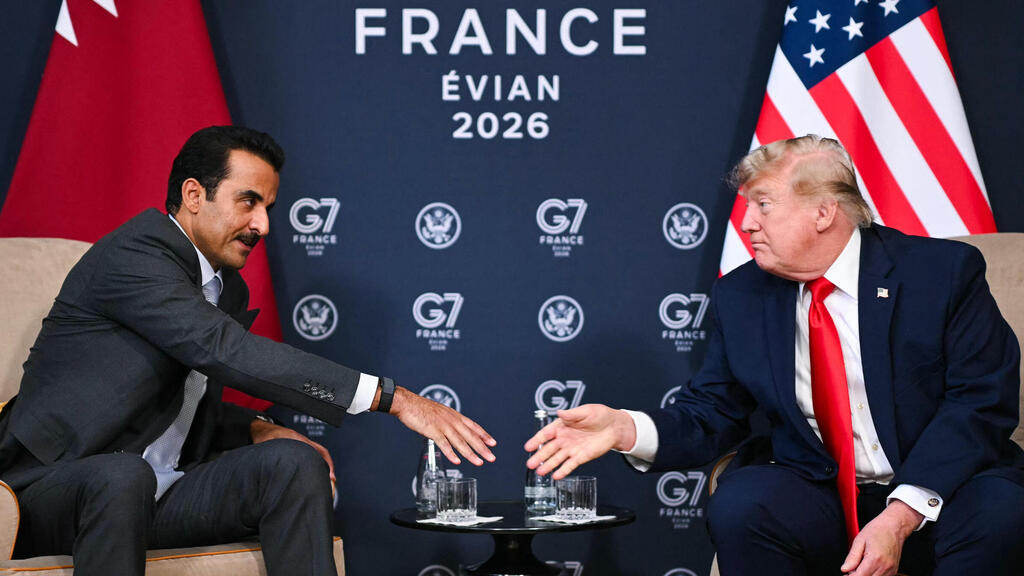
US President Donald Trump meets with Qatari Emir Tamim bin Hamad Al Thani
(Photo: Mandel NGAN / AFP)
It has not authored the order. It has rented itself out as the only working switchboard, and the rent it charges is immunity.
The mechanism is simple and has been visible since the mid-1990s. Qatar built Al Udeid Air Base into the largest American military footprint in the Middle East, the forward headquarters for U.S. Central Command and the runway that launched strikes across two decades of regional war.
At the same time, Doha gave political shelter to Hamas’ leadership after its expulsion from Damascus, hosted a Taliban political office through the final years of the Afghan war and bankrolled Al Jazeera into the most consequential ideological loudspeaker the Muslim Brotherhood’s worldview has ever had.
Washington got its base. The Islamist movements got their patron. Qatar got something neither side could easily take away: a hand on both ends of every wire.
That dual-hosting model is the entire defense strategy. It is not deterrence through strength, since Qatar has no army worth mentioning and depends on Turkish and American security guarantees to survive. It is deterrence through indispensability.
Pressure Doha over its financing of Hamas’ political infrastructure, and the Pentagon quietly notes that Al Udeid’s runways are not easily replaced. Pressure Doha over its decades of bankrolling Brotherhood-affiliated movements from Tunis to Tripoli to Cairo, and Washington’s negotiators point out that the hostage channel to Hamas, the back channel to the Taliban and now the deconfliction line to Tehran all run through the same switchboard.
Every constituency that might otherwise punish Qatar needs something from it first.
The landlord metaphor extends into the financial architecture that makes the arrangement durable. The Qatar Investment Authority has spent two decades buying stakes across American real estate, sports franchises and media companies, while Doha funds endowed chairs at a long list of American universities.
None of this is illegal, and none of it is unique to Qatar among Gulf states. What is unique is the consistency with which it has been deployed alongside the basing and mediation strategy.
By the time any administration considers real pressure on Doha, it is weighing not only Al Udeid and the hostage channel but a web of domestic constituencies with their own reasons to prefer the relationship intact. The rent gets collected in Washington before it gets collected in Beirut or Gaza.
The events of the past week are the model running in real time, across three theaters simultaneously. In Switzerland, Al Thani and Pakistan’s Shehbaz Sharif sat across from American and Iranian negotiators as the joint mediators of the framework governing the war’s aftermath, the same framework that produced the 60-day Strait of Hormuz commitment and the promise of a hotline to manage future disputes.
In Lebanon, as Israeli operations against Hezbollah continued and Beirut’s government pressed Washington for restraint, it was Al Thani on the call with Vance, Kushner and President Joseph Aoun, discussing the architecture of a new deconfliction cell.
And in Doha, in the same news cycle, Al Thani sat for an Al Jazeera interview in which he criticized Israeli conduct in Lebanon while presenting Qatar as the indispensable author of regional calm. Mediator, broker and commentator, all performed by the same government in the same week, each role reinforcing the others.
This is not incidental overlap. It is the architecture working exactly as designed.
A government that mediates a ceasefire, hosts the party violating it and then editorializes about the violation through its own state broadcaster has not achieved neutrality. It has achieved control of the narrative at every stage of the conflict it claims to be resolving.
Lebanon’s government, desperate for any restraint on Israeli operations, has no incentive to question Doha’s role. Washington, eager to keep the Iran framework from collapsing during its most fragile 60-day window, has no incentive to question Doha’s role.
And Jerusalem, watching a state that subsidizes the political wing of an organization still holding the bodies of murdered hostages get praised in Washington statements as an indispensable partner, is left absorbing the cost of an arrangement it never agreed to.
The Gulf’s other capitals have understood this and adjusted accordingly, mostly through quiet imitation, since open rupture with Doha now means open rupture with whatever channel Washington currently needs.
 Amine Ayoub
That asymmetry is the actual achievement of Qatari diplomacy. Riyadh and Abu Dhabi built their regional weight on capital and oil markets. Doha built its weight on having something everyone else needs access to and nobody else will host.
It is a smaller, poorer, militarily negligible state that has nonetheless made itself the one address in the Gulf no American administration has been willing to seriously pressure.
Washington has the tools to change this calculation and has so far declined to use them.
The first is conditionality on Al Udeid itself, structured so that continued American basing access is explicitly tied to verified curtailment of financing for Hamas’ political and military infrastructure, not the rhetorical distancing Doha has offered for years while the money kept moving.
The second is deliberate redundancy in mediation channels, expanding Pakistan’s role and cultivating Oman and Jordan as alternative back channels precisely so that no single capital can claim sole-source status on hostage negotiations, Taliban contacts or Iran deconfliction.
The third is treating Al Jazeera’s editorial line as a foreign policy input subject to scrutiny rather than background noise, since a state broadcaster that shapes Arab public opinion against Israel and the United States is doing strategic work, not journalism, regardless of how it is licensed in Washington bureaus.
None of this requires confrontation for its own sake. It requires Washington to notice that the flexibility that makes Qatar useful in a crisis is the same flexibility that lets it hedge against American interests once the crisis passes.
A landlord who rents rooms to both the fire department and the arsonist is not neutral. He simply profits no matter which way the fire spreads.
Until Washington makes that arrangement more expensive than it is currently profitable, Doha will keep collecting the rent, and the region will keep paying it.
Amine Ayoub, a fellow at the Middle East Forum, is a policy analyst and writer based in Morocco. Follow him on X: @amineayoubx