


Within the gilded, cavernous expanse of the Beştepe Presidential Compound in Ankara, the atmosphere this week possessed a suffocating stillness. U.S. President Donald Trump sat framed by an oversized leather chair, the American flag and blue NATO star behind him. Beside him, NATO Secretary-General Mark Rutte maintained a rigid posture, his face a mask of diplomatic neutrality as the president spoke. Trump spoke of Spain with caustic clarity, treating its prime minister not as the leader of a sovereign European democracy, but as a delinquent contractor who had simply stopped showing up to work.
Every outlet covering the summit instantly framed the encounter around an impatient president losing his temper over defense budgets and publicly degrading an ally. That narrative is accurate, but superficial. Spain's true disintegration began two and a half years earlier in Madrid, when Prime Minister Pedro Sánchez decided that punishing Israel mattered more to his domestic coalition than honoring the Western alliance. Wednesday's outburst was a strategic invoice, and Spain has been running up the bill since October 2023.
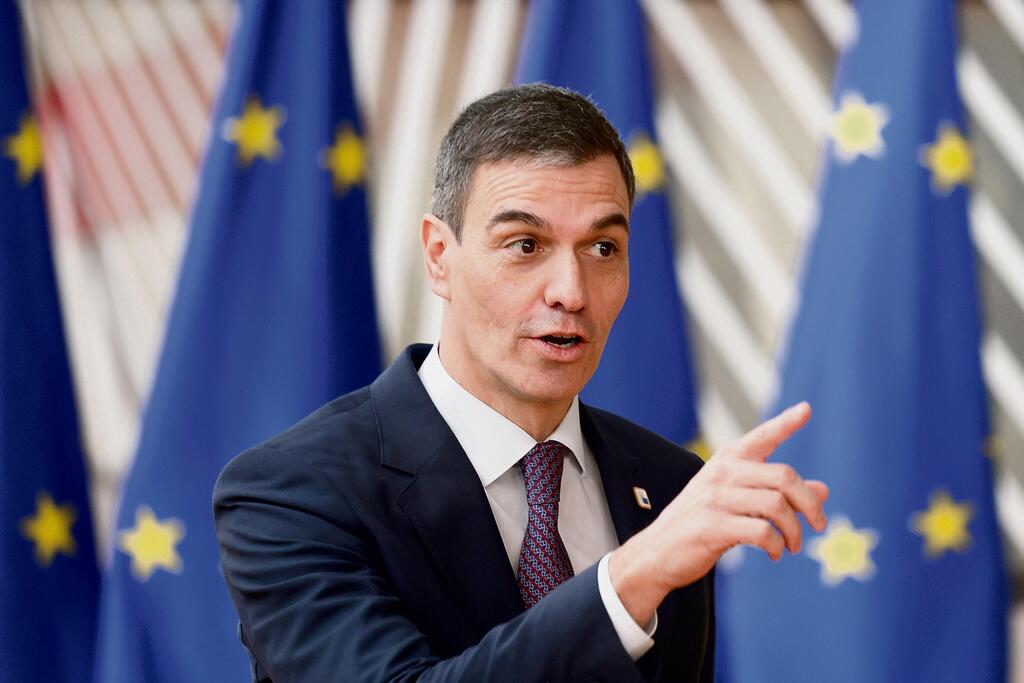
Spanish Prime Minister Pedro Sánchez
(Photo: AP/Omar Havana)
Turning toward Treasury Secretary Scott Bessent, Trump issued a blunt directive to sever commercial ties, stating Washington does not want to do trade business with Spain anymore because they do not participate and they do not pay. He concluded with a simple verdict: Spain is a wasted cause.
The timeline of abdication
NATO leaders endorsed a benchmark requiring member states to allocate five percent of GDP to defense. Spain, alone among all thirty-two allies, refused to commit, negotiating a unique carve-out instead. Yet, Spain's profound quarrel with Western security originates not in Brussels, but in Jerusalem.
The deliberate path to isolation began in October 2023, when Madrid implemented a quiet bilateral arms ban, halting all weapons transactions with Israel within days of the October 7 attacks. This initial fracture deepened in May 2024, when Sánchez aligned Spain with Ireland and Norway to formally recognize a unilateral Palestinian state, a move that fractured Western unity and effectively rewarded Hamas diplomacy.
By September 2025, the Sánchez administration unrolled nine distinct punitive measures against Israel, systematically attempting to isolate the Jewish state within Europe. This hostile trajectory reached its legislative peak in October 2025, when the Spanish parliament officially enacted the comprehensive arms embargo into national law through a razor-thin vote of 178 to 169. The final transformation from a diplomatic dissenter to an active operational liability was completed in February 2026, when Madrid denied U.S. forces access to critical airbases and closed its airspace during the opening hours of the allied campaign against Iran.
The strategic spillover
This isolationist instinct did not remain confined to the Levant for long. When Washington and Jerusalem launched Operation Epic Fury in late February 2026, a decisive joint campaign against the Iranian regime that eliminated Supreme Leader Ali Khamenei in its opening salvos, Spain rapidly positioned itself as the most vehement objector in Europe, targeting the United States directly. Madrid denied American forces the operational use of the jointly managed naval and air bases at Rota and Morón, prompting Trump to threaten an immediate trade cutoff during a tense encounter that March, telling Sánchez directly that his government’s behavior was terrible.
Sánchez responded by actively reviving the historical slogan "No a la guerra," the anti-war rallying cry that had flooded Spanish streets during the Iraq War two decades earlier. Weeks later, Madrid went further, completely closing Spanish airspace to American military aircraft and forcing fifteen U.S. transit planes to execute complex, long-range rerouting maneuvers. Spanish Defense Minister Margarita Robles defended the obstruction by declaring the allied operation against Iran to be profoundly illegal and profoundly unjust. Israeli Foreign Minister Gideon Sa'ar’s final counter-verdict was unsparing, noting that Spain had chosen to stand openly with tyrants.
The Illusion of Ethical Sovereignty
The Moncloa Palace has consistently attempted to frame this pattern of defiance as an exercise in ethical foreign policy. The official narrative from Madrid suggests that by implementing arms embargos and restricting superpower military actions, Spain is acting as a principled custodian of international law, protecting its citizens from being dragged into foreign escalations. This posture is tailored meticulously for domestic political consumption, serving to unite a fractured, left-wing governing coalition around a shared adversarial stance toward Washington and Jerusalem.
This self-styled humanitarianism, however, is a strategic delusion. True geopolitical principle requires uniformity, yet Madrid’s application of international law is glaringly selective. The Sánchez administration routinely weaponizes the vocabulary of human rights to undermine a fellow democracy fighting an existential multi-front war, while simultaneously offering passive indulgence to the revisionist regimes and terrorist proxies destabilizing the Mediterranean basin.
 Amine Ayoub
By denying operational access to Rota and Morón during a critical Western confrontation with the Iranian regime, Spain did not preserve its neutrality; it actively compromised the collective defense capabilities of the entire alliance. Morality in statecraft cannot be decoupled from its strategic consequences, and Madrid’s ethical posture is ultimately a luxury item subsidized by the very security architecture it seeks to dismantle. Spain is engaged in an unsustainable form of geopolitical free-riding, operating under the naive assumption that the Western umbrella will continue to shelter the Iberian peninsula even as Madrid aggressively cuts away at its spokes.
Regional luxury versus frontline realism
This systemic unreliability is what the Ankara summit made visible. Every time an ally requested cooperation, Madrid manufactured a moral pretext to refuse, proving that conscience is remarkably easy to afford when other nations' soldiers pay the blood currency to maintain global order. This dynamic illustrates a widening chasm within NATO. Trump’s grievances extended beyond Spain; he renewed demands regarding Greenland from Denmark, noting that few answered the call against Iran except highly exposed frontline states. For states in the Middle East or Eastern Europe, proximity to threat leaves no room for theater. Spain has abused its geographic comfort, a stark contrast to the realistic foundation of the Abraham Accords.
The verdict
Sánchez’s office responded to the humiliation with standard bureaucratic platitudes about excellent relations and business as usual. Madrid will likely weather this immediate diplomatic storm, since European Union trade policy cannot be unilaterally severed by executive order. Yet the rhetorical escalation continues precisely because the underlying strategic deficit remains unaddressed.
The biting irony cannot be overstated. In Ankara, Spain managed to position itself as more toxic to Washington than Turkey, a volatile, revisionist NATO member that has spent years undermining Western interests and playing a duplicitous double game. For a Western European democracy to be structurally demoted beneath even an unreliable authoritarian partner like Turkey reveals the true depth of Madrid’s self-inflicted isolation.
Spain wished to be remembered as the moral conscience of the West, the government bold enough to draw a line its allies refused to see. Instead, Ankara delivered a stark preview of its actual legacy once the primary guarantor of Western security stopped pretending to believe the illusion. A wasted cause is not a mood. It is a structural verdict, and Spain drafted the first lines of it long ago in Madrid.
- Amine Ayoub, a fellow at the Middle East Forum, is a policy analyst and writer based in Morocco. Follow him on X: @amineayoubx