


The IDF confirmed Saturday that Raad Saad, Hamas’s second-in-command, was killed in a targeted strike in Gaza City, an operation approved despite an ongoing ceasefire and international pressure to avoid escalation.
Saad was traveling with bodyguards in western Gaza City when his vehicle was struck around midday, according to the IDF. The operation was approved following recommendations by IDF Chief of Staff Lt. Gen. Eyal Zamir, Military Intelligence chief Maj. Gen. Shlomi Binder, Southern Command chief Maj. Gen. Yaniv Asor and Prime Minister Benjamin Netanyahu.
Strike that killed Raad Saad
(Video: IDF)


The decision to carry out a targeted killing of a senior Hamas figure in the heart of Gaza City during a ceasefire was highly unusual. Israeli officials were aware the strike ran counter to the approach urged by U.S. President Donald Trump, who in a recent phone call encouraged Netanyahu to give diplomatic efforts time to advance his proposed plan for Gaza, according to Israeli political sources.
Israeli officials cite several factors behind the decision.
First, the strike eliminated one of the central architects of the Oct. 7 attack, in which Hamas terrorists led a cross-border assault that killed about 1,200 people in Israel. Saad played a key role in building Hamas’s military capabilities, founding its military academy and shaping combat doctrines, including urban warfare, artillery operations and large-scale raids such as the Oct. 7 massacre.
Second, the operation sent a message to Washington and regional mediators that Israel will not accept any scenario in which Hamas remains a dominant military or governing force in Gaza, even during a ceasefire. Saad’s ability to move openly and in daylight along one of Gaza’s main thoroughfares was viewed in Israel as evidence of growing confidence among Hamas leaders, including Gaza chief Izz al-Din Haddad, during the truce.
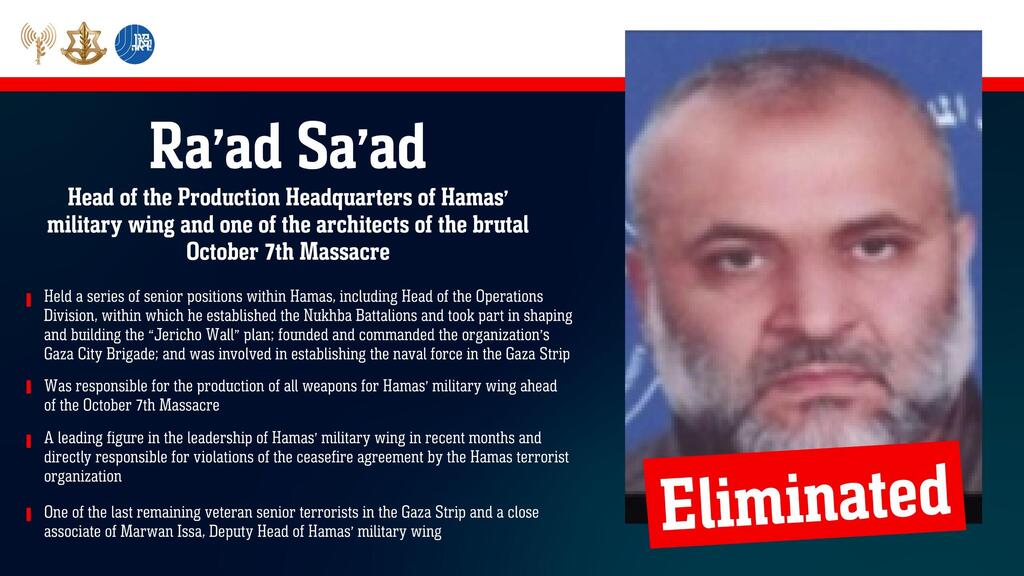
(Photo: IDF)
Despite U.S. calls for restraint, Israeli officials have made clear they are unwilling to tolerate signs of renewed freedom of movement or consolidation of power by Hamas terrorists.
A third factor cited by Israeli officials was that perceived overconfidence. By striking Saad in a highly visible manner, Israel sought to send a clear warning to Haddad and other senior and mid-level Hamas figures that no ceasefire, diplomatic process or international pressure will allow them to remain in Gaza as an armed or governing authority.
The killing reflects Israel’s broader strategy during pauses in fighting: continuing intelligence-driven operations to degrade Hamas’s leadership while signaling that the group’s survival as a military force in Gaza remains a red line for Jerusalem.