


The geopolitical enthusiasm surrounding proposals to integrate Saudi Arabia into a broader regional framework through normalization rests on a profound miscalculation of strategic risk. Proponents within diplomatic quarters depict a realignment across the Middle East, offering Israel normalized relations across the Gulf in exchange for binding security guarantees from the United States and a civilian nuclear infrastructure for Saudi Arabia.
Yet for Israeli security planners charged with safeguarding the nation against existential threats, this proposal demands cold analytical rigor rather than diplomatic optimism. To sanction domestic nuclear capabilities for Saudi Arabia, whether through fuel cycle control, indigenous enrichment or state-administered reactor facilities, represents an indefensible departure from defense doctrine. Israel has long maintained that non-proliferation across its periphery is an absolute strategic imperative, non-negotiable regardless of economic or diplomatic inducements.
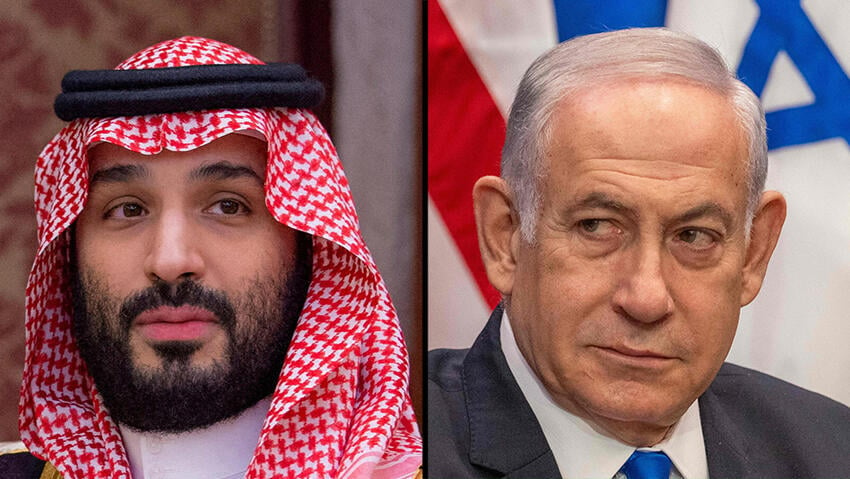
Saudi Crown Prince Mohammed bin Salman, Prime Minister Benjamin Netanyahu
(Photo: Jim WATSON / AFP, Bandar Algaloud/Courtesy of Saudi Royal Court/Handout via REUTERS)
The Begin Doctrine remains an unyielding principle dictating that no regional state harboring structural political instability or potential future hostility can be permitted to acquire weapons of mass destruction or the dual-use industrial capacity to produce them. Surrendering this standard to accommodate nuclear ambitions in Saudi Arabia would permanently erode the regional balance of power.
While diplomatic advocates argue that international safeguards can mitigate proliferation risks, history demonstrates that technical safeguards are administrative constructs designed for static political environments. They provide no security against a state that chooses to nationalize facilities, expel inspectors or pivot toward weaponization.
Once a nation acquires fuel cycle control or enriches uranium, the threshold between peaceful nuclear energy generation and military application becomes a matter of political intent rather than technological barrier.
Proponents of nuclear development rely on the narrative of an irreversible societal transformation in Saudi Arabia. External observers point to entertainment, the curtailment of religious police and social relaxations as evidence of a post-Islamist transition. However, this perspective confuses tactical autocratic modernization with institutional secularization.
For three centuries, monarchical authority has been tied to Wahhabism, a puritanical strain of Sunni Islamism providing the ideological foundation for state cohesion. Although current leadership has suppressed senior clerics to consolidate authority, it has not eradicated the entrenched religious consciousness of the populace. The religious establishment has been coerced into silence rather than converted. In moments of acute crisis, autocratic rulers routinely capitulate to religious zealotry to restore standing.
The strategic hazard of trusting Saudi Arabia with nuclear capabilities becomes even more pronounced when examining structural economic vulnerabilities across the country. The ambitious restructuring plan known as Vision 2030 was conceived to liberate the nation from its reliance on oil exports.
Years after its announcement, the initiative faces severe execution shortfalls and fiscal strain. Flagship megaprojects like NEOM have suffered extraordinary cost overruns, capital shortfalls and execution delays, forcing financial authorities to scale back construction targets and quietly reallocate capital reserves.
Although absolute foreign direct investment inflows have shown modest statistical growth from a low base in recent years, foreign investment continues to fall drastically short of official state targets. The kingdom remains bound to global hydrocarbon cycles. Persistent fiscal deficits occur whenever crude prices drop below budgetary break-even thresholds, severely undercutting the government's ability to sustain public subsidies.
This structural economic decline threatens internal stability. For decades, the monarchy sustained political compliance by distributing oil revenues through public sector employment, energy subsidies, healthcare and tax exemptions. Today, fiscal imperatives have forced the government to introduce value-added taxation, curtail public sector benefits and compel a historically protected populace into an uncompetitive private job market.
Although official figures for youth unemployment show statistical improvement, severe structural underemployment and a profound skills mismatch between traditional educational output and private sector demands remain deeply entrenched. This economic transition disproportionately impacts younger demographics who face limited career mobility. While an urban elite attends state-sanctioned cultural events, substantial populations in peripheral provinces experience stagnant living standards and mounting financial pressures in daily life.
The governance model in Saudi Arabia intensifies these regime fragility risks by centralizing state authority into a single individual. By dismantling the traditional consensus-driven decision-making process among royal family members, current leadership has eliminated internal checks and balances, creating a single point of failure.
In an autocratic system lacking democratic mechanisms, a free press, or an independent judiciary, public grievances cannot be mediated or absorbed. Internal pressures accumulate silently within the state until reaching a critical breaking point.
Israel must confront the historical precedent of Iran in 1979. The Pahlavi monarchy was celebrated by the United States as a stable, modernizing ally and a pillar of stability in the Middle East. Iranian nuclear development was supported by Western powers through technical cooperation programs. In months, popular anger and religious mobilization swept the monarchy away, transferring nuclear infrastructure to a hostile regime in Iran.
 Amine Ayoub
The flaw in current diplomatic calculus is the failure to recognize that political regimes are transient, whereas industrial infrastructure and technical knowledge are permanent. Diplomatic commitments bind only the specific administration that signs them, but physical reactors, enrichment facilities and domestic engineering expertise endure across political transitions.
If Saudi Arabia acquires a complete nuclear fuel cycle, indigenous enrichment or research facilities, the strategic balance of the Middle East is irrevocably altered. A future convulsion, whether induced by palace rivalries, economic collapse or popular revolt, could instantly transform a civilian nuclear footprint into a weapons program. Once a state possesses the material baseline and expertise to enrich uranium, crossing the threshold to atomic weaponry requires only a political decision.
Israel's strategic posture must account for a geopolitical asymmetry between its position and that of the United States. Foreign policy priorities in the United States fluctuate according to domestic electoral cycles and global realignments, allowing strategic planners to absorb the long-term risk of a nuclearized Middle East behind oceanic distance.
Israel, possessing no strategic depth and situated within immediate strike range, enjoys no such luxury. Accepting nuclear capability in Saudi Arabia in exchange for a normalization agreement sacrifices security requirements for temporary diplomatic capital.
Regional architecture constructed upon the decrees of an autocratic sovereign is intrinsically vulnerable to historical shifts. Israel cannot base its national survival on the multi-generational stability of a foreign ruling house whose domestic durability remains uncertain.
Israel must maintain an uncompromising, permanent stance against any nuclear proliferation across the Arabian Peninsula. Non-proliferation is not a flexible bargaining chip to be traded for temporary diplomatic ceremonies, but a non-negotiable, existential prerequisite for enduring long-term national survival and regional stability.
Israel's strategic doctrine has always rested on self-reliance, credible deterrence and the decisive operational capacity to prevent neighboring states from acquiring capacity or infrastructure for mass destruction. Surrendering this foundational defense posture for the fleeting promise of formal diplomatic ties would represent a catastrophic historical error.
True security in the Middle East is forged through unyielding national strength, strategic denial, regional vigilance and the absolute preservation of non-negotiable red lines, never through fragile diplomatic bargains built upon the precarious, deeply unpredictable and transient foundations of an autocratic rule.
- Amine Ayoub, a fellow at the Middle East Forum, is a policy analyst and writer based in Morocco. Follow him on X: @amineayoubx