

Yesterday's earthquake was a jolting reminder that Israel is facing a significant threat to human life and to its ability to function as a state. When the ground shook near the Dead Sea, it did not expose physical damage, but rather a terrifying question no government wants to answer: How would Israel have functioned if the reference scenario had materialized this morning?
In national risk management terms, today’s earthquake was what is known as a “near miss.” The system was spared a test of outcomes, but received a sharp warning. The professional question that should be keeping us awake is not how we performed during a magnitude 4.2 quake, but what would have happened at magnitude 7.5. According to all reference scenarios, such an event would cause hundreds of deaths, severe national disruption, thousands of collapsed buildings, blocked transportation routes and loss of control over critical infrastructure, because Israel has failed to implement its building reinforcement program in high-risk areas.
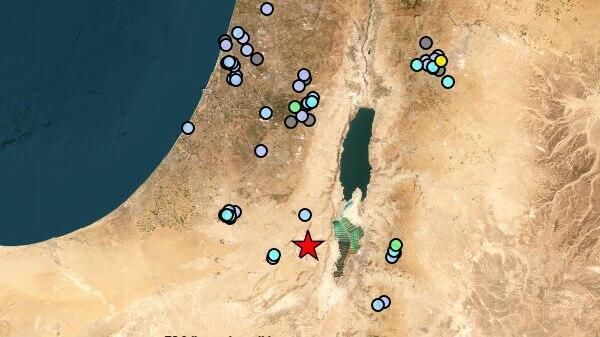
Yesterday's earthquake near the Dead Sea
As someone who has worked in emergency management and presented a structured model for a national crisis management headquarters to former Prime Minister Naftali Bennett, with instructions to continue planning along those lines, I state with regret: The gap between the reference scenario and actual preparedness is a chasm of managerial negligence.
Lessons not learned, from COVID-19 to October 7
The answer to the question of how we would function lies in how we investigate the past. The refusal to establish a state commission of inquiry into the events of October 7, and the disregard for lessons from managing the COVID-19 crisis prove that nothing has been learned.
A state that refuses to independently and objectively investigate its failures condemns itself to repeat them, only on a larger scale.
We already know what will happen when disaster strikes. The government will once again invent a “project czar” or establish a new authority with an impressive name. This is a cosmetic solution designed to create the illusion of control. Authorities without legal powers, without real ability to pool national resources and without enforcement tools vis-à-vis government ministries are a guaranteed recipe for functional chaos when every second counts.
A professional model versus governance by patchwork
Managing a national emergency requires a fundamentally different governmental organizational architecture. The model I presented was based on three pillars that simply do not exist in Israel’s current system of governance:
First, a national crisis management headquarters. A permanent, authoritative body with legal power to pool resources and subordinate government ministries to a single, clear set of priorities during emergencies and preparedness stages.
Second, reference scenario-based management. Massive investment in risk mitigation, from reinforcing hazardous materials infrastructure in peripheral areas to ensuring functional continuity across all critical systems.
Third, a culture of investigation and learning. Turning professional conclusions into binding work plans rather than recommendations that gather dust in drawers for political reasons.
The earthquake near the Dead Sea was a quiet wake-up call on a noisy day. It showed us that nature does not wait for commissions of inquiry or coalition agreements. The nightmare scenario of hundreds of fatalities and a functionally paralyzed state is not a pessimistic forecast. It is nature’s work plan, one we are choosing to ignore.
Instead of waiting for the next powerless “czar” to stand helpless amid the rubble, we must build the national management infrastructure now. Today we received a free warning. If we fail to establish a national headquarters with real authority, the next earthquake will leave no one left to ask the questions.
Talya Lankri is a reserve colonel, former head of a division at the National Security Council, and a member of the Deborah Forum