

The first round of negotiations between Iran and the United States ended with cautious optimism, as expected. Iran signaled some willingness to show flexibility on the nuclear issue while hardening its position on ballistic missiles. The United States may ultimately settle for a nuclear-only agreement, but such a deal would have to include new and significant components.
If an agreement of this kind does take shape, Israel should support the United States and not condition its backing on dismantling Iran’s missile program or ending its support for regional proxies.
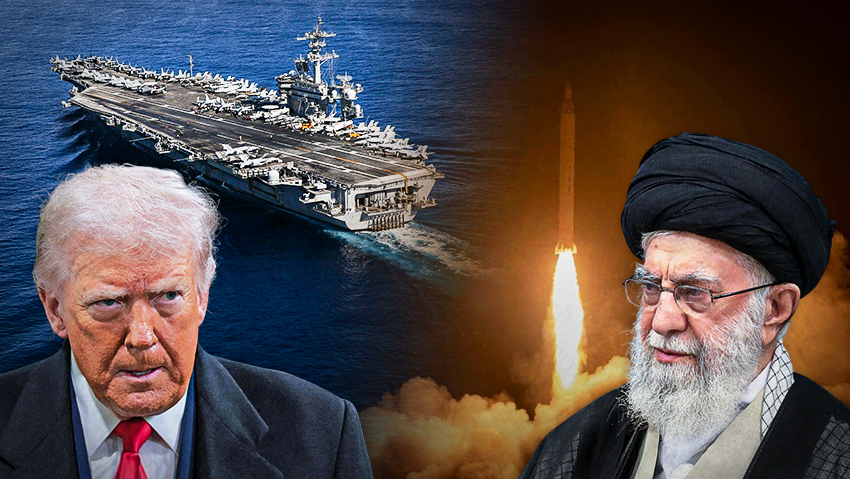
Donald Trump and Ali Khamenei
(Photo: Anna Moneymaker/AFP, KHAMENEI.IR/AFP)
The initial round of talks, which even included an unplanned handshake between representatives of the two countries, clarified the boundaries of the negotiations. From Iran’s perspective, missiles are not up for discussion, as they are viewed as defensive. At the same time, Iran declared a willingness to show flexibility on the nuclear issue in a way that would reassure Washington, as Foreign Minister Abbas Araghchi stated, but without agreeing to a complete halt to enrichment or the removal of its 440 kilograms of uranium to a third country.
Araghchi also said Iran is prepared to discuss a regional nuclear mechanism, an idea previously floated by the United States and rejected by Iran in the past.
Israel’s position on Iran has undergone a significant shift. For decades, the primary focus was on preventing Iran from obtaining nuclear weapons. Now, from Israel’s perspective, the ballistic missile threat has become a parallel concern.
Trump and his representatives have also expressed relative optimism following the sides’ agreement to continue negotiations in the coming days. They appear to be banking on Iranian flexibility, despite Tehran’s public statements, possibly along the lines of a Qatari-Turkish-Egyptian proposal that would include a multi-year halt to enrichment, removal of uranium to a third country and a future commitment to lower enrichment levels, even below those set in the JCPOA.
Trump appears to prefer achieving a credible, strict nuclear agreement over launching a war with uncertain outcomes, as long as his core commitment that Iran will not obtain nuclear weapons is upheld. The firm positions of Arab allies, China’s public support for Iran, fears of a global economic shock triggered by an oil crisis, potential damage to regional arrangements the United States is pursuing in Gaza, Lebanon and Syria, and American public opinion favoring an agreement over military action all weigh in favor of diplomacy over conflict.
At the same time, it is reasonable to expect that Trump will not accept an agreement similar to the JCPOA, from which he withdrew in 2018. That reality will soon force Iran to make consequential decisions that determine whether the path ahead leads to war or to a settlement.
The United States is likely to compromise on missiles and proxies, but it must insist on the core principles outlined above, and no less importantly, on the creation of effective and credible enforcement mechanisms that go beyond reliance on International Atomic Energy Agency inspectors alone. If Iran seeks to avoid an attack, it will have to accept additional oversight involving direct or indirect American participation.
Anything less would constitute failure and could push the United States toward a military confrontation it does not seek.
 Dr. Haim Golovenzits
The Iranian missile issue is not new. It developed in parallel with Iran’s nuclear ambitions, accelerating during the Iran-Iraq War and expanding in the 1990s through cooperation with Syria and Libya and large-scale purchases from North Korea, eventually leading to domestic production of the Shahab missiles. As early as 1996, Iranian officials warned that Tehran could strike any point in Israel with hundreds of missiles.
On the eve of Prime Minister Benjamin Netanyahu’s rushed trip to Washington over the negotiations, Israel should support any nuclear agreement that meets these principles and refrain from initiating military action against Iran’s missile program at this stage. A strict, credible nuclear deal would represent a clear Israeli achievement after decades of struggle, especially if it includes a tangible American military commitment to preventing Iran’s nuclearization.
The missile threat, contrary to some portrayals, is not new, and Iran did not make direct use of it against Israel until 2024. Iran’s missile launches toward Israel occurred only after Israeli actions in Damascus and Tehran and the launch of a broader military operation in May 2025.
Israel’s demand to limit Iran’s missile range to 300 kilometers is unlikely to be accepted. If and when a nuclear agreement is successfully implemented, Israel can then address the missile threat through covert measures below the threshold of war, as it did for years on the nuclear front, or through overt military action if required, backed by credible public deterrence.
Dr. Haim Golovenzits is a Middle East analyst and commentator