


The geopolitical earthquake shaking Washington's relationship with Madrid has opened an unexpected window for one of the Arab world's oldest territorial grievances. Spain's refusal to allow the United States access to its Rota and Morón military bases during the Iran campaign, its consistent failure to meet NATO defense spending targets, and Prime Minister Pedro Sánchez's confrontational posture toward the Trump administration have collectively generated something rare in North African affairs: a genuine crack in Spain's strategic armor over Ceuta and Melilla. Into that crack, Morocco's most consequential new partner, Israel, is uniquely positioned to press.
The pieces have been assembling for months. In March 2026, Michael Rubin of the American Enterprise Institute, writing through the Middle East Forum, called on the Trump administration to formally recognize Ceuta and Melilla as occupied Moroccan territory, branding Spain "a colonial power running colonies across the Strait of Gibraltar." Days later, Representative Mario Díaz-Balart, chairman of the House Subcommittee on National Security and one of Marco Rubio's closest congressional confidants, declared publicly that the enclaves "are not in the geographic territory of Spain" but rather in Moroccan territory, and that their fate should be "established, negotiated, and discussed between friends and allies." This was not the fringe speaking. This was the architecture of a coordinated strategic repositioning.
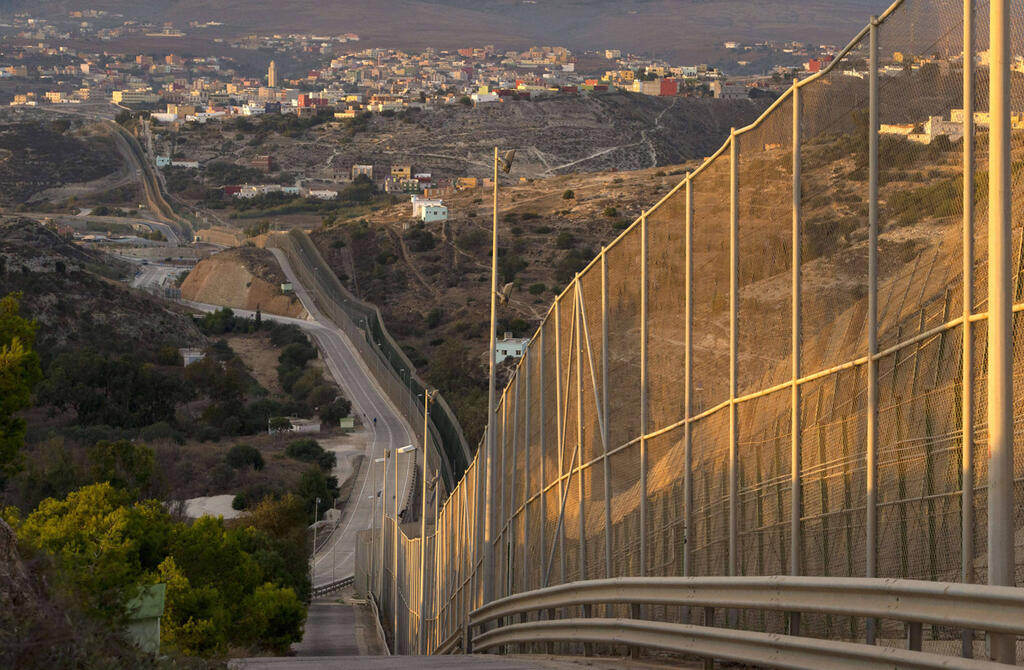
Melilla
(Photo: AFP)
Spain's estrangement from Washington has deepened further. An internal Pentagon email, reported by Reuters in April 2026, outlined options including suspending Spain from NATO over its refusal to facilitate U.S. operations against Iran. Defense Secretary Pete Hegseth made the administration's contempt for European free-riding explicit, singling out allies who refused to contribute to the Strait of Hormuz campaign. Trump himself had already called Spain "terrible" in March and directed his Treasury Secretary to cut economic dealings with Madrid. Critically, Article 6 of the Washington Treaty explicitly excludes territories in continental Africa from NATO's collective defense obligations, meaning Ceuta and Melilla stand legally exposed. The alliance umbrella Spain has long relied upon to insulate its colonial holdouts from diplomatic pressure simply does not extend there.
This is where Israel enters the equation, and does so with unusual leverage.
The Abraham Accords transformed Morocco from a quiet interlocutor with Israel into a formal military partner. In January 2026, Israel and Morocco signed a joint military work plan for the year during the third meeting of their Joint Military Committee in Tel Aviv, which the IDF described as deepening cooperation with a "key partner for regional stability." The two countries had already concluded a security cooperation agreement in 2021. This bilateral architecture gives Israel something it has rarely possessed in North African politics: direct strategic stake in Rabat's regional success.
That stake has an obvious application to Ceuta and Melilla. The Trump administration's Abrahamic coalition, built around shared opposition to Iran and common economic incentives, has created an operational triangular relationship between Washington, Jerusalem, and Rabat. Israel's voice in that triangle carries disproportionate weight. When Israeli officials signal alignment with a partner's strategic interests, that signal registers powerfully in a White House that has placed Abraham Accords expansion at the center of its foreign policy vision. Morocco's territorial claim over the enclaves is not simply a bilateral dispute with Spain; it is increasingly a litmus test for whether the Trump administration will reward its most cooperative partners over its most obstinate NATO members.
Israel can advance Morocco's cause through three distinct channels. First, through direct diplomatic signaling. Israeli acknowledgment that Spain's continued occupation of African territory undermines the post-colonial credibility that normalization frameworks require would reframe Ceuta and Melilla as a regional governance issue, not merely a bilateral spat. Second, through Washington corridors where Israel's influence is considerable, Israeli officials can amplify the case that Morocco's strategic contribution, anchoring the western Mediterranean, controlling the southern approach to the Strait of Gibraltar, and serving as America's longest-standing treaty partner, warrants concrete American support on its most persistent territorial demand. Third, Israel can expose Spain's glaring hypocrisy. Madrid has been among the loudest European voices condemning Israeli territorial policies and settlements. Spain recognized a Palestinian state in 2024 while simultaneously maintaining European enclaves on African soil that predate modern Israel by four centuries. That contradiction is potent and deserves to be driven home repeatedly in international forums.
None of this requires military adventurism. Morocco has consistently pursued its northern claims through legal, demographic, and diplomatic pressure rather than force. The model is patient and effective. Israel's role would be diplomatic amplification within an alliance structure already sympathetic to Rabat's position. The United States designates Morocco a Major Non-NATO Ally, has signed a new 10-year defense roadmap with Rabat, and is simultaneously threatening to suspend Spain from the alliance it refuses to support financially or operationally.
Spain finds itself diplomatically isolated at precisely the moment its most exposed territorial possessions lack a legal defense guarantee. The Abraham Accords created a framework for reconfiguring Middle Eastern and North African alliances in ways that serve American and Israeli interests simultaneously. Helping Morocco recover Ceuta and Melilla would serve that framework and punish a NATO member that has repeatedly chosen obstruction over partnership at the alliance's most critical juncture. For Israel, amplifying Morocco's claim is not charity. It is strategic investment in the partner that, across the Strait of Gibraltar, holds the key to one of the world's most vital maritime chokepoints.
Amine Ayoub, a fellow at the Middle East Forum, is a policy analyst and writer based in Morocco.
First published: 23:36, 04.25.26