


On October 30, an Algerian military convoy reached Arlit in northern Niger. Reuters described it as Algeria’s first deployment of troops abroad since the 1973 Yom Kippur War. The distinction is between ground forces and earlier air support: in August, Algeria sent four Su-30 fighters, an Il-76 transport and an Il-78 refueling aircraft to Niamey, and transferred four helicopters to Niger. That marks a shift to ground presence.
The obvious story is Russia. The better story is gas.
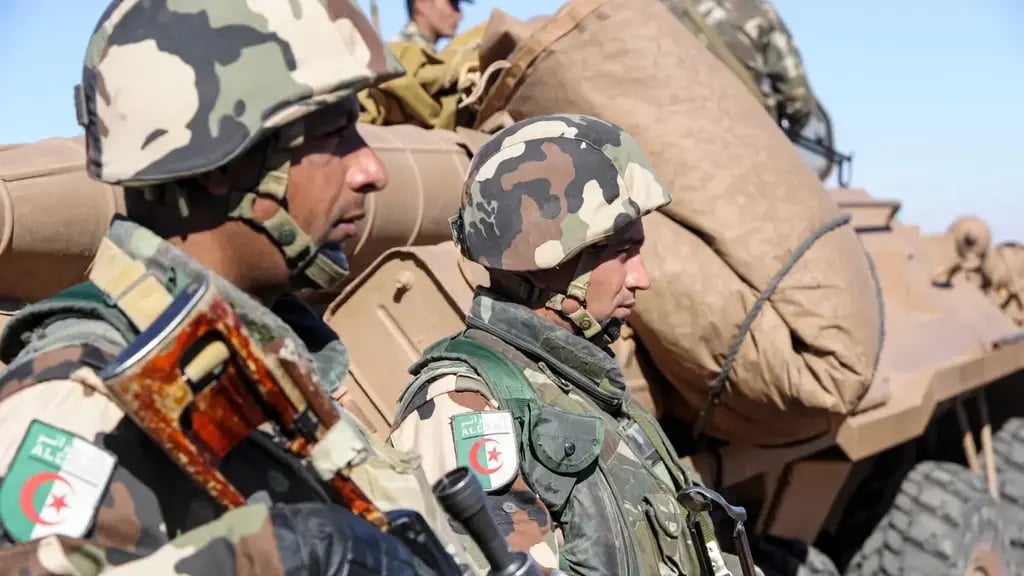
Algerian soldiers stand guard in In Amenas, southeast of the capital
(Photo: AFP)
Algiers says its troops will protect energy and economic interests in Niger. Sonatrach, the state oil and gas company, has investments there and is involved in the proposed Trans-Saharan Gas Pipeline, which would carry Nigerian gas through Niger to Algeria and export markets. Algerian senators have described the mission as protection for oil projects. The pipeline is not confirmed as the convoy’s immediate assignment, but it explains Niger’s growing importance to Algiers.
A convoy in Arlit will not change Israel’s military balance. It could alter the environment around Morocco, Israel’s most consequential North African partner. As Jerusalem concentrates on Iran and the Gulf, it should watch the security of Morocco’s eastern and southern approaches and the unresolved contest over Western Sahara.
On October 25, both parliamentary chambers approved President Abdelmadjid Tebboune’s notification to send army units abroad. The upper house voted unanimously. Article 91 of Algeria’s constitution, revised in March 2026, permits such deployments after approval by two-thirds of each chamber. The vote formally authorized the ground deployment now underway in Niger.
Niger has been ruled by military officers since the July 2023 coup that ousted President Mohamed Bazoum. It is fighting insurgents linked to al-Qaeda and Islamic State. Algeria shares a long border with Niger and fears that Sahelian insecurity could spread north. Protecting investments, energy projects and the frontier are credible reasons for the deployment.
Relations between Algiers and Niamey have been volatile. Algeria condemned the 2023 coup. Ties later deteriorated after Mali accused Algeria of shooting down a Malian drone near the border, and Niger recalled its ambassador. They have since improved. After a failed mutiny in Niamey in August 2026, Niger requested help. Algeria sent four Su-30 fighters with support aircraft and transferred four helicopters.
On October 21, Niger’s defense minister, General Salifou Mody, met Tebboune and signed a military cooperation protocol with army chief General Saïd Chanegriha. Its operational terms remain unpublished. The visit came four days before parliament approved the deployment, signalling a deliberate expansion of security ties.
Russia is part of the picture, but not the whole explanation. Algeria relies heavily on Russian weapons, while Moscow expanded its Sahel presence as Western forces withdrew. France left Niger in December 2023. Russian instructors and air-defense equipment reached Niamey in April 2024, while US troops remained at the same base. Defense Secretary Lloyd Austin confirmed the Russian presence the following month. American forces left in September 2024.
Algeria and Russia need no joint command to benefit from overlapping interests. Both seek influence with Niger’s military government and have reasons to resist a renewed Western security presence. Algeria brings geography, energy ties and conventional forces; Russia brings weapons, instructors and diplomatic support. Their interests can diverge, since Algiers guards its regional primacy. The evidence supports convergence, not coordination of the October deployment.
Arlit also has a uranium dimension. Niger nationalized the SOMAÏR mine, formerly operated by France’s Orano, in 2025. Potential buyers for its stockpile reportedly included Russian interests. On September 23, 2025, an ICSID tribunal ordered Niger not to sell or transfer uranium held in violation of Orano’s rights. Orano later condemned a shipment from the site as contrary to that order. No evidence links the Algerian convoy to the uranium. Its arrival in a mining town nevertheless highlights the overlap between security, resources and outside influence.
Pressure on Morocco also runs through the Security Council. Resolution 2797, adopted on October 31, 2025, extended MINURSO until October 31, 2026. It took Morocco’s autonomy proposal as a basis for negotiations while retaining the goal of a mutually acceptable solution and language on self-determination. The vote was 11 in favor, none against, three abstentions and one non-voting member.
The revised US draft went further. It would rename MINURSO the UN Mission in Western Sahara, or MINUSO, removing the referendum from the mission’s name. It made Morocco’s autonomy plan the sole basis for negotiations and proposed reducing the military component. An earlier version set deadlines for ending peacekeeping operations and cutting uniformed personnel; Washington removed them after objections from Council members.
On October 30, Russia vetoed the US text. Moscow had circulated a rival draft to extend MINURSO for another year without changing its name or mandate. The American proposal received 11 votes in favor, one against and three abstentions. The Russian alternative received only three votes in favor, and Washington voted against it. With neither text adopted, MINURSO’s mandate was due to expire on October 31.
For Algeria, the veto was a diplomatic gain. Algiers backs the Polisario Front and treats Western Sahara as central to its rivalry with Morocco. Moscow prevented Washington from putting its preferred framework into the UN mandate. That does not prove Russia acted at Algeria’s request or that the two capitals coordinated their moves. It does show that a permanent member can block a proposal backed by most of the Council, leaving Rabat without the change it sought.
The combined pressure is real without a formal axis. Algeria is expanding its military reach into Niger. Russia is consolidating its Sahel presence and has blocked a US initiative on Western Sahara. Morocco faces a difficult neighborhood to the east and south, while its diplomatic effort over autonomy remains vulnerable to great-power rivalry. The links are strategic, not necessarily operational.
This matters to Israel because its partnership with Morocco is more than symbolism. The countries restored relations in December 2020. In November 2021, their defense ministers signed a memorandum covering defense cooperation, intelligence, training and industry. At the Marrakech Airshow in October 2026, Israel opened its first national pavilion in Morocco with eight defense companies. The partnership gives Israel a partner on the Atlantic and Mediterranean approaches, but it is no guarantee of Moroccan security.
Morocco’s policy is shaped by its own interests: Western Sahara, relations with Europe, African diplomacy and domestic opinion. Jerusalem should not expect Rabat to take every Israeli position, or assume normalization alone will deter pressure from Algeria. Cooperation should focus on capabilities that answer Moroccan needs: intelligence exchange, air and missile defense, counter-drone systems, cyber defense, training and defense-industrial projects.
Energy competition adds another layer. Algeria continues to promote the Trans-Saharan Gas Pipeline, while Morocco is advancing the African Atlantic Gas Pipeline, designed to connect West African gas producers with Morocco and European markets. In July 2026, ECOWAS leaders signed an intergovernmental agreement for the Atlantic project in Freetown, starting its next implementation phase. Neither route is yet an operating export corridor. Their rivalry reflects competing regional networks and ambitions.
 Amine Ayoub
Washington should keep Western Sahara from becoming another arena for great-power obstruction. It should sustain negotiations, support Morocco’s autonomy proposal as a basis for talks and recognize that a settlement must address self-determination. It should also press for transparency around foreign military deployments and infrastructure agreements in the Sahel.
Israel should deepen practical cooperation with Rabat without treating every Algerian move as a threat directed at Israel. Algeria’s deployment is about securing interests and increasing influence in Niger. The consequences may still reach Morocco, and therefore Israel.
The 1973 comparison is powerful, but the circumstances differ. Algerian forces went to Egypt then to fight Israel. The convoy now in Niger is tied, according to Algiers, to economic and energy interests. It does mark a consequential shift: Algeria is willing to place ground forces beyond its borders to protect what it regards as strategic interests.
- Amine Ayoub, a fellow at the Middle East Forum, is a policy analyst and writer based in Morocco. Follow him on X: @amineayoubx