


If U.S. military aid to Israel is indeed halted entirely at the beginning of next year, as could be inferred from President Donald Trump's sudden announcement on the morning of the congressional midterm elections, it will be conclusive proof that Benjamin Netanyahu must not be allowed to serve another term as Israel's prime minister.
Trump's announcement is intended to influence the millions of American voters who have fallen victim to propaganda claiming that military aid to Israel is responsible for the high cost of living in the United States and the economic hardships facing the younger middle class. This claim is entirely baseless. Annual military aid to Israel, agreed upon by President Barack Obama and Prime Minister Netanyahu in a 10-year memorandum of understanding set to expire at the end of 2028, amounts to less than $4 billion. That represents approximately 0.35% of this year's U.S. defense budget and just 0.013% of the country's national income. These figures are far smaller than even the routine margin of statistical error in macroeconomic calculations.
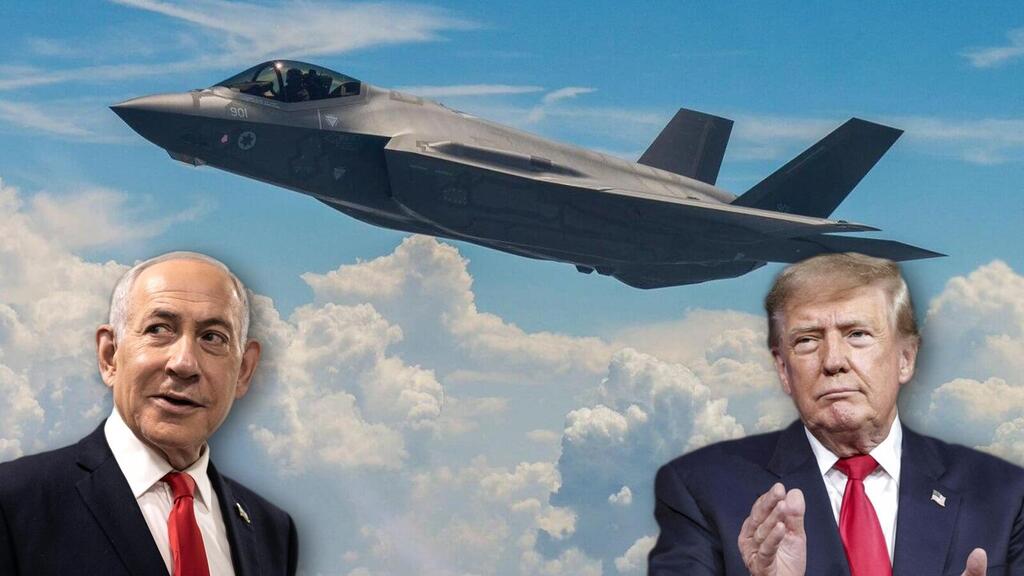
Benjamin Netanyahu and Donald Trump
(Photos: Lockheed Martin, Jewel Samad/Pool Photo via AP, Alex Wong/Getty Images North America/AFP)
Moreover, the United States benefits enormously from these aid agreements, which partly finance joint military research and development programs, enable the joint production of advanced weapons and defense systems, and bring Israeli defense technology to America. Every dollar of military aid is spent purchasing American-made products, including equipment that could be purchased more cheaply in other countries. American defense industries benefit from these arrangements, meaning that the actual economic cost of long-term military assistance to Israel is virtually zero.
If Trump nevertheless saw fit to tear up the aid agreement two years before its expiration, doing so publicly and in one sweeping move, money was not his motivation. Rather, it was the growing hostility toward Israel's current government in general, and Benjamin Netanyahu in particular, across American public opinion, on the left, the right and in the center.
Trump's advisers urged him to make a public and conspicuous break with Netanyahu's Israel, or at least to openly distance himself from it. After delays and hesitation, the president finally did so on Election Day. It was a resounding slap in the face to Israel's sitting government, even though Trump quickly clarified that ending the aid had been "agreed with Bibi long ago." It is true that the possibility of ending military assistance came up in discussions between the two leaders about a year and a half ago, but the understandings reached were entirely different. There was to be no immediate termination and certainly no complete cutoff.
Let us not fool ourselves: Abruptly ending military assistance would not be a catastrophe, but it would place a substantial burden on Israel's next government. Put simply, the 2027 budget would face an additional annual shortfall of approximately 15 billion shekels, equivalent to roughly 12% of the defense budget before U.S. assistance. That gap would have to be filled through new taxes and further cuts to civilian spending on welfare, health care, education, infrastructure and other services.
Because Israel would have to pay from its own budget for military imports from the United States that have until now been provided free of charge, the country's persistent balance-of-payments surplus would disappear and could even turn into a deficit. The consequences would extend far beyond the shekel's exchange rate. They would affect all of us. Even the ultra-Orthodox.
On one point, Trump is right: Israel has a highly successful economy and will be able to cope effectively with the termination of military aid without suffering an economic crisis. I also assume that once the congressional elections are over, Trump's announcement, confused and inaccurate as usual, will be softened. In practice, we are likely to see a gradual reduction in assistance spread over an extended period.
But the international and domestic American impact will remain. Even for Israel's greatest friend in the White House, President Donald Trump, the Israeli government led by Benjamin Netanyahu has become a heavy liability. So heavy, in fact, that he is prepared to throw it under the wheels of his election campaign.