

"I made a deal with Netanyahu that we're going to stop giving Israel $4 billion a year. We're not going to pay Israel anymore," U.S. President Donald Trump said Tuesday in an interview with Fox News. "They're fine with it. They don't need us," Trump added, although he emphasized that Israel remains "a great ally" and that the United States would help it if needed.
Trump went on to claim that Prime Minister Benjamin Netanyahu had initiated the discussions. "You can look at it as a barter arrangement. You can look at it as military aid or cash. We give them things and money worth $4 billion, and they don't need it," Trump said. "Bibi Netanyahu came to me, and we've been talking about this for several years because it's a tremendous amount of money."
Trump's remarks on stopping economic aid to Israel
(Video: Fox News )


The president's remarks suggest that Washington could end its annual military assistance to Israel earlier than previously expected, although it remains unclear whether a formal agreement has been reached or how such a move would affect the existing U.S.-Israel aid arrangement, which runs through 2028.
Trump's comments come as Americans vote in Tuesday's midterm elections, amid expectations that the next Congress could be less supportive of Israel.
In recent years, Israel has faced increasingly sharp criticism from within the Democratic Party, particularly among its progressive wing. During Trump's current term, however, criticism of Israel has also become more prominent among some Republicans. One example is conservative commentator Tucker Carlson, who has repeatedly criticized Israel and questioned the need to maintain Washington's close relationship with Jerusalem.
Opposition to continued U.S. military assistance to Israel comes from two distinct political camps, although their motivations differ significantly.
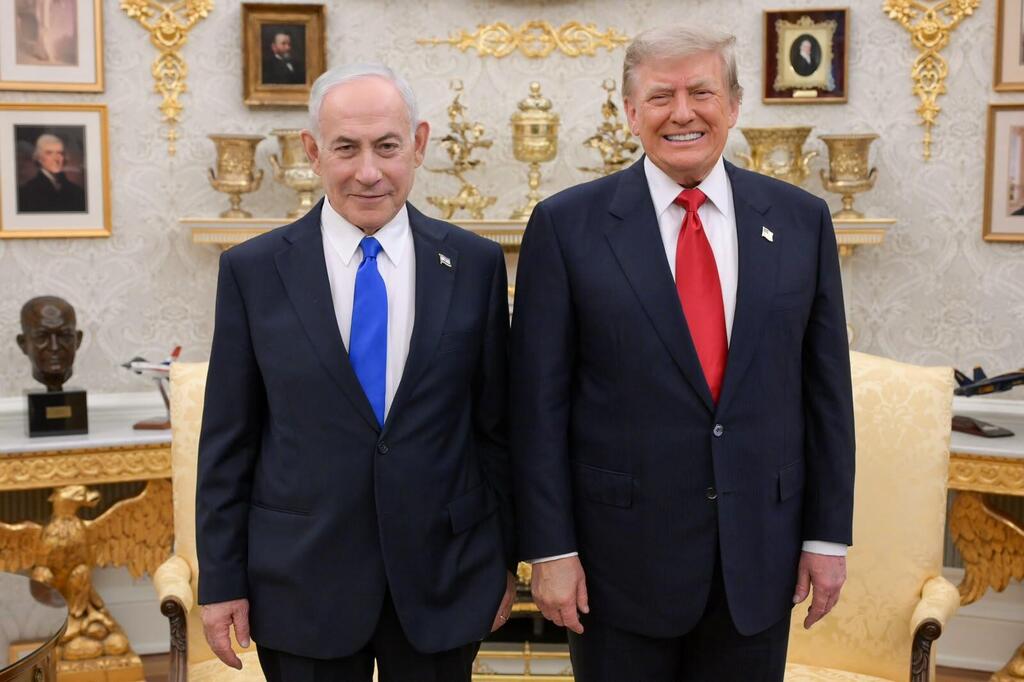
End of the economic aid era: Netanyahu and Trump
(Photo: Maayan Toaf/GPO)
On the left, figures such as Sen. Bernie Sanders and Rep. Alexandria Ocasio-Cortez have opposed military assistance to Israel on ideological grounds, particularly over concerns about American weapons being used to harm civilians and sustain Israeli control over Palestinian territory.
On the right, members of the "America First" wing of Trump's MAGA movement take a more isolationist approach, arguing that the United States should not be responsible for financing other countries' security without receiving something in return.
That position is reflected in Trump's approach to Ukraine, including the minerals agreement, and to European allies, whom he has repeatedly criticized for relying on Washington's military protection while investing too little in their own defense. The administration has consequently demanded that NATO members increase their defense spending.
Did Trump and Netanyahu agree to end aid ahead of schedule?
Until Trump's statement Tuesday, no agreement to completely terminate American military assistance to Israel had been publicly disclosed.
Netanyahu had previously suggested that U.S. assistance would gradually decline and acknowledged that relations between the two countries had deteriorated significantly. However, he had not announced that American aid would be eliminated altogether, certainly not as early as next year.
The current agreement was scheduled to expire in 2028, and Washington and Jerusalem had been negotiating its possible replacement. Among the options under discussion was a new framework based on cooperation rather than traditional military assistance. Netanyahu had previously stated that American military aid to Israel in its existing form would end in 2028. Trump, however, appeared to suggest Tuesday that the change would take effect as early as 2027.
In an interview with The Economist in January, during a visit to the United States, Netanyahu publicly disclosed for the first time that he would not seek a full renewal of the approximately $4 billion annual aid package. "I want to reduce military aid over the next 10 years," Netanyahu said at the time, answering affirmatively when asked whether his goal was to eliminate Israel's dependence on American assistance altogether.
His remarks pointed toward a gradual transition rather than the immediate termination now described by Trump.
Netanyahu warns Israel must expand its alliances
At an event ahead of Israel's elections, where Netanyahu outlined his national security doctrine, the prime minister raised the possibility that Israel could lose the support of the United States and would need to develop alternative alliances around the world.
"In two years, a president could come to power, a man or a woman, who is very hostile to Israel," Netanyahu warned. "How will you deal with that? How will you operate vis-à-vis the United States? And beyond that, what are the necessary solutions?"
Netanyahu, who did not accept responsibility for the current state of relations with Washington, said Israel must work to preserve its ties with the United States while simultaneously developing other strategic partnerships.
"First of all, we must do everything we can over these two years, and in the two years that follow, in the American arena, through good times and bad," he said. "The second thing is to create other alliances. That's what I'm working on now with many countries in our region and outside it. India is not a small country, and there are many others."
Addressing other potential international partners, Netanyahu pointed to developments in Latin America and Europe. "There is a major shift in Latin America. We must expand our network of alliances and develop capabilities that make us valuable to everyone," he said. "And incidentally, in Europe as well. Countries that condemn us have some nerve, by the way. They condemn us and then come to us. And I tell them: It depends on you, on how you behave."
Netanyahu argued that Israel still possesses diplomatic leverage but would need considerable international expertise to navigate changes in American politics and its relationships with other countries.
In an interview with Channel 10, Netanyahu also addressed the future of economic and security relations with Washington, predicting that Israel would no longer be able to rely on American assistance at the levels it had received in the past. "America has changed. It's over, and it will end. It's only a matter of time," he said.
The $38 billion agreement set to expire in 2028
The current U.S.-Israel military assistance agreement was signed on September 14, 2016, under a memorandum of understanding committing Washington to provide Israel with $38 billion over the decade from 2019 through 2028. It remains unclear whether Trump's remarks Tuesday accurately reflect the timetable for ending that agreement or whether he was referring to a longer-term arrangement to replace it.
The memorandum represented an increase in American assistance compared with the $34.4 billion provided over the preceding decade. It also included provisions directing most, and ultimately nearly all, of the assistance toward purchases of American-made defense products, a requirement that adversely affected Israeli defense manufacturers. The agreement took effect in October 2018.
Following the war that began with the October 7 attacks, the Biden administration approved an additional one-time assistance package of approximately $14 billion for Israel. That amount was increased to $17.6 billion two months ago, according to the report.
More recently, Washington and Jerusalem have been negotiating a new agreement for the following decade, expected to be described as a "cooperation agreement" rather than a traditional aid package. Under the emerging framework, funding would reportedly be directed toward joint defense research and development.
Trump's latest announcement raises significant questions about the future of that arrangement, particularly whether the United States intends to discontinue its existing commitments before 2028 or whether the president was describing the proposed transition to a different model of security cooperation.
For now, the precise terms and timetable of the agreement Trump says he reached with Netanyahu remain unclear.