


Even before Prime Minister Benjamin Netanyahu presented U.S. President Donald Trump and his team with newly gathered intelligence on Iran—focusing on its nuclear activity and, more urgently, the rehabilitation of its ballistic missile program threatening Israel—the U.S. president issued a series of significant security statements that Israeli officials in Tel Aviv had been waiting to hear.
“Now I hear that Iran is trying to build up again, and if they are—we’re going to have to knock them down. We’ll knock the hell out of them. But hopefully, that’s not happening,” Trump said.
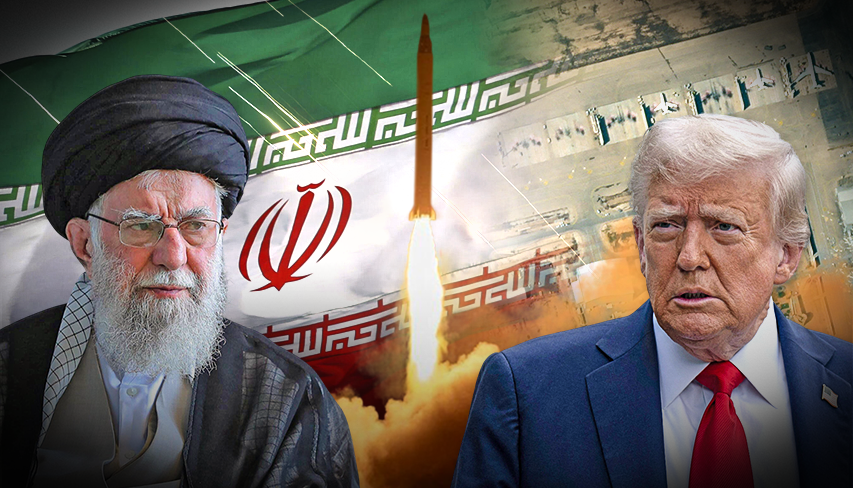
(Photo: Brendan Smialowski/AFP, AP Photo/Majdi Mohammed, Planet Labs Inc./Handout via REUTERS, Shutterstock)
When asked whether the U.S. would intervene if Tehran attempted to rebuild its ballistic missile arsenal or restart its nuclear program, Trump responded “yes” to the former and “immediately” to the latter.
In unusually direct language, Trump affirmed his backing for Israel, acknowledged the threat posed by Iran’s long-range, heavy and precision-guided missiles, and signaled awareness that China is likely backing Tehran, though he stopped short of naming it. He went as far as to publicly approve a planned Israeli operation aimed at weakening Iran’s capabilities.
His stance on the nuclear threat was even more forceful, vowing immediate U.S. intervention if Iran revives its program. According to current assessments, the missile threat is now seen as more pressing and advanced than Iran’s nuclear project.
Ali Shamkhani, senior advisor to Iran’s Supreme Leader Ayatollah Ali Khamenei, responded on X, declaring: “Under Iran’s defense doctrine, responses are set before threats materialize. Iran’s missile capability and defense are not containable or permission-based. Any aggression will face an immediate harsh response beyond its planners’ imagination.”
 Yossi Yehoshua
Earlier this month, Israel raised its alert level following an Iranian missile drill. The concern: such an exercise could quickly shift from simulation to reality, with Iran potentially launching a surprise heavy barrage on Israel, similar to the strategy reportedly considered ahead of June's 12-day war. The core lesson of this threat is clear: who strikes first matters. Will Israel carry out a preemptive strike on missile launchers, or will Iran fire the opening salvo? That opening move could determine the outcome of the next round of fighting.
Meanwhile, protests over worsening economic conditions and poor living standards broke out at several locations across Tehran on Monday, marking the second consecutive day of demonstrations in the capital’s markets and central areas. The unrest intensified following the resignation of Iran’s central bank governor, Mohammad Reza Farzin, prompting large crowds to take to the streets.
However, these developments are far from signaling the downfall of the regime. For a true shift in power to occur, regime change in Iran would likely need to come from within the military—a body that is generally more professional than ideological and remains somewhat removed from the regime’s entrenched political-economic structure.
In contrast, the Islamic Revolutionary Guard Corps (IRGC) maintains unwavering loyalty to the regime, grounded in deep ideological commitment and direct economic interests in its continued survival. Put simply, street protests alone are unlikely to topple the regime.
Meanwhile, IDF Chief of Staff Lt. Gen. Eyal Zamir declared that the military operates according to enemy capabilities, not just intentions. Following two years of sustained combat across multiple fronts, Zamir on Monday approved a set of directives aimed at reinforcing the IDF’s foundations and incorporating lessons learned from the war and the investigations into the October 7 attacks. The new directives include adjustments in several key areas, such as readiness, training, preparedness, safety and security, operational planning, manpower, and personnel welfare.