

Israel's election is behind us. The people have spoken, as the saying goes. It is still unclear exactly what they said, or who will form the next government, but one thing is already apparent: Even after years of crises, division, wars and a national catastrophe whose magnitude is difficult to comprehend, we still struggle to agree on the most basic question of what needs to change.
And this is not about politics, at least not in the conventional sense. As far as I'm concerned, Israel could be governed by a right-wing, left-wing, centrist, ultra-Orthodox or Arab government. I don't care about the labels. I want a government that serves all citizens, takes responsibility for its actions and works to improve their lives. I know. Outrageous demands.
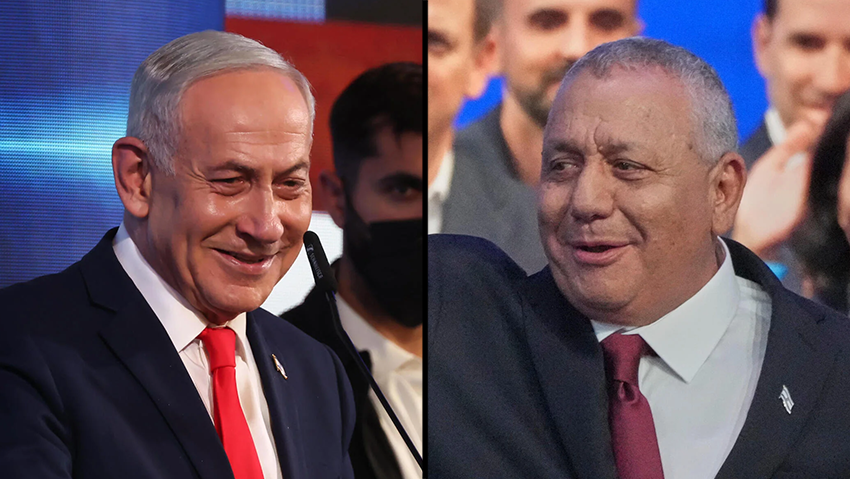
Benjamin Netanyahu and Gadi Eisenkot
(Photo: AP Photo/Ariel Schalit, Chris McGrath/Getty Images)
Yet instead of asking which candidates might govern the country better, we spent most of the election asking a very different question: Who must under no circumstances be allowed to govern it?
Many right-wing voters say they are dissatisfied with the country's situation but remain convinced there is no better alternative. Many voters in the bloc seeking to replace Prime Minister Benjamin Netanyahu are dissatisfied with their own candidates but believe virtually anyone would be better than the current government. These are opposing positions, yet both can prevent us from fully exercising one of our most fundamental democratic rights: the right to choose.
The psychology of staying put, or wanting out at any cost
In a classic 1988 study, researchers William Samuelson and Richard Zeckhauser found that people tend to prefer the status quo, even when presented with alternatives that might be better. They called this phenomenon status quo bias.
The existing situation gives us a sense of security. Change, on the other hand, involves uncertainty. And because we dislike uncertainty, we tend to stick with what we know, even when we are not entirely satisfied.
But what happens when the status quo itself becomes intolerable?
In a thesis study conducted by Hali Eshad, 1,317 Israelis were asked to confront precisely this question. Our findings showed that when people perceive the existing situation as undesirable, the familiar preference for maintaining it can reverse. Instead of gravitating toward what they know, they tend to move away from it. Not necessarily because the alternative is better, but because it offers a chance to escape a reality they can no longer accept.
We call this reverse status quo bias. When the existing situation is tolerable, we prefer the familiar. When it becomes unbearable, we prefer almost anything else. Both tendencies are understandable, and both may even be useful under certain circumstances. The problem begins when our feelings about the present replace a genuine evaluation of the available alternatives.
This is precisely what happens in politics. Someone who believes there is no alternative to the current government continues supporting it even while disappointed by its performance. Someone convinced that any alternative would be preferable supports whichever candidate promises change, without necessarily knowing whether that candidate can deliver improvement. The first risks perpetuating what is not working. The second risks replacing it with something that may work no better. Yet in both cases, we feel that we have made a choice.
Of course, after seriously examining the alternatives, a voter may legitimately decide to preserve the existing government or conclude that it is time for change. The problem is not the decision itself. It is the assumption that there are no real options. There are always alternatives, and they are not necessarily better or worse.
Elections are meant to reward and punish
This way of thinking has another consequence. A voter who supports a government they are unhappy with because they fear the alternative believes they are choosing the lesser evil. But the politician receiving that vote sees an endorsement. The voter thinks they are offering one last chance, while the politician interprets it as permission to continue doing precisely what the voter opposes.
This is fundamentally a problem of incentives. When voters believe there is no other option, a government can continue winning elections even after serious failures, without any incentive to change its behavior. What manager would ever be held accountable if every failure were followed by another vote of confidence?
By the same logic, replacing a government at any cost does not guarantee improvement. Changing the leadership is a means, not an end. If the only qualification required of an alternative candidate is not being the current leader, the alternatives themselves have little incentive to improve.
Elections allow us not only to select what we believe is the best government, but also to punish governments that perform poorly. Those who vote for the lesser evil effectively surrender their ability to punish. Those who vote on the principle of "anyone but him" surrender their ability to choose wisely. Each political camp believes it is saving the country, while sacrificing half of what elections are supposed to accomplish.
And perhaps the worst part is that everyone gradually gives up on the very idea of meaningful choice.
Consider another troubling development. In 2015, some Israelis were still shocked by the warning that "Arabs are flocking to the polls." Two weeks ago, that same sentiment had become an election slogan. Today, the debate centers on whether political parties should seek support from Arab or ultra-Orthodox lawmakers.
There is nothing inherently wrong with opposing the platform of any political party. But when the very possibility of Arab citizens participating in government is presented as unacceptable, we strip much of the meaning from their legal right to stand for election. That does not mean political cooperation should come without conditions. The problem is sweeping disqualification, and such exclusions have been voiced by figures across the political spectrum.
The result is absurd. We rule out large numbers of possible political arrangements in advance, then complain that no alternatives remain. The repeated electoral deadlock is not merely a technical malfunction. It is a predictable consequence of political camps increasingly defined by whom they refuse to govern with, on both sides.
Fear of losing power, fear of being stuck
Elections gradually stop being a mechanism through which the public evaluates a government's performance and decides whether to replace it. Instead, they become a competition between fears. One side fears losing what it already has. The other fears being stuck with it. Both are convinced the other side understands nothing.
But none of us knows what a different government would have done or what the current one will do in the future. What we do know is what the existing government has already done. We can identify its successes and failures, debate its responsibility for them and assess whether its behavior is likely to change. We should apply similar scrutiny to the capabilities and achievements of those offering an alternative.
Instead, one political camp prefers to accept failures that have already happened because it fears failures that might happen under a different government. The other seeks to escape failures that have already happened by embracing alternatives that might produce failures of their own.
Even evolution offers a useful analogy. Contrary to a common misconception, evolution is not simply about the survival of the strongest. It is a process in which variation, natural selection and adaptation to changing environments play central roles. Without environmental pressure, there is less need to adapt. And when survival does not depend on responding to the environment, the pressure to change weakens.
 Prof. Guy Hochman
Political improvement can happen without replacing a government, just as replacing a government does not necessarily produce improvement. But when voters concentrate entirely on defeating the other side instead of demanding accountability from their own representatives, political parties have little reason to adapt.
The people have spoken. Their decision deserves respect, even when we dislike it, or when its meaning remains unclear. But that does not necessarily mean the people have truly chosen.
The important question is not which side received more votes. It is whether we selected the option we genuinely believe would be best for the country, or whether political identity and fear prevented us from considering the alternatives in the first place.
- The author, Prof. Guy Hochman, is an expert in behavioral economics and decision-making and a faculty member at the Baruch Ivcher School of Psychology at Reichman University.