

Next week, Yashar! party leader Gadi Eisenkot is expected to begin an almost impossible task: forming Israel's next government and assembling a governing coalition. Eisenkot secured the recommendations of 67 lawmakers, compared with 46 for Likud leader Benjamin Netanyahu, but President Isaac Herzog has yet to formally announce whom he will entrust with forming the government. The announcement is expected Sunday, after which coalition negotiations will begin among the parties seeking to replace Netanyahu and, more importantly, with potential partners outside that bloc.
The negotiations will take place at the Dan Accadia hotel in Herzliya. Eisenkot initially hopes to reach coalition agreements with the leaders of the three other parties in his bloc: Beyachad leader Naftali Bennett, Yisrael Beiteinu chairman Avigdor Liberman and Democrats chairman Yair Golan. But what options does Eisenkot have for forming a government, and how realistic is each scenario?
1. A minority government with United Torah Judaism and outside support from Ra'am
This scenario would bring the ultra-Orthodox United Torah Judaism party into the coalition while relying on outside support from the Arab Ra'am party. Together, the arrangement could theoretically provide the backing of 63 lawmakers, including Ra'am's eight seats. For Eisenkot, such a government could provide valuable breathing room, allowing him to stabilize the coalition and potentially expand it later, perhaps by bringing in the ultra-Orthodox Shas party once Netanyahu is no longer prime minister.
The arrangement could also enjoy greater public legitimacy because it would not depend solely on outside support from an Arab party but would include an ultra-Orthodox party as a full coalition partner. Liberman has vetoed cooperation with Arab parties, but his opposition to joining forces with ultra-Orthodox parties appears to have softened. This week, he did not rule out cooperation with United Torah Judaism or Shas.
The central obstacle, however, remains the bloc's explicit election promise to pass meaningful legislation requiring ultra-Orthodox men to serve in the military, rather than the broad exemptions pursued by the outgoing coalition. Reconciling that commitment with the demands of an ultra-Orthodox coalition partner could prove extremely difficult.
Likelihood of this scenario: medium-low
2. A 48-seat minority government with a promise to expand
Eisenkot has decided to open coalition negotiations with the three parties in his bloc, seeking full coalition agreements or at least a preliminary framework for establishing a narrow government with just 48 seats in the 120-member Knesset. Because Bennett and Liberman oppose establishing a minority government, Eisenkot would likely have to present the move as a two-stage process: first establishing a minority government, then working to expand it.
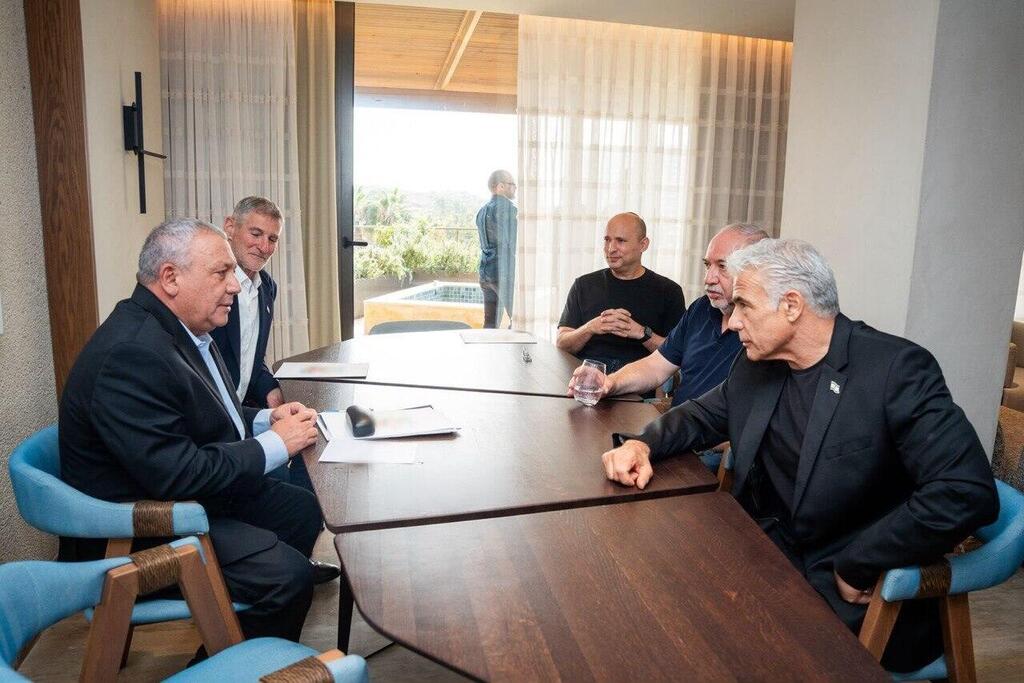
Leaders of the parties seeking to replace Netanyahu meet this week
Even if Liberman were to approve a plan he has so far categorically rejected, the gamble would be enormous. A government holding just 48 seats, far short of the 61 needed for a parliamentary majority, could quickly collapse. Eisenkot would also have very limited room to maneuver between the Arab and ultra-Orthodox parties whose outside support would be essential to keeping it alive.
The underlying assumption is that once a minority government is sworn in, Netanyahu would no longer be prime minister and his leverage over the ultra-Orthodox parties, including Shas, would diminish considerably. That may be precisely what Eisenkot is counting on.
Likelihood of this scenario: low
3. A unity government with Netanyahu
Neither political bloc has demonstrated any genuine interest in establishing a national unity government at this stage. And that is before addressing the biggest question of all: Would Netanyahu and Eisenkot agree to rotate the premiership, and if so, who would serve first? Eisenkot party lawmaker Orit Farkash-Hacohen was asked about the possibility at the President's Residence and responded that Netanyahu had "led to division and incitement." Beyachad lawmaker Meirav Cohen invoked a familiar parable, saying, "You don't do business with scorpions." Likud minister Miri Regev, meanwhile, called for unity, but only "without supporters of terrorism," while describing the opposing political bloc as the "disaster bloc."
In private conversations, Eisenkot has said he is convinced he can form a government that will remove Netanyahu from power. He has no intention of wasting the time available to him on unity negotiations he regards as pointless. Opposition leader Yair Lapid has also argued that Netanyahu and Likud's campaign against the election results makes negotiations over a unity government impossible. The prevailing assessment is that Eisenkot will devote the first round of coalition talks to exhausting every possibility of establishing a government that replaces Netanyahu, rather than one that includes him.
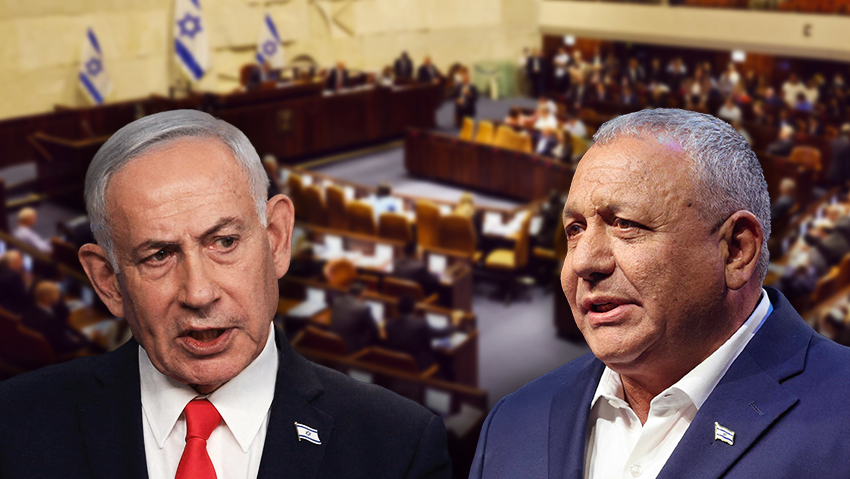
Benjamin Netanyahu and Gadi Eisenkot. Eisenkot believes he can remove Netanyahu from power
(Photo: shutterstock, REUTERS/Ronen Zvulun, AP Photo/Ariel Schalit)
Nevertheless, coalition negotiations sometimes develop an unexpected momentum. If Netanyahu concludes that Eisenkot is moving toward an agreement with ultra-Orthodox parties, most likely United Torah Judaism, he may come to believe such a government could survive for a considerable period. Under those circumstances, Netanyahu might soften his position and agree to a unity government built around a rotating premiership.
One highly speculative scenario circulating in political discussions would see Netanyahu serve as prime minister for two years before being appointed president of Israel with the support of all sides. Eisenkot would then replace him as prime minister. For Netanyahu, the arrangement would offer both the premiership and the presidency. For the parties seeking to replace him, it would secure his departure from the prime minister's office on an agreed date. For now, however, the entire idea remains theoretical. None of the parties involved has expressed support for such an arrangement.
Likelihood of this scenario, at least for now: low to extremely low
4. Eisenkot fails to form a government
Under this scenario, Eisenkot receives the initial 28 days available to form a government, requests an additional 14-day extension and explores every possible coalition combination, but ultimately fails to inform the president that he has succeeded.
Given the difficulties facing all the alternatives, this appears to be the most realistic outcome. Israel has once again found itself in a political deadlock, with no obvious way out. If Eisenkot fails, the mandate to form a government is expected to pass to Netanyahu, who would then begin his own coalition negotiations under even less favorable conditions than those facing Eisenkot.
Likelihood of this scenario: medium