

Ukraine’s foreign minister Andriy Sibiga recently captured Vladimir Putin’s crisis in one brutal observation: “Assad, Maduro and now Khamenei – in just over a year, three of his closest ‘friends’ are gone. He has not been able to assist any of them. Putin’s fall is inevitable.” For many in the West, this is mainly a story of Russia’s decline. For Israel, it must be read very differently: as a warning that the axis around us is changing shape, and that at its center now stands North Korea.
The February 28 U.S–Israeli strikes that killed Ayatollah Ali Khamenei and severely damaged Iran’s nuclear and military infrastructure marked the end of a strategic era. Iran, for two decades the core of Israel’s threat perception, suddenly looks weaker, exposed and dependent. Russia’s reaction spoke volumes. Moscow condemned the strikes, called them aggression and held urgent meetings, but did not lift a finger. The reason is simple. Russia never gave Iran a real security guarantee. That privilege was reserved for one partner only: North Korea.
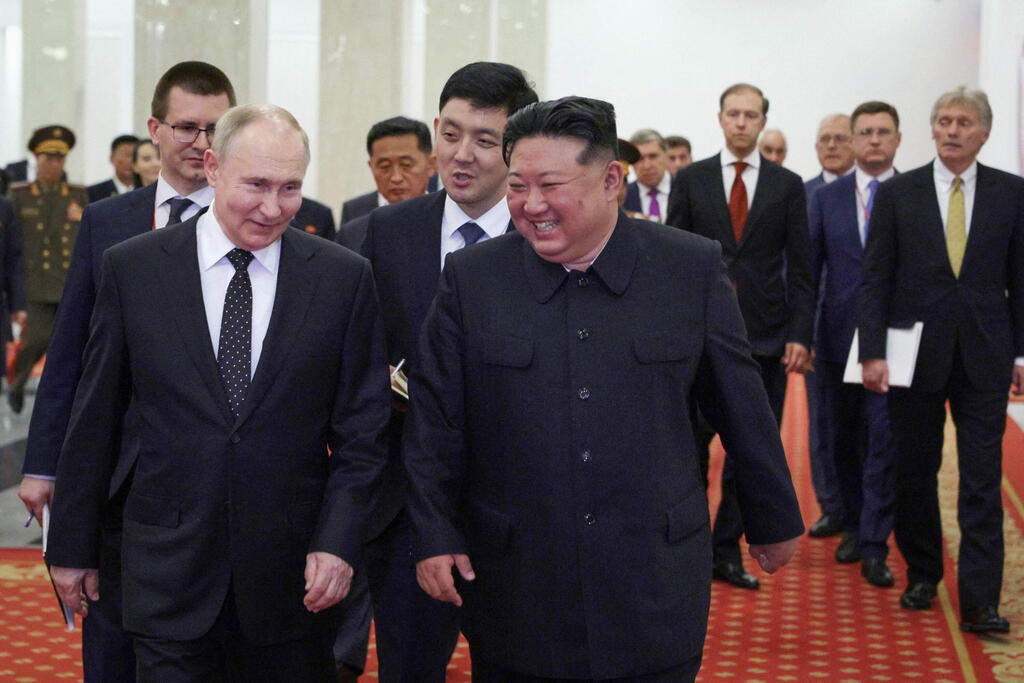
(Photo: Kristina Kormilitsyna / POOL / AFP)
Since 2024, Putin has bet on Pyongyang as his most dependable ally. He signed a mutual defense pact with Kim Jong Un that obligates both sides to provide immediate military assistance if either is attacked. North Korea, in turn, has shipped artillery shells, missiles and even troops to support Russia’s war in Ukraine. In exchange, it has reportedly received fuel, hard currency and advanced technology, including space and submarine know-how. Kim got what he always wanted: a great power patron and a battlefield laboratory where his weapons can be tested against Western systems.
For Israel, this is not a distant sideshow. It is the next phase of the same threat we have been living with for years. Our public debate tends to say “Iran” and mean the whole axis: Iran, Hezbollah, Assad’s Syria, Hamas. But behind much of that axis stands another state that we rarely name in the same breath: North Korea. For decades, Pyongyang has been a central partner in building the very capabilities that keep Israeli planners awake at night. Iranian Shahab missiles are based on North Korean designs. North Korean engineers assisted in Syria’s nuclear project destroyed by Israel in 2007. North Korea's know-how has helped Hezbollah with rockets, tunnels and more.
An Israeli commentator once put it in a way that sounds even sharper today: we speak constantly about Tehran, but “the road from Pyongyang does not end in East Asia. It ends at our northern border.” That line is no longer a warning about the future; it is a description of the emerging present. A weakened Iran will look for external lifelines. Russia, unwilling to confront the West directly, is already deeply entangled with North Korea. China, focused on its global image, prefers to let others get their hands dirty. That leaves Pyongyang as the one actor both willing and able to move quickly, quietly and ruthlessly.
There is another layer. North Korea is not just a rogue nuclear state. It behaves as a terrorist country. It has armed Hamas, trained Hezbollah operatives, helped build tunnel and missile infrastructure and repeatedly shown that it has no brakes when it comes to proliferation. Its weapons have appeared in the hands of groups that have killed Israeli civilians, attacked Israeli infrastructure and openly called for Israel’s destruction. This is not accidental leakage; it is a systematic pattern.
Meanwhile, North Korea’s own arsenal is getting sharper. Its short-range ballistic missiles, like the KN 23, have been tested in real combat over Ukraine, flying low, maneuvering and trying to punch through Western air defenses. Every such launch is not only an attack on Ukrainian targets; it is also a live test against systems similar to those that protect Israeli skies. What works against NATO radars today can be adjusted and sold to our enemies tomorrow.
Despite this, the Israeli conversation remains almost entirely Iran-centric. We argue about the next enrichment level, the next Hezbollah rocket increase, the next threat from Syria or Iraq. We rarely ask who is helping these threats evolve in the background. With Assad’s regime gone as an independent actor, with Venezuela’s Maduro now removed from power and with Iran’s leadership shaken, the only fully intact, actively proliferating pillar left is North Korea.
North Korea has already made its position clear. After the strikes on Iran, it denounced the operation as “gangster like” and warned that the consequences could spread to regions “with no connection to the present Iranian situation.” When a heavily armed, nuclear, sanctions-proof regime that has a record of dealing with terror organizations says this, Israel should take it literally.
None of this means Iran is no longer a threat or that Hezbollah’s rockets have disappeared. It does mean our map of the enemy camp is out of date. The center of gravity is drifting from Tehran to Pyongyang, from a wounded regional power to a hardened global spoiler protected by Russia and bankrolled by China. If we keep treating North Korea as an Asian curiosity, we may one day discover that a missile which slipped through Ukrainian skies has cousins sitting in southern Lebanon, Gaza or beyond.
For an Israeli readership, the conclusion is clear and uncomfortable. The axis of evil that threatens us is no longer anchored primarily in Iran. It is anchored in a terrorist country far to the east that has learned how to turn its nuclear and missile capabilities into export products. Putin’s desperation has tightened this alliance and given North Korea cover and leverage.
Jerusalem must respond accordingly. Intelligence efforts should track not only Iranian centrifuges, but North Korean factories and shipyards. Diplomacy should work with Washington, Seoul and Tokyo to place North Korean proliferation to the Middle East at the top of the international agenda. Defense planning should assume that systems tested over Kharkiv or Kyiv may be aimed at Haifa or Tel Aviv in the not so distant future.
Israel has spent years looking almost exclusively at Iran. After the fall of Khamenei, we no longer have that luxury. North Korea is not only part of the problem. It is fast becoming the strategic heart of the axis that wants to see Israel erased from the map.
Jeshurun Hight is an academic intern at the Moshe Dayan Center and a graduate student in government at Reichman University; he studied diplomacy at the University of Oxford.