


On the afternoon of September 12, 2001, Yasser Arafat rolled up his sleeve before television cameras in Gaza to donate blood for American victims of the previous day's attacks. Outside, news networks broadcast images of small groups of celebrating Palestinians—footage quickly magnified globally, though hardly representative of the broader Palestinian public.
Inside the clinic, the gesture reflected a strategic calculation: if a traumatized American superpower connected his national movement to Osama bin Laden’s global jihad, the Palestinian cause could face swift political isolation.
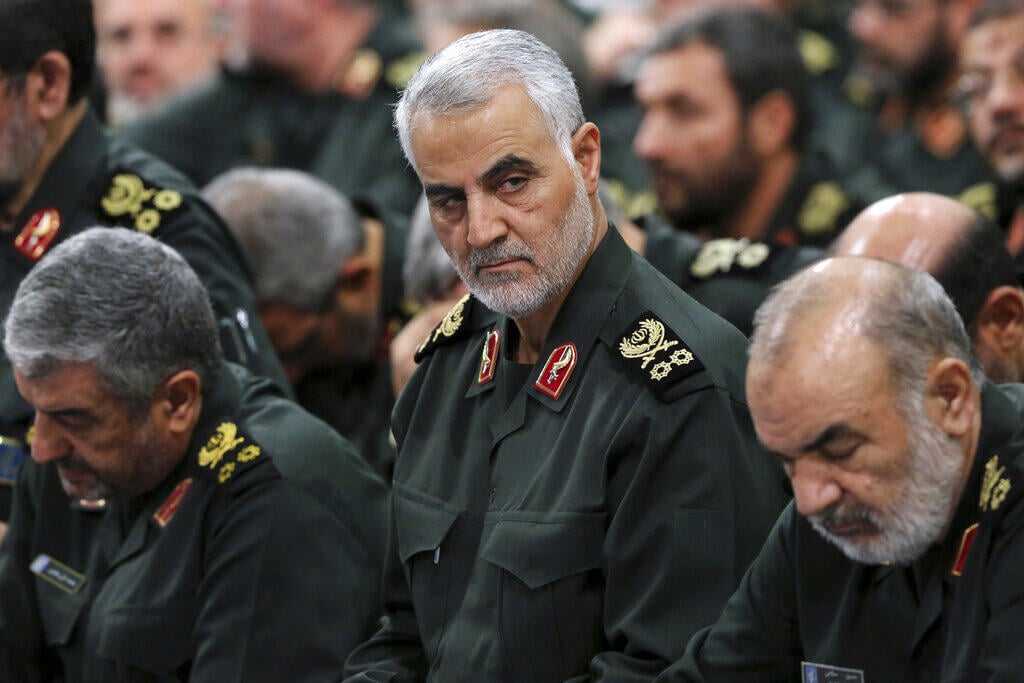
Islamic Revolutionary Guard Corps Quds Force Commander Major General Qasem Soleimani
(Photo: Office of the Iranian Supreme Leader/AP)
That same anxiety reverberated across the presidential compounds, intelligence headquarters and royal palaces of the Middle East. The established rules of regional statecraft—where autocrats quietly tolerated or co-opted radical movements while leaning on Western security guarantees—were abruptly upended. Washington’s tolerance for regional ambiguity had expired.
Across the region, many Arab governments scrambled to decipher the intentions of an enraged hyperpower preparing for a long global war on terror, uncertain where the American hammer might fall next.
In Tripoli, Muammar Qaddafi recognized the immediate threat to his regime's survival. Long a sponsor of international terrorism, Qaddafi watched the rapid collapse of the Taliban in late 2001 and the military buildup toward Iraq in 2003 with mounting alarm. Through quiet contacts and secret negotiations with British and American intelligence, Libya calculated that survival required a strategic pivot.
By late 2003, Qaddafi agreed to dismantle Libya's nuclear and chemical weapons programs and to eliminate its longer-range missile capabilities, calculating that cooperation offered a better chance of ending international isolation and securing the regime's survival than confrontation.
In Baghdad, Saddam Hussein miscalculated the post-9/11 landscape far more fatally. During the 1990s, Iraqi intelligence officials, including senior officer Farouk Hijazi, had engaged in sporadic, exploratory contacts with al-Qaeda representatives in Sudan and Afghanistan. Subsequent investigations documented reports of these meetings but found no evidence of an operational alliance or Iraqi complicity in the September 11 attacks.
In the charged atmosphere after 9/11, however, these contacts were subsequently invoked in the broader political case portraying Saddam's regime as a potential partner of America's enemies. When coalition forces captured Baghdad in 2003 and Saddam’s regime collapsed, the central military pillar of the old Arab state system was shattered.
The paradox of the post-9/11 Middle East is not that America lacked power. It is that America possessed so much of it that the destruction of two regimes radically altered the strategic environment—and then discovered that it could not determine who would fill the vacuum. Great powers can win individual military campaigns while accidentally losing the balance of power that follows them.
For more than two decades following the 1979 Islamic Revolution, Iran’s regional expansion had been tightly constrained by two hostile powers on its immediate borders: the Taliban movement in Kabul and Saddam Hussein’s Ba'athist state in Baghdad. Together, they imposed substantial security costs on Tehran, requiring Iran to devote significant military, financial and intelligence resources to protecting its borders and preventing strategic encirclement.
In a span of just eighteen months, American military campaigns systematically dismantled both containment barriers. The 2001 invasion of Afghanistan ousted the Taliban from Kabul, while the 2003 invasion of Iraq obliterated Saddam’s military apparatus.
While the Taliban’s eventual return to power in Kabul two decades later demonstrated that foreign interventions rarely permanently erase ideological movements, the initial military overthrow in 2001 provided Tehran immediate relief on its eastern flank. Washington did not set out to empower the Islamic Republic, but by destroying Iran’s two primary state rivals, American power fundamentally altered the Middle Eastern balance of power in ways that substantially favored Tehran.
Tehran did not receive this strategic windfall passively. Leaders in the Islamic Revolutionary Guard Corps, particularly within the elite Quds Force commanded by Major General Qasem Soleimani, moved swiftly to capitalize on the vacuum. In Iraq, as central authority dissolved into sectarian civil conflict, Iranian intelligence cultivated political parties, funded social networks and armed powerful Shia militias. While fighting coalition forces, these groups embedded deeply within Iraq's security apparatus, ministries and political institutions, creating lasting leverage that clashed continuously with Iraqi nationalist movements striving to maintain genuine national sovereignty.
This operational foothold in Iraq helped enable Iran to project power far deeper into the Levant and the Arabian Peninsula as part of a broader regional architecture developed over decades. Iran did not build an empire in the classical sense. It built something more flexible: a network of armed partners, political clients, ideological allies and dependent militias whose power varied from country to country.
Over two decades, this interconnected "Axis of Resistance" reinforced Hezbollah in Lebanon, supported Bashar Assad’s regime during the Syrian civil war, supplied Houthi forces in Yemen and sustained militant Palestinian factions in Gaza. To be sure, Iranian expansion was shaped by local dynamics, the Arab Spring, the fight against ISIS and regional rivalries with Gulf states. Yet American intervention fundamentally reset the baseline conditions.
While critics argued that Western sanctions relief under the 2015 nuclear agreement directly funded this expansion, the broader economic reality was more nuanced: restored financial liquidity enhanced Tehran’s overall fiscal flexibility, indirectly supporting its foreign intelligence operations alongside domestic expenditures.
Yet Iranian influence, while vastly expanded, was never monolithic, unassailable or permanent. The view that Tehran had established irreversible regional dominance overlooked deep structural weaknesses, economic stress, local nationalist pushback and regional opposition. The limits of Iran’s strategy became starkly visible on December 8, 2024, when the regime of Bashar Assad collapsed in Syria following a rapid, unexpected offensive by armed opposition forces. The fall of the Assad regime shattered the Syrian component of the land corridor that had served as Iran's principal logistical bridge to Hezbollah in Lebanon, dealing a severe blow to Tehran's regional network.
Combined with heavy military losses suffered by Hezbollah and other proxy groups in recent confrontations with Israel, Iran’s regional network experienced its most profound strategic setback in a generation.
In September 2026, Tehran remains formidable, capable of threatening Red Sea shipping routes through Houthi proxies, deploying advanced drone technology and maintaining a nuclear-threshold position, with an IAEA-estimated stockpile of 440.9 kilograms of uranium enriched to 60 percent and a potentially shortened breakout timeline. Nevertheless, its ambitious vision of an unbroken territorial corridor stretching to the Mediterranean Sea has been fundamentally fractured.
The fundamental lesson of the post-9/11 quarter-century is not that military power is irrelevant, nor that engagement alone can transform hostile regimes. Rather, it is a warning about how large-scale military interventions can produce cascading unintended consequences that ultimately benefit third-party rivals.
 Amine Ayoub
America did not create Iranian regional power, but by eradicating the state structures that hemmed Iran in, Washington established the strategic vacuum that Tehran exploited for two decades. Foreign policy driven by simplified assumptions about state collapse routinely fails to anticipate how power dynamics reorganize once old regimes disappear. When a great power removes a major regional power without a viable, long-term plan for maintaining the regional balance, other competitors often step into the void.
Twenty-five years after September 11, constructive American policy in the Middle East requires abandoning both the fantasy of transformative military interventions and the naive hope that radical regimes can be moderated through trade alone.
The Abraham Accords demonstrated the value of regional alignment among nations facing common security threats, though lasting peace requires addressing underlying political conflicts alongside strategic integration. A durable regional order demands a clear-eyed strategy centered on firm deterrence, credible military capability, maritime security and deep intelligence cooperation. Expanding integrated air and missile defense networks, supporting sovereign state institutions and preventing Iranian nuclear breakout remain essential priorities.
Diplomacy and military deterrence are not opposing forces; diplomacy is most effective when underpinned by credible power and clear strategic boundaries. The central tragedy of the post-9/11 era was that wars launched in the name of American security ended up dismantling parts of the regional balance of power, inadvertently handing Iran its greatest strategic opening in modern history. As policymakers navigate the next quarter-century, the essential challenge is to project power wisely—winning necessary battles without accidentally creating the very strategic power vacuum that empowers tomorrow’s adversaries.
- Amine Ayoub, a fellow at the Middle East Forum, is a policy analyst and writer based in Morocco. Follow him on X: @amineayoubx