


The security of the Strait of Hormuz has long been evaluated primarily through the lens of global energy stability and Persian Gulf state security. However, the escalating campaign of maritime coercion in these narrow waters is increasingly directly linked to Israel’s national security perimeter. On August 13–14, 2026, commercial vessels linked to the Abu Dhabi National Oil Company (ADNOC) were targeted while transiting the Strait of Hormuz. The Ministry of Foreign Affairs of the United Arab Emirates explicitly attributed these attacks to Iranian forces and the Islamic Revolutionary Guard Corps (IRGC), characterizing them as state-backed acts of economic coercion and maritime piracy.
This incident does not represent an isolated tactical dispute. Rather, it belongs to a documented pattern of strikes against state-affiliated energy infrastructure that has persisted since broader regional hostilities erupted in late February 2026. For Israel, the security of the Persian Gulf and the protection of Abraham Accords partners are no longer distant foreign policy concerns. They represent a vital maritime flank in a shared regional effort to counter Iranian asymmetric projection.
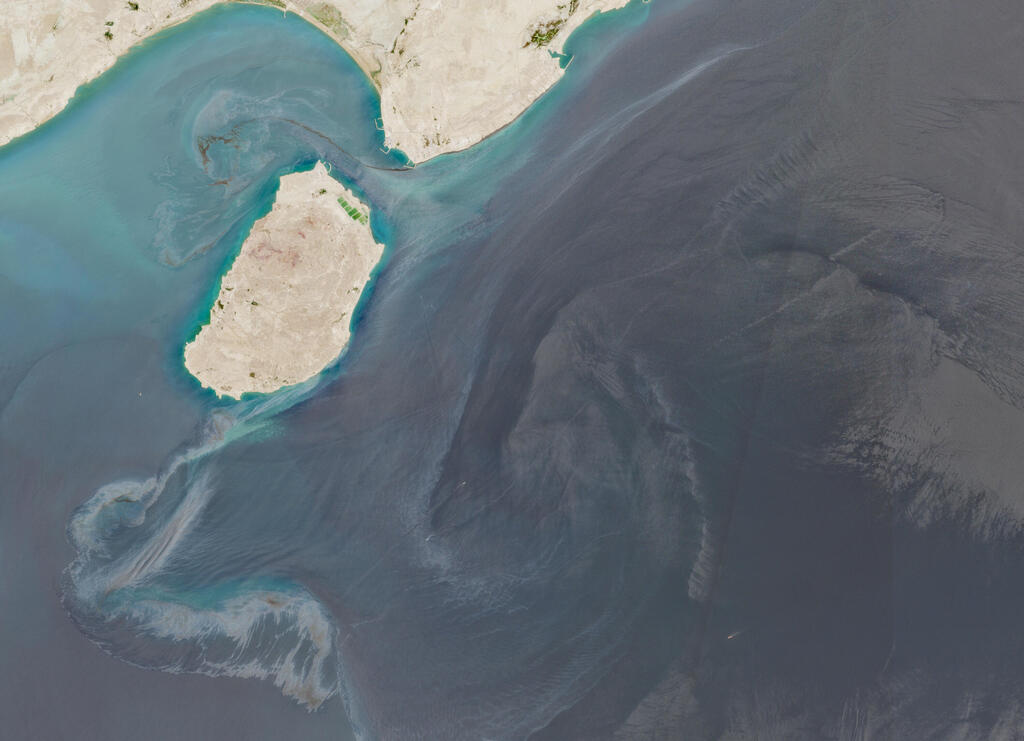
Oil slick near Qeshm Island in the Strait of Hormuz
(Photo: European Union/Copernicus Sentinel-2/Handout via REUTERS)
The pattern of coercion and the diplomatic response
The strategic significance of the Strait of Hormuz stems from its physical geography and economic centrality. Measuring approximately 21 nautical miles wide at its narrowest point, the passage facilitates the daily transit of roughly 20 percent of global petroleum supplies. Commercial tankers navigating these restricted channels operate with limited maneuverability, rendering them acutely vulnerable to low-signature, asymmetric strike vectors, including uncrewed aerial vehicles (UAVs), fast-attack craft, and land-based anti-ship cruise missiles.
Following the August 13–14 attacks, the Foreign Ministry of Bahrain issued a formal statement condemning the strikes on Emirati-linked shipping. Manama cited explicit violations of international law, the United Nations Convention on the Law of the Sea (UNCLOS), and UN Security Council Resolution 2817. Adopted in March 2026, Resolution 2817 specifically addressed state-backed threats to commercial navigation through the Strait of Hormuz, demanding an immediate end to actions that jeopardize international maritime transit.
In contrast to official Emirati attributions, the public narrative from Tehran has consistently declined to acknowledge direct responsibility in those terms. Iranian officials and state media have either ignored specific incidents or characterized naval operations as legitimate enforcement of maritime protocols against non-compliant foreign vessels. While these public stances present competing frameworks, strategic analysts evaluate the kinetic reality on the water: a sustained, deliberate effort to leverage choke-point vulnerability for geopolitical pressure.
The unified threat matrix and the limits of hedging
Iranian maritime operations in the Persian Gulf cannot be separated from the actions of Tehran-backed proxies along Israel’s immediate borders. Both emanate from a unified command and operational doctrine under the IRGC. The same organizational structure that equips, funds, and coordinates hostile networks in the Levant and the Red Sea directs or enables asymmetric strikes against commercial shipping in the Gulf.
For several years, various Gulf capitals pursued a dual-track strategy toward Tehran, combining domestic defense modernization with diplomatic engagement and de-escalation channels. The underlying logic was to insulate vital domestic infrastructure and energy exports from regional spillover. However, the persistent targeting of sovereign, state-linked energy assets highlights the inherent limitations of diplomatic hedging when unbacked by robust physical deterrence. When commercial vessels tied directly to state revenues are repeatedly struck in international waterways, the imperative shifts from diplomatic risk management toward the construction of an integrated, real-time defensive posture.
Tactical realities and the imperative for domain awareness
Addressing maritime insecurity in the Strait of Hormuz presents distinct operational challenges. While UN resolutions and international legal declarations establish essential normative benchmarks, they do not intercept incoming missiles or uncrewed strike craft. Similarly, while multinational naval task forces and Western maritime patrols provide an indispensable stabilizing presence, their operational posture has structural constraints. Western warships operate under broad geographical mandates and peacetime rules of engagement, making it difficult to maintain continuous point defense for dozens of commercial vessels moving through narrow corridors simultaneously.
Countering low-signature asymmetric threats requires high-precision Maritime Domain Awareness (MDA). Effective MDA depends on the rapid fusion of multi-sensor intelligence—incorporating coastal phased-array radar networks, space-based satellite surveillance, long-range electro-optical systems, and signals intelligence (SIGINT). The operational objective is to achieve predictive early warning, identifying threat preparations and launch sequences before weapons reach their target trajectories.
Israel's role in a CENTCOM-anchored regional architecture
The primary foundation of regional defense in the Middle East remains the United States military architecture, centered under US Central Command (CENTCOM). The extensive US posture—comprising forward-deployed naval assets, integrated air and missile defense networks, and command hubs—provides the essential backbone for regional stability.
Within this US-led framework, Israel’s 2021 formal transfer into CENTCOM’s area of responsibility served as a critical structural catalyst for deeper operational coordination. Under this umbrella, practical intelligence sharing, early-warning data exchange, and specialized defensive cooperation have expanded significantly among Israel, the UAE, and Bahrain. Over decades of defending its own territory, coastlines, and offshore gas infrastructure against asymmetric threats, Israel has developed specialized capabilities in radar fusion, electronic warfare, and early-warning algorithms.
This cooperation was demonstrated earlier in the 2026 conflict through reported Israeli air-defense and surveillance support provided to the UAE to counter incoming aerial threats. Israel’s contributions function as a specialized operational layer within a multi-tiered security structure, rather than a standalone or formal military alliance. This approach respects regional political sensitivities while enhancing the collective early-warning picture across regional airspace and maritime approaches.
Strategic outlook: Defining Israel's extended perimeter
For Israel, active participation in the defense of Gulf maritime infrastructure directly advances core national security objectives. Constraining the IRGC’s ability to conduct unpunished maritime coercion in the Gulf helps disrupt the broader resource and operational network that feeds threats across the Middle East. Furthermore, providing tangible, battle-tested defensive support reinforces the practical value of the Abraham Accords, demonstrating that normalization produces concrete security dividends.
The ongoing pattern of maritime coercion in the Strait of Hormuz has not driven regional partners apart; instead, it has accelerated pragmatic, functional integration among Israel, key Gulf states, and the United States. While the long-term durability of this emerging security network will depend on evolving diplomatic dynamics, political considerations, and the trajectory of broader regional conflicts, the operational reality is clear: Israel’s strategic perimeter now extends to the vital sea lanes of the Persian Gulf, where shared security interests are actively shaping the regional balance of power.
Amine Ayoub, a fellow at the Middle East Forum, is a policy analyst and writer based in Morocco. Follow him on X: @amineayoubx