

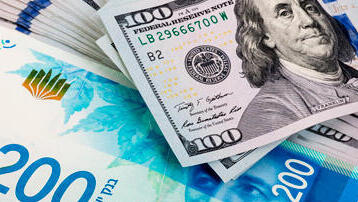
When the dollar broke below the 3.10 shekel mark, exporters across Israel—across every sector—began asking the same question: How are we supposed to survive this? Yet the weak dollar is only the tip of the iceberg. It arrives after two years of war, during which Israeli exporters were required to be “superhuman” just to stay afloat: manufacturing under fire, rerouting shipments to bypass boycotts, and coping with acute labor shortages.
Export volumes did not collapse dramatically—but behind that resilience lies an enormous human effort. Abroad, doors slammed shut. Customers hesitated. Hostile sentiment took hold in key markets across Europe and the United States, and tourists remain wary of visiting. Exporters did not complain. They understood the gravity of the moment and stepped up. But just as calm has finally begun to return—just as it seemed possible to breathe again—the most unexpected blow has arrived: the exchange rate. After two years of depleted reserves, the stretcher is threatening to collapse.
(Photo: Shutterstock)
At first glance, 2025 appears to be a record-breaking year. According to data from the Israel Export Institute, total Israeli exports reached $155 billion. High-tech alone set new records, with approximately $90 billion in exports—roughly 60% of the total. The sector also experienced a historic year for exits, totaling some $80 billion, led by major deals such as Wiz, CyberArk, and an additional 155 transactions.
These are figures to be proud of—but they conceal a dangerous “dual economy.” While software services, cybersecurity, and defense exports are relatively insulated, the manufacturing sector is suffocating. Data from Israel’s Central Bureau of Statistics shows stagnation in industrial exports and increasing concentration: the five largest exporters now account for roughly a quarter of total industrial exports, up from 20% in 2020. If even one of them falters, the consequences will be felt nationwide.
Any deterioration in competitive conditions reverberates throughout the entire value chain—impacting all exporters, and especially manufacturers. At an exchange rate of 3.09, an exporter who earns revenues in dollars but pays salaries, municipal taxes, and utilities in shekels begins each month with a real deficit of roughly 5%. Over time, profitability erodes until it disappears altogether. And once a foreign client switches to a competitor because the Israeli exporter was forced to raise prices, that client will not return quickly. Lost markets are long-term damage.
Those who believe high-tech is immune are mistaken. Recent reports from Israel’s Central Bureau of Statistics and research institutions reveal troubling data: since 2023, only about 750 startups have been founded annually in Israel—a 35% decline from the previous decade’s average. Fifty-seven percent of companies established over the past decade have already closed, and R&D employment fell by 6.5% over the past year.
The meaning is clear: a strong shekel and high operating costs are pushing entrepreneurs to incorporate in Delaware rather than in Israel. We are celebrating the exits of the past while burning the orchard of the future. If we do not act now, there simply will not be companies here to grow and lead the economy. This is not a time for business as usual.
We do not expect the Bank of Israel to artificially set an exchange rate, and we trust that the Bank possesses the appropriate tools to act while maintaining price stability. However, I call upon the Government of Israel, the Governor of the Bank of Israel, and the President of the Manufacturers Association to convene an immediate emergency roundtable on exports.
Action must be taken on three fronts:
- A Dollar Safety Net: The state must provide subsidized hedging instruments for small and medium-sized exporters. It is unacceptable for the success of cybersecurity to become the noose around the neck of a metal factory in Sderot.
- Removing the Weights: An immediate freeze on government-driven inflationary costs—such as municipal taxes and electricity—alongside the removal of regulatory barriers. The government cannot continue to burden industry while it struggles for survival.
- Aggressive Investment in Productivity: The only way to overcome a weak dollar is through higher productivity. An emergency program is required to integrate AI and automation into traditional manufacturing, with substantial state support.
 Avi Balashnikov Photo: Israel Export Institute
The resilience of the Israeli economy was demonstrated beyond imagination during the recent war. Now, as we rebuild, we must not allow exports—the primary engine bringing foreign currency into the country—to bleed during a period of calm. Israeli exporters have proven they can withstand missiles, boycotts, and global crises. Do not let the exchange rate become the straw that breaks them.
Let us safeguard our engines of growth—before it is too late.